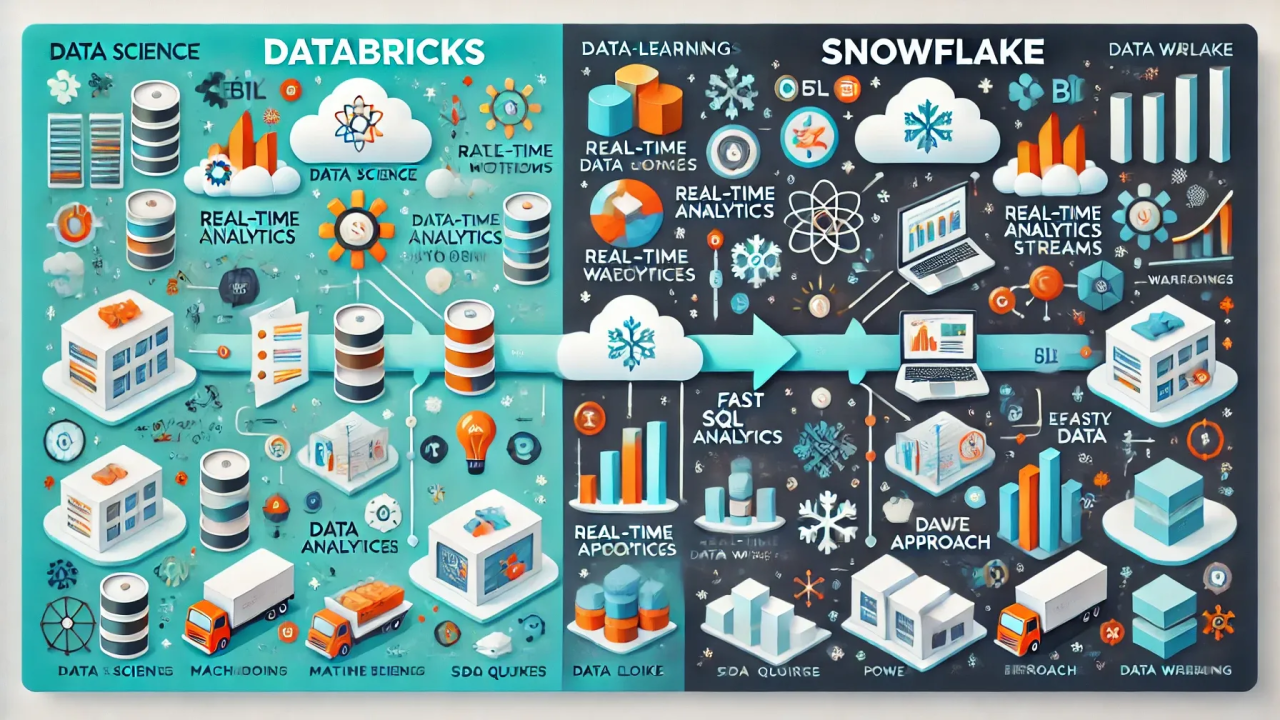
Databricks and Snowflake both handle big data well, but they were built for different starting points - Databricks as a Spark-based engineering and ML platform, Snowflake as a cloud data warehouse - and the right pick follows from what your team actually does most.
Where Databricks is stronger
Built on Apache Spark, Databricks leads on heavy data engineering and machine learning. It's a full platform for data scientists and engineers, not just a warehouse - collaborative notebooks, support for Python, Scala, and R, and tight integration with the ML lifecycle. Delta Lake gives it ACID reliability over lake-scale data, its open-format approach handles unstructured and semi-structured data (text, images, logs) more naturally, and it's well suited to real-time use cases like fraud detection and IoT processing where Snowflake leans batch.
Where Snowflake is stronger
Snowflake was built as a cloud warehouse and excels there: fast SQL over structured data, an analyst- and BI-friendly environment that drops cleanly into Tableau, Power BI, and Looker, and a Data Sharing feature that lets organizations collaborate without duplicating data. It manages infrastructure, scaling, and optimization behind the scenes so teams focus on analysis rather than backend tuning, and its pay-as-you-go model is cost-effective for periodic batch analysis rather than continuous processing.
Which to choose
Choose Databricks if you're building AI or ML models, real-time processing and unstructured data are central, and you value an open, multi-language platform. Choose Snowflake if your primary goal is SQL analysis of structured data, your team is focused on BI and reporting, and data sharing and collaboration are core to how you operate.
Or use both
Many organizations run both and play to each platform's strengths - Databricks for ETL and machine learning, Snowflake for warehousing and BI reporting. The decision isn't really "which one wins"; it's matching each workload to the platform built for it, and for a lot of teams that means a hybrid rather than a single choice.



Leave a Comment