A healthcare company is hiring a contract Snowflake developer. Fully remote, contract-to-hire, sitting on the Aetna Stars data team. Standard stuff - until you read the second required skill: experience building and working with a semantic data layer. The third: proficiency working with YAML files.
Stop and ask why one of the largest healthcare companies in the world needs someone to build a semantic layer badly enough to make it a top-three hiring requirement, right next to Snowflake itself.
The answer is the whole story of data engineering in 2026 - and it explains a phrase you've seen a hundred times on LinkedIn this month: context engineering.
First, clear up where the semantic layer actually sits
The job posting itself invites the confusion. It lists Snowflake, BigQuery, and "semantic data layer" in the same breath, as if they're peers. They aren't.
Snowflake and BigQuery are the warehouse - the
storage-and-compute layer where your physical tables live:
dim_member, fct_claims, the actual rows. They're
peers to each other. If you know one, you're arguing about syntax and pricing,
not concepts.
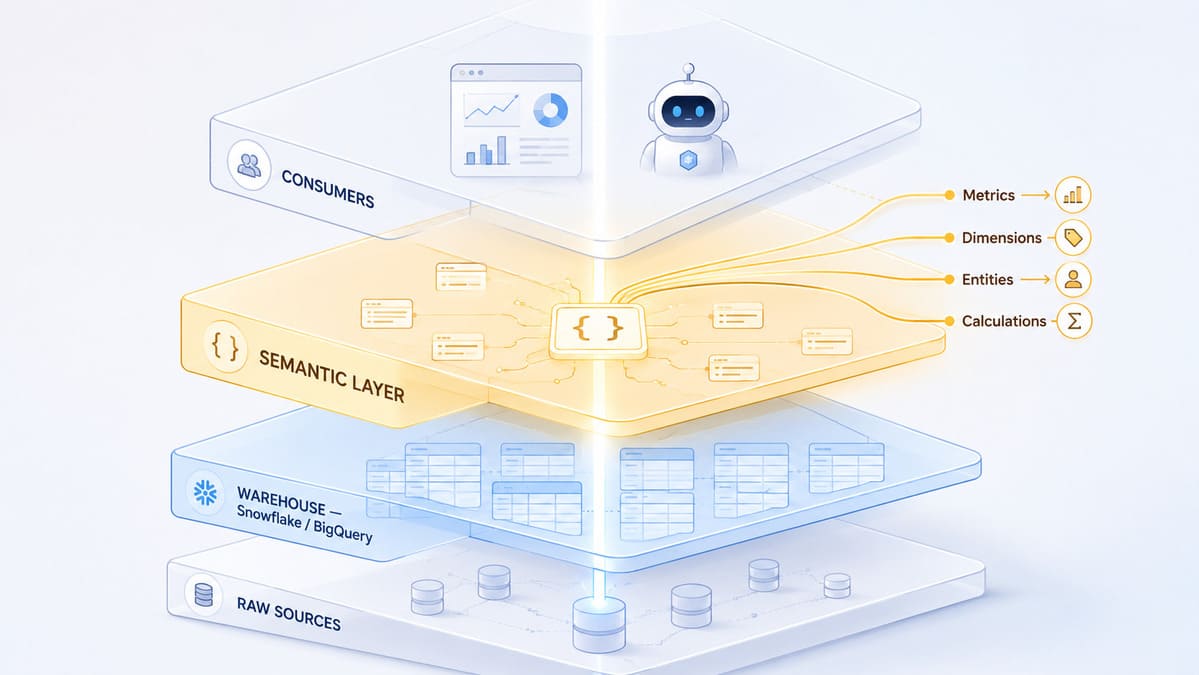
The semantic layer sits on top of both. It's the translation layer between raw tables and whoever's consuming them. The stack looks like this:
Raw sources → warehouse (Snowflake / BigQuery: where the data is stored) → semantic layer (what the data means) → consumers (dashboards, analysts, and now AI agents).
So the semantic layer is a level above the warehouse, not beside it. It's where you define meaning as code: what "active member" means, how a "Star Rating" is calculated, which entities relate to which, which joins are legal and which are landmines. It answers what does this data mean - a completely different question from where is this data stored.
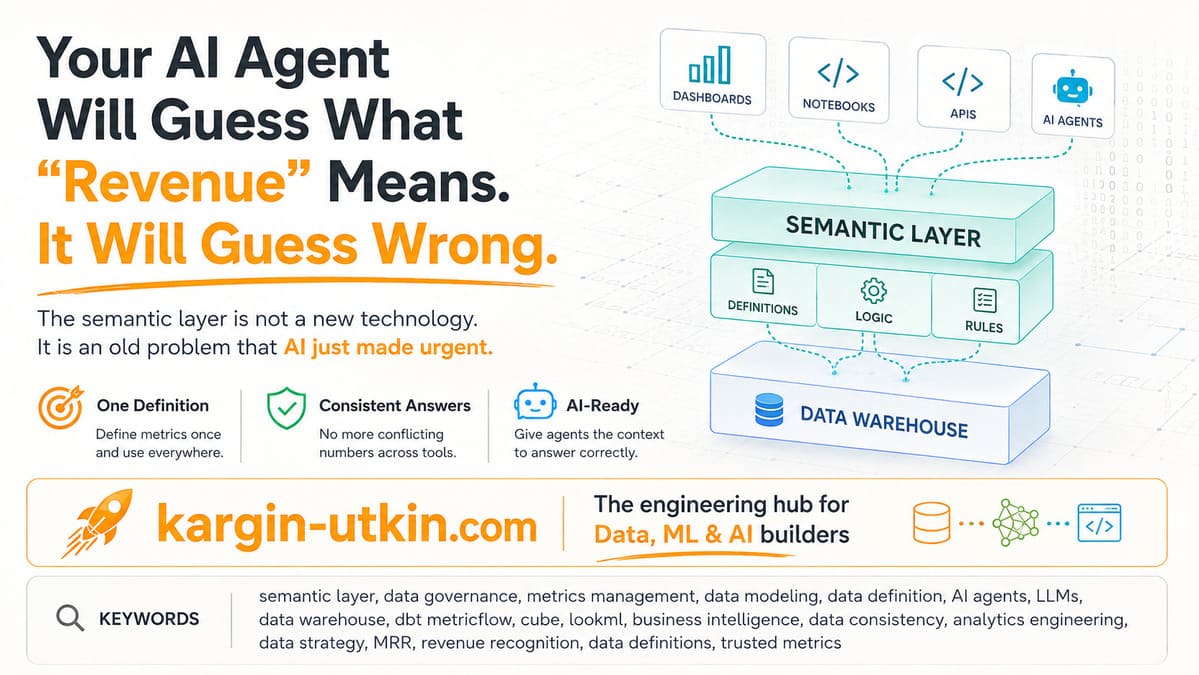
Without one, every analyst and every tool re-derives the important numbers its own way, and you end up in the meeting where four people have four values for "revenue" and all four are technically "right." In Aetna's world, swap "revenue" for "member" and "Star Rating," and the stakes stop being awkward and start being regulatory.
Why YAML is sitting right next to it
Notice the posting pairs the semantic layer with YAML. That's not a coincidence - modern semantic layers are authored in YAML. dbt's Semantic Layer (MetricFlow), Cube, and Snowflake's own semantic models - the ones behind Cortex Analyst - all define metrics and entities in YAML files.
So "semantic layer + YAML + Snowflake" isn't three separate skills stapled together. It's one coherent workflow: hand-author the model in YAML, and let the warehouse serve queries against it. The JD isn't fishing for a generalist. It's describing a specific craft, precisely.
What changed: the semantic layer got a new, unforgiving customer
Here's the part that turns a decade-old idea into a 2026 job posting.
The semantic layer is not new. Metrics layers, OLAP cubes, the eternal "single source of truth" - data teams have built versions of this since before "data engineer" was a title. For years it fed one kind of customer: BI dashboards and the analysts reading them. And plenty of teams quietly skipped it, let definitions drift, and survived - because a human analyst can eyeball a weird number and think that's not right, let me check the logic.
Then we pointed LLMs at the warehouse.
Ask an agent - Cortex Analyst, a text-to-SQL tool, any of them - "what were Star Ratings for Medicare members last quarter," and the model has no idea what your tables mean. So it guesses. It invents a join, grabs the wrong date column, silently conflates two definitions of "member," and hands back a confident, wrong answer with a chart attached. Unlike your analyst, it won't squint at the result. Neither will the executive who asked.
The YAML semantic layer is what closes that gap. It tells the model: here's what a member is, here's how a Star Rating is computed, here's the one correct way to join these tables - and here's the join you must never make. It's the guardrail that turns "impressive demo" into "a number you'd stake a compliance filing on." In healthcare, where a wrong Star Rating isn't an embarrassment but a revenue and regulatory event, that guardrail isn't optional.
That's why Aetna is hiring for it. Not because semantic layers are new - because the cost of not having one just jumped from "annoying" to "the AI will confidently mislead a regulator."
This is what "context engineering" actually is
Which brings us to the buzzword. Open LinkedIn and you'll find "context engineering" sold as an exciting new discipline. Databricks launched a context-engineer certification in mid-July. Vendors are shipping "unified context layers." The recurring confession of the season is your AI is ready, your data foundation isn't.
Strip the branding, and most of "context engineering" is the semantic layer wearing a 2026 outfit. The context you're supposedly engineering - the definitions, entities, relationships, and rules a model needs to answer correctly - is exactly what a semantic layer has always encoded. The CVS/Aetna posting is the tell: it's a context-engineering role in everything but name. Nobody typed "context engineer" on it. They typed "semantic data layer" and "YAML," because that's the actual work.
The honest part: what's genuinely new, and what's a rebrand
I'm suspicious of rebrands, so let me be fair, because this one isn't pure marketing.
What's a rebrand: the core artifact. Defining metrics, modeling entities, curating blessed joins, maintaining one canonical definition of a business concept - that's classic semantic-layer and data-modeling work. "Context engineering" did not invent any of it.
What's genuinely new, and worth taking seriously:
-
The consumer changed, and it's less forgiving. A dashboard consumes the one metric you defined. An agent consumes your entire model and reasons across it - so the gaps and ambiguities a human used to paper over now surface as wrong answers, at scale. The bar for completeness went up.
```
-
Retrieval became part of the job. It's no longer enough to define meaning; you have to make it findable by a model at query time. That's why embeddings and retrieval benchmarks - NVIDIA's Nemotron embed topping the charts last week - are suddenly semantic-layer-adjacent. Delivering context is now a first-class concern, not just storing it.
-
Natural language raised the stakes on precision. When the interface was SQL, the analyst carried half the context in their head. When the interface is "just ask a question," all of that context has to live in the model - explicitly - or the AI fills the gap with a guess.
```
So: real shift, or just moving the cost? Both, honestly. The artifact is old. The customer, the stakes, and the delivery mechanism are new. The semantic layer didn't change - the price of skipping it did.
Should you reskill for this?
If you're a data engineer: yes, and specifically -
-
Learn to author semantic models in YAML - dbt's Semantic Layer / MetricFlow, Cube, or Snowflake's semantic models if that's your stack. This is the concrete, hireable skill the Aetna posting is paying for right now.
```
-
Get good at entity and metric modeling - not the tool, the thinking. What's the grain? What's the canonical definition? Which joins are safe, and which quietly corrupt the answer? That's the durable part that survives every tool migration.
-
Start asking a new question of every model you build: what would an agent need to know to get this right with no human in the loop? That question is basically the whole job now.
```
If you're hiring: the CVS/Aetna posting gets it right. Name the actual skills - semantic layer, YAML, the warehouse - instead of chasing a "context engineer" title that means something different at every company. The work is legible. Hire for the work.
The semantic layer spent a decade as unglamorous plumbing that careful teams built and rushed teams skipped. AI didn't make it new. It made it unskippable - and turned a quiet best practice into a line item on a job description at one of the largest healthcare companies on earth. That's the whole trend, minus the buzzword.
Leave a Comment