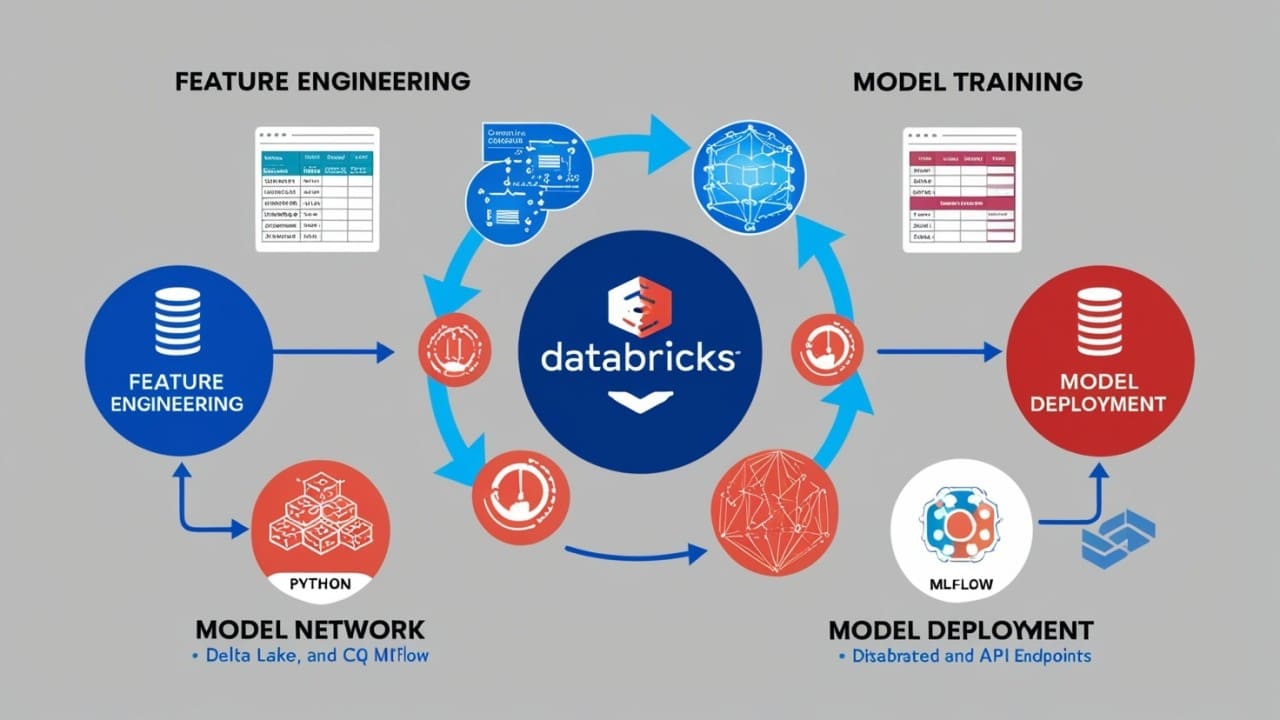
Databricks, built on Apache Spark, covers the end-to-end ML lifecycle on one platform - data preparation, feature engineering, training, and deployment - without stitching together separate systems. Its appeal for ML teams comes from four things: Spark's distributed computing for massive datasets, collaborative notebooks shared across engineers, scientists, and analysts, native support for TensorFlow, PyTorch, and scikit-learn, and a lakehouse architecture that gives high-speed access to lake-scale data with warehouse reliability.
Feature engineering
Spark handles the cleaning, aggregation, and transformation of large datasets; Delta Lake's ACID transactions keep data consistent through complex pipelines; and you can write the work in SQL, Python, or a mix. A customer-segmentation aggregation in PySpark:
from pyspark.sql import functions as F
df = spark.read.format("delta").load("/path/to/delta_table")
df = df.groupBy("customer_id").agg(
    F.avg("purchase_amount").alias("avg_purchase"),
    F.max("purchase_date").alias("last_purchase_date"))
Or a fraud-detection style aggregation in SQL over a rolling window:
SELECT customer_id, SUM(amount) AS total_spent, COUNT(transaction_id) AS num_transactions
FROM transactions
WHERE transaction_date > current_date - INTERVAL 30 DAYS
GROUP BY customer_id;
Delta Lake's time travel versions the underlying datasets, so feature pipelines stay reproducible - you can always recompute features from exactly the data that produced an earlier model.
Model training
Training integrates with the usual frameworks and adds MLflow for experiment tracking and model versioning, GPU-enabled clusters for deep learning, and Hyperopt or Optuna for hyperparameter search. A minimal workflow - load from Delta, train, and log the run to MLflow:
train_data = spark.read.format("delta").load("/path/to/train_data")

from sklearn.ensemble import RandomForestClassifier
from sklearn.model_selection import train_test_split
X_train, X_test, y_train, y_test = train_test_split(
    train_data["features"], train_data["labels"], test_size=0.2)
model = RandomForestClassifier(n_estimators=100).fit(X_train, y_train)

import mlflow.sklearn
with mlflow.start_run():
    mlflow.sklearn.log_model(model, "random_forest_model")
    mlflow.log_metric("accuracy", model.score(X_test, y_test))
The same pattern scales from a retail model predicting customer lifetime value to a healthcare model predicting patient outcomes from clinical records - what changes is the data and the framework, not the workflow.
Model deployment
Databricks supports real-time serving (models exposed as REST APIs through MLflow model serving), batch inference (Spark scoring large datasets), and scheduled inference via Databricks Jobs. Serving and batch scoring are both a few lines:
# Real-time: serve the logged model as an API
mlflow.sklearn.log_model(model, "model")
mlflow.models.serve("model", host="0.0.0.0", port=5000)

# Batch: score a Delta table and write predictions back
predictions = model.transform(spark.read.format("delta").load("/path/to/data"))
predictions.write.format("delta").save("/path/to/predictions")
That same split covers an e-commerce recommendation API serving personalized suggestions in real time and a finance fraud model flagging suspicious transactions as they occur.
Best practices
- Build on Delta Lake for reliable, consistent data through both feature engineering and inference.
- Automate the pipelines with Databricks Jobs or Airflow rather than running them by hand.
- Tune cluster configs - autoscaling and spot instances cut cost on bursty training and batch workloads.
- Share notebooks and dashboards so the work is reviewable and reusable across the team.
The throughline is that one platform handles feature engineering, training, and deployment with the same tools and the same governed data - which is what makes Databricks a practical base for recommendation engines, fraud detection, and predictive analytics rather than three separate stacks bolted together.



Leave a Comment