Seven Data Platforms, One Honest Comparison: How I Frame the Decision in 2026
Every few months, someone asks me a version of the same question:
"We're picking a data platform. Should we go with Snowflake, Databricks, or ClickHouse?"
And every few months, I have to bite my tongue before answering. Because the question is wrong.
Not the platforms - the framing. "Which platform is better" is the wrong question. It produces the wrong answer almost every time, and the teams that ask it tend to end up with the wrong system 18 months later.
The right question is: what workload are you actually running, and which engine is built for that workload?
That sounds obvious. It isn't. Most teams I work with picked their platform based on what their CTO read on LinkedIn, what a vendor's sales engineer demoed in a conference room, or what their previous company used. None of those are bad inputs. But none of them are the workload.
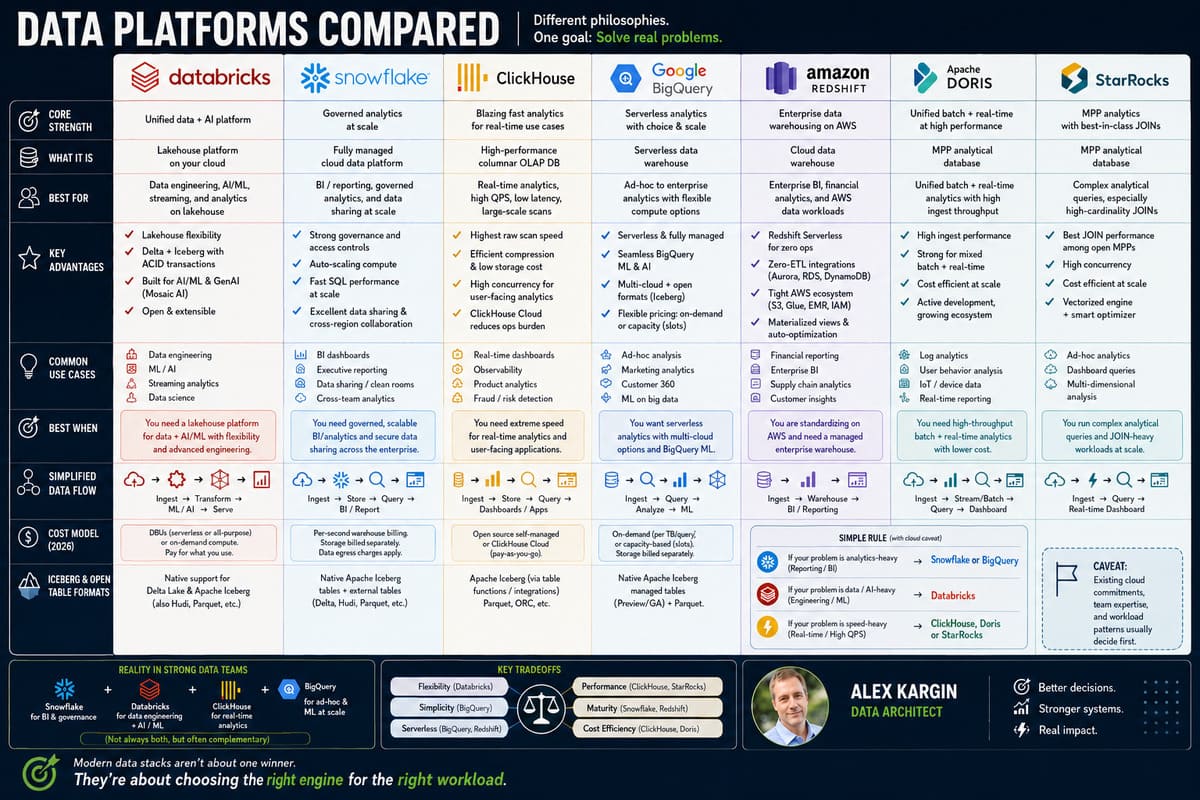
Below is how I actually frame the seven-platform decision in 2026. The chart at the bottom is the executive summary. The reasoning above it is what actually matters.
The Decision Has Three Layers, Not One
Most platform comparisons treat the choice like picking a winner in a single dimension. They aren't.
There are three layers that have to align, and the order matters:
- Workload type. What are you actually computing?
- Operational constraints. Cloud, team skillset, governance, budget.
- Architectural fit. Does the engine's design match how you'll actually use it?
Most teams skip layer 1 and go straight to layer 3 ("ClickHouse is fastest"), which is how you end up with ClickHouse running governance-heavy BI dashboards for a regulated industry. The engine is fine. The fit is wrong.
Let me walk through what layer 1 actually looks like.
The Four Workload Patterns
Almost every data workload I've seen falls into one of four buckets. Once you know which bucket your workload sits in, the platform shortlist narrows quickly.
Pattern 1: Governed BI and Reporting
You're running dashboards. Multiple teams need access. Some of them are external (customers, partners, auditors). The data is sensitive. You care more about correctness, lineage, and access control than about raw query speed.
This is the Snowflake sweet spot. Also BigQuery, if you're a GCP shop. Redshift if you're standardized on AWS and your governance needs are AWS-IAM-shaped.
The clue you're in this pattern: someone in the room keeps saying "SOC 2" or "data sharing" or "row-level security."
Pattern 2: Data Engineering + AI/ML
You're doing more than analytics. You're transforming data, training models, serving predictions, running streaming pipelines. The Python code lives next to the SQL. You need notebooks, MLOps tooling, and the ability to express a workload that isn't expressible in plain SQL.
This is the Databricks sweet spot, full stop. Snowflake has chased this with Snowpark, Streamlit, and Cortex, but the lakehouse design still wins for serious data-engineering and ML workloads.
The clue you're in this pattern: the team is split between "data engineers" and "data scientists" and they actually need to share infrastructure.
Pattern 3: Real-Time, User-Facing Analytics
You're embedding analytics into a product. Or you're running a dashboard that thousands of concurrent users hit. Or you're powering a customer-facing API that needs to return aggregated data in under 100ms. Latency is a feature, not a footnote.
This is the ClickHouse sweet spot. Doris and StarRocks are credible alternatives if your specific workload favors their architectures - StarRocks if you're JOIN-heavy, Doris if you need unified batch + real-time with strong ingest throughput.
The clue you're in this pattern: someone says "p95 latency" in a meeting about a dashboard.
Pattern 4: Ad-Hoc Analytics with Variable Demand
You don't know what you're going to query. The workload is bursty. You want to pay for what you use, not pre-commit to capacity. The queries are exploratory and may or may not run again.
This is the BigQuery sweet spot. Snowflake's on-demand model also works here. Redshift Serverless has gotten genuinely good for this in the last 18 months.
The clue you're in this pattern: the data team is small, the use cases are evolving, and "capacity planning" hasn't happened yet.
The Mistake That Costs Teams the Most
The mistake isn't picking the wrong platform. The mistake is picking the platform first, then discovering which workload pattern you're in.
I've seen this go wrong in both directions:
- A team picks ClickHouse because "it's the fastest." Six months in, they're running governance-heavy reporting for a financial services use case and discover they've built a bespoke access-control layer on top of ClickHouse that Snowflake would have given them for free.
- A team picks Snowflake because "everyone uses it." Eighteen months in, they're trying to serve a customer-facing analytics product and their Snowflake bill is climbing into the six figures because every concurrent user is spinning a warehouse.
Both teams could have made better choices. Both teams chose the engine before they understood the workload.
The Iceberg Wildcard
There's a development in 2026 that's quietly making the platform choice less consequential than it used to be: open table formats.
Apache Iceberg in particular. As of this year, every major platform on the chart below - Snowflake, Databricks, BigQuery, Redshift, ClickHouse, Doris, StarRocks - supports Iceberg natively or via integration. Delta Lake support is nearly as broad.
What that means in practice: the table you write to in Databricks can be read by Snowflake. The data you land in BigQuery can be queried from ClickHouse. The platforms are starting to look less like walled gardens and more like compute engines pointed at shared storage.
This doesn't make the choice irrelevant. Each engine still has architectural strengths the others lack. But it dramatically lowers the cost of being wrong, because migrating off Iceberg-backed data is fundamentally easier than migrating off proprietary storage.
If you're choosing a platform in 2026, the question "does this support Iceberg as a first-class citizen?" is now as important as "is the query engine fast?" Maybe more.
What the Chart Actually Tells You
A few things worth pointing out that the chart can't fully convey:
The "Reality in Strong Data Teams" panel is the most important part. The strongest data teams I work with don't use one platform. They use Snowflake + Databricks + ClickHouse, with Iceberg as the connective tissue and BigQuery as the ad-hoc/ML-at-scale escape hatch. The "pick one" framing is a vendor framing, not an architectural reality.
The "Best When" row is the row you actually decide on. Everything else is descriptive. The "Best When" row tells you whether your situation matches the platform's design.
The "Cost Model" row will save you more pain than the "Key Advantages" row. Key Advantages are marketing. Cost Model is what you actually live with at month 18 when the bill arrives.
The "Simple Rule" with the caveat is intentionally minimal. It's the right starting heuristic. The caveat below it ("Existing cloud commitments, team expertise, and workload patterns usually decide first") is what actually plays out in real decisions. Don't skip the caveat to get to the rule.
The Decision Framework I Actually Use
When a team asks me to help them choose, I walk through these questions in order. Most teams skip to question 5 and waste 2-3 months. Don't.
- What cloud are you already on? This is usually the biggest constraint and the one teams pretend doesn't exist. If you're on AWS with significant commit, Snowflake or Redshift makes life easier. If you're on GCP, BigQuery has a meaningful home-field advantage. If you're multi-cloud or cloud-agnostic, that narrows differently.
- What does your team know how to operate? A team of Python/Spark engineers will be productive on Databricks fast. A team of SQL-and-BI analysts will be productive on Snowflake fast. A team that doesn't have anyone who's run a real OLAP database will struggle with self-hosted ClickHouse no matter how good the benchmarks are.
- What's the dominant workload? Use the four-pattern map above. Be honest about what you'll actually run, not what you wish you'd run.
- What does the second-most-important workload look like? This is where teams get bitten. Snowflake is great for BI but expensive for user-facing analytics. Databricks is great for AI/ML but historically weaker for governed BI. ClickHouse is fast but you'll need to build your own governance layer. Plan for the workloads you'll add later.
- What's the cost model that fits your business? Pay-per-query (BigQuery) is brilliant when usage is bursty and unpredictable. Capacity-based (Snowflake credits, BigQuery slots) is better when usage is steady. Self-managed open-source (ClickHouse, Doris, StarRocks) wins on raw cost-efficiency but loses on operational overhead. There's no universally cheaper option - there's only the option that's cheaper for your usage pattern.
- What does your data look like in 3 years? This is where Iceberg matters. If your data is in Iceberg, you can change engines later without rewriting it. If your data is in proprietary storage, you're committed for longer than you think.
Notice that "which platform has the best benchmarks?" is not on this list. Benchmarks are useful for shortlisting, not for deciding. Every benchmark has a context, and the context rarely matches yours.
The Honest Takeaway
The data platform market in 2026 is in a strange place. The engines are converging - every major platform now does most things acceptably. The differentiation is moving from "what can this platform do?" to "what is this platform built for?"
The strongest data teams I see in 2026 are doing three things:
- They have more than one platform. Usually two, sometimes three.
- They use Iceberg or Delta as the storage layer so they can move workloads between engines.
- They don't argue about which platform is better. They argue about which workload belongs where.
If you take one thing from this whole comparison, take that.
Modern data stacks aren't about one winner. They're about choosing the right engine for the right workload.
#DataEngineering #DataPlatforms #Snowflake #Databricks #ClickHouse #BigQuery #Redshift #ApacheIceberg #ModernDataStack #DataArchitecture

Leave a Comment