
Here's a number worth sitting with: by early 2026, most companies running AI-agent pilots hadn't moved a single one to production - one widely cited survey put it around 78%. The hype cycle produced thousands of striking demos: agents that write SQL, triage tickets, debug code. The technology works in a notebook, with clean inputs and an engineer watching. The gap between that and "runs unattended against real data and real consequences" is where almost everyone gets stuck. The interesting part isn't the failure rate - it's that the blockers are consistent and mostly not about the model.
Blocker 1: reliability
A demo that works 90% of the time is a great demo and an unusable product. An agent that takes ten steps at 95% reliability each succeeds end-to-end only about 60% of the time - errors compound. Production needs consistency the model alone doesn't provide, which means validation at each step, bounded retries, and a clear definition of "done" the agent can check itself against.
Blocker 2: integration
The demo talks to a clean API. Production talks to a twenty-year-old ERP, an undocumented internal service, and a database whose schema only one person fully understands. Most of the work in shipping an agent is the unglamorous plumbing - auth, rate limits, error handling, data access - that no demo shows. This is ordinary engineering, and it's where the timeline actually goes.
Blocker 3: orchestration
One agent is manageable. Several agents handing work to each other introduce the hard distributed-systems questions - who owns state, what happens when one stalls, how a partial failure unwinds. Teams underestimate this because the single-agent demo hid it entirely.
Blocker 4: latency and cost
Agentic loops make many model calls, and each adds seconds and fractions of a cent. A workflow that's impressive at ten seconds and pennies in a demo can be unacceptable at the volume and response time production demands. The economics have to close, not just the logic.
Blocker 5: governance and security
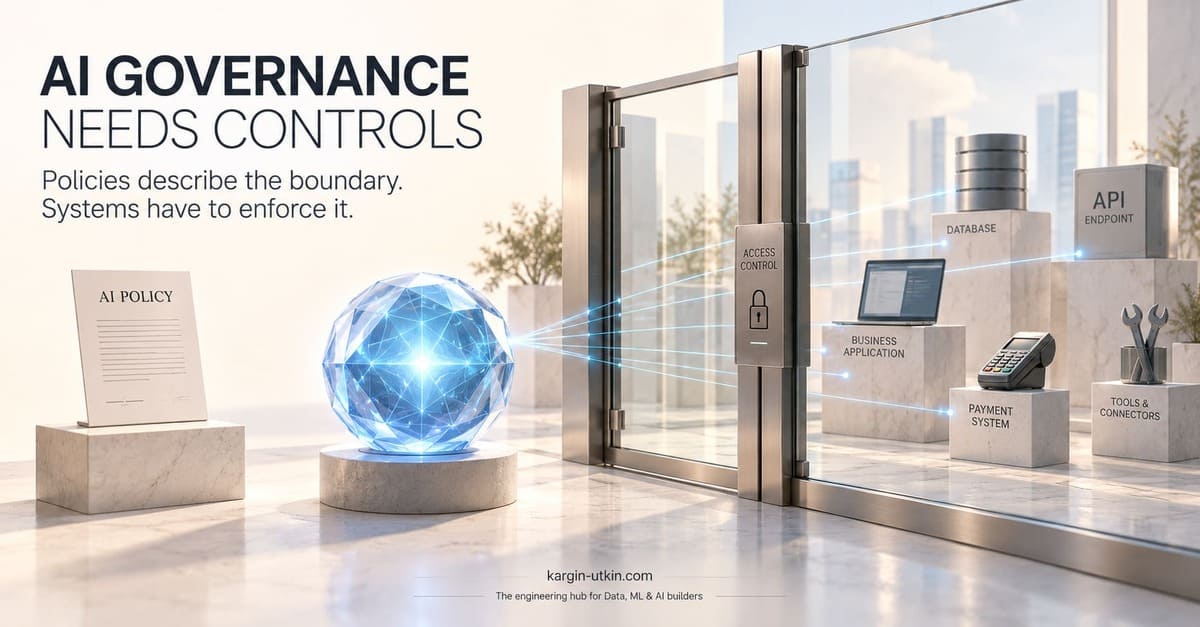
An agent that can act can act wrongly - delete the wrong records, expose data, take an irreversible step. Security, audit, and compliance teams will not sign off on a system that operates with broad permissions and no trail. Least-privilege access, full logging, reversibility, and human approval on high-impact actions aren't optional add-ons; they're the price of admission to production.
What the teams that cross the gap do differently
The organizations shipping agents share a pattern, and it's not a better model. They start narrow - one task, one clear success metric - instead of a sweeping "autonomous" mandate. They invest in the boring infrastructure: evaluation harnesses, observability, and guardrails before scope. They keep a human in the loop where the blast radius is high and remove that human only where results have earned it. And they treat the agent as one component in a well-engineered system, not as the system.
What it means for data teams
If you're piloting agents, the lesson isn't "wait." It's that the work that gets an agent into production is the work you already know how to do - testing, integration, observability, access control - applied to a new kind of component. The model is the easy part. The engineering around it is the job, and it's why most pilots stall and a disciplined few don't.
Leave a Comment