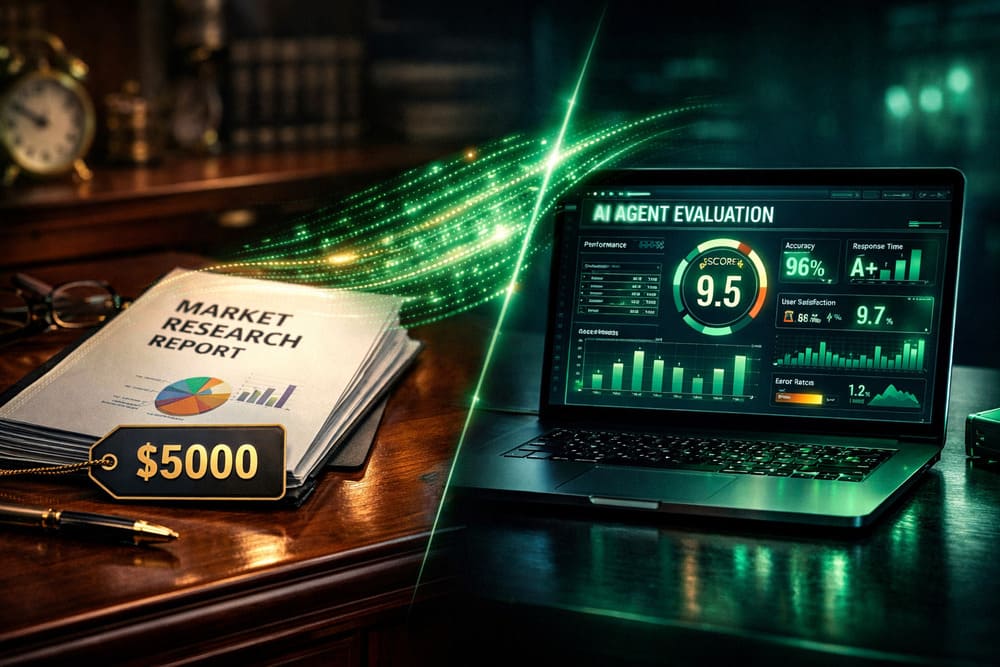
A common piece of founder advice: before writing a single line of code, spend $5,000 on market research. Most technical founders don't have $5,000. They have a weekend, a vague sense that existing tools aren't great, and the optimism that engineers mistake for market validation.
So the usual path is to skip research entirely, build the tool over a few weekends, launch it on Hacker News, collect a handful of upvotes, and watch the GitHub stars plateau. Months of polish later comes the hard lesson - for a Parquet-profiling CLI, for instance, duckdb describe already did 90% of what the tool offered.
There is now a cheaper first step.
Five Agents, Five Minutes, Zero Dollars
Boss.cc runs a business idea through five specialized AI agents. Each evaluates a different dimension:
- Viability Agent: Is this solving a real, painful problem? Who has it? How badly do they need a solution? "Mild inconvenience" does not count.
- Market Agent: How big is the opportunity? Is the market growing or shrinking? Is there a segment willing to pay?
- Competition Agent: Who already does this? What would make someone switch from the existing solution? "Slightly better UX" is almost never enough.
- Revenue Agent: How does this make money? What will people actually pay? Is the pricing model sustainable?
- Risk Agent: What is the most likely way this fails? What is being missed because the founder is too close to the idea?
Each agent scores the idea 1-10 with detailed reasoning. If the average falls below 7, a Pivot Agent suggests modifications and the entire panel re-evaluates.
Is It as Good as Real Market Research?
No. A real market research report involves customer interviews, survey data, competitive win/loss analysis, and pricing sensitivity studies that an AI model operating on training data cannot replicate. For a Series A raise or a $500K hiring decision, get the real report.
But most data engineers building side projects and early-stage tools do not need a perfect report. They need a sanity check - someone without emotional investment to say "this is worth pursuing" or "you are about to waste six months building something that already exists."
A tool like this gives that sanity check in five minutes instead of six weeks.
When to Use It
- Before building. Run the idea through the agents before creating the GitHub repo. Five minutes now can save three months of building something nobody wants.
- Before pitching. When applying to YC or pitching angels, the Competition Agent surfaces the tools you should already know about. Better to discover them now than during a partner meeting.
- When choosing between two ideas. Run both and compare scores. A dbt model dependency visualizer scoring 5.1 against a SQL cost estimator for BigQuery scoring 7.6 makes the choice clear - the visualizer loses because existing dbt docs and dbt-osmosis already cover it.
- When a colleague asks for an opinion on their startup idea. Send the link instead of spending an awkward lunch feigning enthusiasm about an "Uber for data cleaning" concept.
When NOT to Use It
- As a replacement for talking to actual users. No AI evaluation substitutes for sitting down with five potential customers and asking "would you pay for this?"
- As the final word on whether to proceed. It is a first filter, not a verdict. Ideas that score 5 might still work with a different go-to-market. Ideas that score 8 can still fail on execution.
- For deep-tech or highly regulated verticals. The AI may not fully grasp regulatory barriers, patent landscapes, or niche technical constraints in fields like medical devices or defense contracting.
The Real Value: Catching Blind Spots
The most valuable output is not the score - it is the reasoning. When the Competition Agent lists seven tools you have never heard of, that is worth more than the number. When the Risk Agent identifies that the target customer (data teams at Series A startups) has zero budget for new tools, that is the kind of reality check founders need and rarely seek.
It is a first filter, not the last word. But it is a good first filter, and it is free.
Leave a Comment