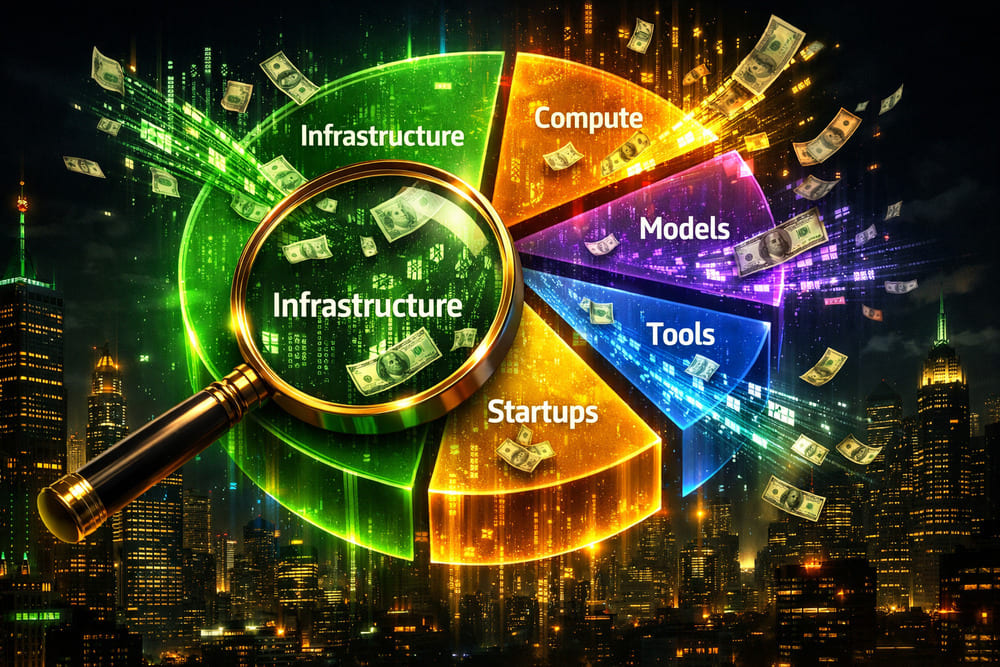
In Q1 2026, AI companies raised an estimated $297 billion. The figure is large enough to lose meaning - somewhere around the GDP of Finland - and it's skewed by OpenAI's reported $122 billion round. But strip that outlier out and the remaining $175 billion still dwarfs any prior quarter of technology investment. The interesting question isn't whether this is a bubble. It's where the money actually lands, and which of those landing spots are durable.
For people who build data and ML systems, that distinction is practical. Some of this spending creates infrastructure you'll use for a decade; some of it funds applications that won't survive contact with a P&L. Following the money tells you which tools are worth learning and which platforms are worth betting a stack on.
Where the money goes
Break a quarter like this into rough channels and a clear shape emerges.
- Compute infrastructure (about half). GPUs, data centers, networking, power. This is the largest slice by far, and most of it flows to a short list of chip and cloud providers. It is also the most durable: the hardware and facilities outlast whichever models run on them.
- Model training and research (15-20%). The cost of training frontier models - compute, data, and the small number of people who can do it. High-risk, concentrated among a few labs, and the part most exposed if returns disappoint.
- Enterprise platforms and tooling (15-20%). The layer data teams touch directly: vector databases, orchestration, serving, observability, governance. Less glamorous, more durable than it looks, because it's where AI meets real production constraints.
- AI-powered applications (10-15%). Products built on top of models. The most visible spending and the most fragile - many of these are features, not companies.
- The startup ecosystem (5-10%). The long tail of early-stage bets, most of which won't return capital, a few of which will define the next cycle.
The revenue question
The number that should anchor any reaction isn't the investment total - it's the revenue underneath it. Frontier labs are generating real and fast-growing revenue, but it remains a fraction of what's being invested against future growth. That gap is the actual debate: bulls see early innings of a platform shift, bears see capital outrunning demand. Both can be partly right, and the resolution won't be uniform across the channels above.
The infrastructure layer is the durable bet
Here's the asymmetry that matters to engineers. If the application layer overheats and corrects, the compute and platform layers largely survive - data centers, chips, and the tooling that runs models don't evaporate because some AI app shut down. The 2000 dot-com crash wiped out websites but left behind fiber, servers, and a generation of infrastructure the next decade was built on. The same logic applies: even a sharp correction in AI applications leaves the infrastructure standing and, often, cheaper.
What it means for the next few years
A few practical reads for data and ML teams:
- Compute stays central and gradually commoditizes. Inference cost per token keeps falling; the work shifts from "can we run this" to "can we run this economically."
- The tooling layer consolidates. The crowded field of vector stores, orchestration, and serving tools will thin out - bet on the ones with real adoption, not the best demo.
- Applications get judged on unit economics. The era of funding any AI wrapper ends; products that don't show margin get cut.
Practical implications
If you're choosing what to learn or what to build on, weight toward the durable layers. Skills in data infrastructure, model serving, retrieval, and the platforms that make AI run in production age well regardless of which labs win. The application layer is where careers and companies are made and lost fastest - exciting, but volatile. A $297 billion quarter is not proof of anything except that the bet is enormous; your job is to stand where the ground stays solid after the number stops being a headline.

Leave a Comment