Every few months, a story shows up that promises to lower costs by "unlocking spare capacity."
Last time I wrote about one, it was Snowflake Interactive Tables - and the conclusion was that the queries don't get cheaper, the cost just moves from query-time to an always-on warehouse.
This week's version is bigger. It involves NVIDIA, residential homes, and the US power grid.
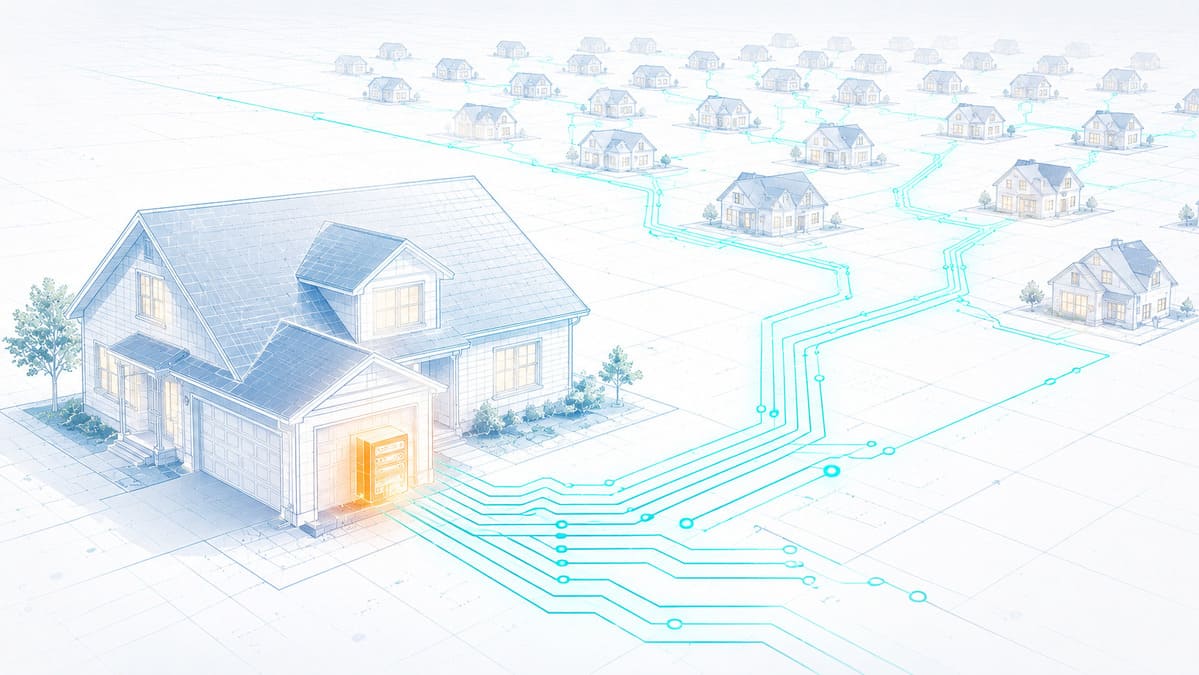
What was announced: Span, the smart-electrical-panel company, is partnering with NVIDIA and homebuilder PulteGroup to deploy XFRA - a distributed network of compute nodes installed at customer homes. Each node packs Dell PowerEdge servers, 16 NVIDIA RTX Pro 6000 Blackwell GPUs, 4 AMD EPYC CPUs, 3 TB of RAM, and a 24-port switch - wired into the home through a Span smart panel and a backup battery. The pitch: data centers without data centers. Homeowners get free or discounted electricity. Hyperscalers skip the 7-year wait for utility interconnection. Proof-of-concept rolls out in Q3 2026 in Nevada or Arizona, scaling to 1 GW by 2027.
It's a genuinely interesting engineering pattern. It's also exactly the kind of story that gets reported with a press-release headline and very few hard questions.
Let me try to ask the questions.
The Real Engineering Problem It Solves
Before critiquing, give credit where it's due.
The problem XFRA is attacking is real and well-documented:
- Speed-to-power is the bottleneck. The Center for Strategic and International Studies reported delays of up to 7 years to get a new data center connected in the largest US markets.
- Inference workloads are increasingly latency-sensitive and geographically distributed - they want to be near population centers, not in remote desert mega-campuses.
- The grid is structurally underutilized. Residential service is sized for peak load (running AC + EV charging + electric oven all at once), so average utilization sits around 40% of the rated capacity.
XFRA reframes the question:
Instead of building one 1 GW facility and waiting 7 years for power, what if you deploy 50,000 × 20 kW micro-nodes into homes that already have 200-amp service sitting half-idle?
As a pattern, that's clever. It's the same instinct as edge inference, CDNs, and federated learning - push the workload to where capacity already exists rather than build new capacity from scratch.
The architecture is also reasonable:
Hyperscaler workload
        ↓
XFRA orchestrator
        ↓
50,000 distributed nodes (homes)
        ↓
Span smart panel — detects household load, modulates compute
        ↓
Backup battery — buffers spikes, handles outages, demand response
        ↓
Residential utility connection
The smart panel is the actually-novel piece. It's what lets the compute "yield" to household demand in real time - turning the always-on inference load into something that looks, from the grid's perspective, like a controllable resource.
That's good engineering.
The Architecture Pattern Worth Studying
Strip away the marketing and XFRA is a textbook edge-distribution-with-buffering pattern. The same shape shows up in:
| Pattern | Centralized version | Distributed version | Buffer |
|---|---|---|---|
| Web delivery | Origin server | CDN edge | Local cache |
| Video streaming | Single CDN | P2P (e.g. Peer5) | Local disk |
| ML inference | Cloud GPU | Edge inference | Model cache |
| AI compute | Hyperscale DC | XFRA nodes | Home battery |
If you've ever designed a system that fans out a centralized workload to many small nodes, you already know the trade-offs.
You're trading:
- Predictable performance → for better placement and lower latency to users
- Centralized failure modes → for distributed failure modes that are harder to debug
- Concentrated capex → for distributed capex with longer payback periods
- One physical site to operate → for 50,000 sites to operate
That last row is where the press releases stop talking.
The Cost-Shift Question
Here's where I get skeptical.
The story sells lower costs. But cost in a system doesn't disappear - it moves. So let's track where it's actually moving.
Capex. A hyperscaler building 1 GW of conventional data center pays roughly $50B in capex (NVIDIA's own estimate). The XFRA pitch says each of 50,000 home nodes is worth $1M in equivalent asset value - so the capex number is similar, but distributed across homes and absorbed by Span, its partners, and presumably whoever finances the rollout. The host homeowner pays nothing upfront and gets the equipment installed for free.
So far so good. But that capex still has to be paid back somehow. From what?
Opex. The compute runs on the customer's electric meter under standard residential rates. Span is upfront that this can be cheaper than commercial DC rates in some markets - but only in places with low fixed residential rates, like Nevada or Arizona. In high-rate states (California, Massachusetts, New York), the math gets harder, and Span is already openly hoping utilities will create "innovation in the tariff model" - i.e., custom lower rates for compute hosts.
In other words, the cost model leans on:
- Cheap residential electricity in the chosen markets, and
- Future tariff structures that don't exist yet.
Both are external dependencies on entities the company doesn't control.
Grid-utilization argument. Span's strongest claim is that adding load to underutilized residential service spreads grid capex over more kWh, lowering per-kWh rates for everyone. That's mathematically correct in isolation - but it assumes the "spare capacity" is actually spare.
The angry commenter on the original pv-magazine article had a fair point:
Building electrification, EV charging, heat pumps, and industrial reshoring are all eating that 60% headroom right now. By the time XFRA scales to 1 GW in 2027, how much of that "untapped" capacity is still untapped?
Nobody knows. And the answer matters a lot, because if the grid runs into capacity constraints, the always-on XFRA load is the one with the least political defensibility - it's the one that homeowners and regulators will turn off first.
Operational opex nobody is pricing yet. A few items missing from the public numbers:
- Thermals. 16 Blackwell GPUs + 4 EPYC CPUs in a residential garage in Phoenix, in August. Industrial DCs maintain ~22°C with redundant cooling. A home garage hits 45°C+ in summer. Either every node needs active climate control (more electricity, more capex), or you're going to see thermal throttling and accelerated hardware degradation.
- Network reliability. Residential ISP uptime is roughly 99.5%. Enterprise DC uptime targets 99.99%. The orchestrator can route around individual node outages - but you need significant overprovisioning to maintain SLA, which raises the effective cost per useful compute hour.
- Churn. Homeowners move. The average US homeowner moves every 8-13 years. If you've deployed 50,000 nodes, you're going to be uninstalling and reinstalling roughly 4,000-6,000 of them every year, with all the truck-rolls, contract transfers, and re-permitting that implies.
- Physical security. A $1M asset behind a residential garage door has a different threat model than the same asset in a hyperscale facility with badge access and armed security.
None of these are dealbreakers. All of them are real opex line items that don't appear in the "1 GW for $50B" comparison.
So... Does the Math Work?
It depends entirely on what you're comparing.
Cheaper than a new central DC - plausibly yes, especially when you factor in the 7-year speed-to-power advantage. If a hyperscaler can deploy 1 GW in 18 months instead of 7 years, the time-to-revenue alone justifies a lot of operational complexity.
Cheaper for the homeowner - yes, if you only look at the electricity bill. The host gets free equipment, discounted (or free) electricity, and free internet. That's a real benefit.
Cheaper for ratepayers in aggregate - maybe, if the grid-utilization argument holds and the "spare capacity" thesis stays intact. Maybe not, if building electrification absorbs that capacity first, in which case XFRA becomes a competing load that puts upward pressure on rates.
Cheaper than ClickHouse, Cerebras, or other inference-optimized architectures - that comparison isn't being made publicly, and I'd love to see it. My guess: at scale, purpose-built inference hardware in a real DC is still cheaper per token. XFRA's advantage isn't unit economics - it's deployment speed.
The Pattern in Plain English
If I had to summarize XFRA in one sentence:
It's an end-run around utility interconnection delays, dressed up as a homeowner benefits program, made possible by a smart panel that turns residential electrical headroom into a controllable compute resource.
The engineering is real. The pattern is interesting. The "win-win-win" framing is marketing.
The losers in this story - if there are any - aren't the homeowners who sign up. They're the ratepayers in 2030 who discover that their utility's "spare capacity" got committed to AI compute before their EV and heat pump needed it. Whether that scenario plays out depends on how fast XFRA scales and how fast the rest of building electrification scales.
The Key Insight
The same pattern keeps showing up across data infrastructure right now:
- Snowflake Interactive Tables: queries don't get cheaper, you pay for a warehouse to stay warm.
- XFRA: electricity isn't free, residential ratepayers are absorbing the capacity bet.
- "Serverless" inference APIs: compute isn't actually cheaper, it's just billed differently.
The headline always says lower cost. The reality is usually shifted cost - onto a different line item, a different party, or a different timeframe.
That's not a reason to reject these patterns. It's a reason to read past the headline before you build on top of them.
The architecture matters more than the announcement.
#DataEngineering #DistributedSystems #EdgeCompute #NVIDIA #AIInfrastructure #GridScale #SmartGrid #InfrastructureEconomics #ModernDataStack #InferenceAtTheEdge



Leave a Comment