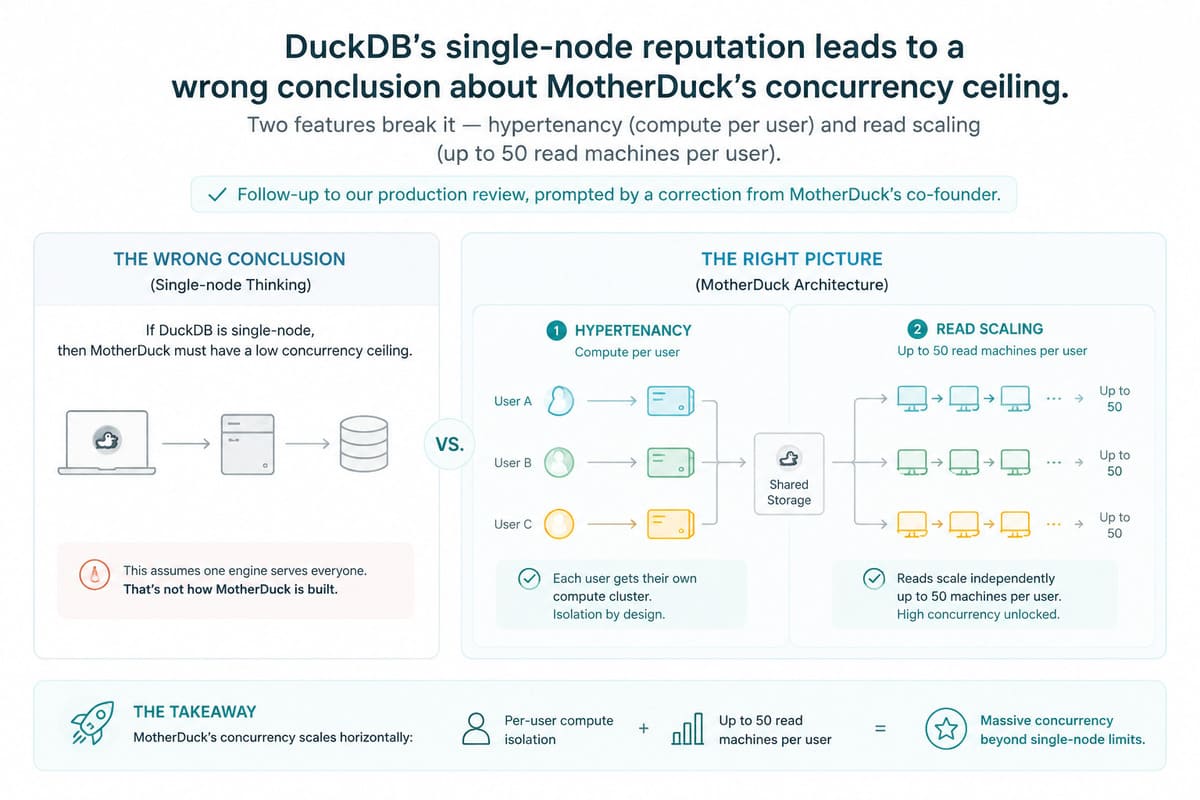
DuckDB's reputation is built on the single node. It runs in-process, screams through analytical queries on one machine, and asks nothing of a cluster. That mental model is so strong that it quietly attaches itself to MotherDuck - the managed cloud service built on DuckDB - and leads to a wrong conclusion: that MotherDuck must inherit DuckDB's single-box ceiling on concurrency and scale. It doesn't, and the reason is two architectural features the single-node framing hides: hypertenancy and read scaling.
This piece is a follow-up to our production review of MotherDuck. After that review, MotherDuck's co-founder Ryan Boyd pointed out in a comment that the evaluation leaned on the single-node DuckDB picture and didn't account for how the service actually fans out under load. He's right, and the gap is worth closing properly, because it changes the answer to the most common objection to DuckDB in production: "it doesn't do concurrency."
Where the single-node assumption comes from
Open-source DuckDB is an in-process engine. You embed it in your application, it uses the cores and memory of that one machine, and concurrency is bounded by that box. For a huge class of analytics - data that fits on one server, a handful of users - that's not a limitation, it's the whole appeal: no cluster, no coordination, no overhead. But it trains people to think "DuckDB equals one machine," and to assume that a cloud product wrapping DuckDB is just that same engine on a rented server, with the same per-box concurrency wall. MotherDuck separates storage from compute and provisions compute per user, which breaks the assumption at its root.
Hypertenancy: compute per user, not per cluster
In a traditional warehouse you size a cluster (or a virtual warehouse) and many users share it; their queries compete for the same compute, and concurrency is a tuning problem you manage centrally. MotherDuck's model is hypertenancy: each user gets their own compute resources - MotherDuck calls these compute instances "ducklings" - provisioned independently and scaling close to the number of users rather than the capacity of one shared cluster. Storage lives in cloud object storage, decoupled from the ephemeral compute that reads it, so spinning up isolated per-user compute is cheap and doesn't require copying data.
The practical effect is that one heavy user can't starve another, because they aren't sharing a box. The concurrency question shifts from "how big do I size the shared warehouse so everyone's queries fit?" to "each user has their own engine" - which is a fundamentally different scaling story than the single-node mental model predicts.
Read scaling: one user, many machines
Hypertenancy handles concurrency across users. Read scaling handles it within a single user or workload. A read-scaling configuration lets one user's read traffic spread across up to 50 machines, so a burst of concurrent analytical queries - a dashboard hit by many viewers, an API serving analytics to an application - fans out across that pool instead of queuing behind a single engine. Because the data sits in shared object storage, these read replicas all see the same data without duplication; they're elastic read capacity bolted onto the same logical database.
This is the piece that most directly answers the "DuckDB can't serve concurrent reads at scale" critique. A single DuckDB process can't, but a MotherDuck database with read scaling is a different shape: the engine is still DuckDB, but the serving layer in front of it is a horizontally-scaled pool, not one box.
What this changes about the decision
Put together, hypertenancy and read scaling mean MotherDuck occupies a spot the single-node framing doesn't have a slot for: the simplicity and speed of DuckDB's engine, with cloud-side scaling for concurrent users and read-heavy serving. The honest comparison to a warehouse like Snowflake or BigQuery isn't "single node vs. distributed" - it's "per-user elastic compute on a DuckDB engine vs. shared elastic compute on an MPP engine," and which fits depends on workload shape and cost, not on a concurrency ceiling that isn't actually there.
None of this contradicts the case for plain, local DuckDB - for single-machine analytics it remains the simplest, cheapest tool, and not everything needs the cloud service. The point is narrower: when you reach for the managed product, you're not reaching for "DuckDB on a bigger server." You're reaching for an architecture that scales compute per user and reads across a fleet, which is exactly the part a single-node intuition misses.
The correction, kept
Our production review stands on its cost and migration findings, but it undersold the scaling model, and a reader who builds the product set us straight. That's worth saying plainly: the concurrency story for MotherDuck is hypertenancy plus read scaling, not the single-node ceiling that DuckDB's reputation makes you expect. If you evaluated MotherDuck and dismissed it on concurrency grounds, that's the assumption worth revisiting.
Leave a Comment