
Batch processing fit an era of smaller volumes and looser latency. As systems began generating terabytes a day and decisions moved closer to real time, ingestion shifted to streaming platforms. Apache Kafka established distributed, high-throughput messaging as the ingestion backbone; Spark Structured Streaming then blurred the line between batch and stream by letting the same engine handle both.
Core platforms in streaming analytics
Apache Kafka
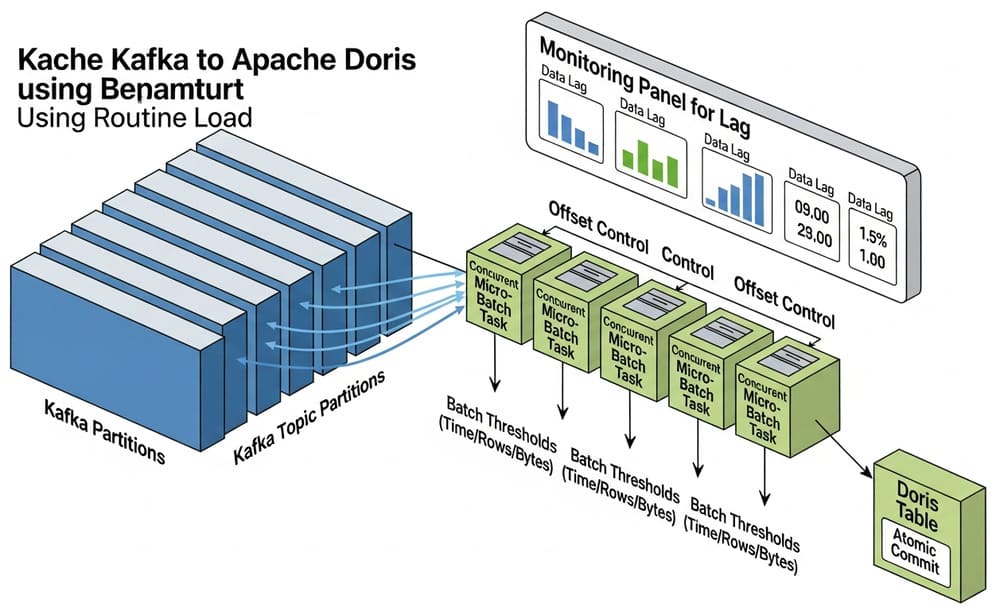
Kafka is a distributed streaming platform built for high-throughput, low-latency message processing. It acts as both a real-time pipeline and an event store: publish, subscribe, store, and replay streams of records.
- Scalability: clusters scale horizontally by adding brokers.
- Durability: replication and partition fault-tolerance keep data intact through node failures.
- Flexibility: the pub/sub model backs everything from logging and metrics to real-time analytics and feature pipelines.
Design topics and partitions deliberately - partition count sets your parallelism ceiling and your load balance across consumers.
Apache Pulsar
Pulsar is a distributed messaging and streaming platform with two features Kafka historically lacked out of the box:
- Multi-tenancy: multiple tenants share one cluster with isolation.
- Geo-replication: native cross-data-center replication, useful for global deployments.
- Layered architecture: separating serving (brokers) from storage (BookKeeper) lets the two scale independently.
Reach for Pulsar when you need native geo-replication and consistent performance across regions.
Spark Structured Streaming
Spark Structured Streaming extends Spark's batch engine to streaming by treating a stream as an unbounded table, so you write SQL-like queries and reuse existing Spark workflows.
- Unified engine: the same DataFrame/Dataset API processes batch and streaming data.
- Fault tolerance: checkpointing and write-ahead logs let jobs recover from failures.
- Familiar APIs: SQL and DataFrame operations for engineers already on Spark.
Tune checkpointing intervals to trade fault-tolerance granularity against processing latency.
Designing a scalable, fault-tolerant pipeline
Ingestion layer. Use Kafka or Pulsar as the backbone. Size topics and partitions to your throughput; consider multiple clusters at very high ingestion rates.
Processing layer. Run Spark Structured Streaming on the stream. Choose micro-batch or continuous processing based on latency targets, and enrich streaming records by joining against static reference datasets.
Storage and analytics layer. Land processed data in a warehouse like Snowflake or a distributed store such as HDFS. Confirm the sink can absorb the streaming write rate, and put dashboards on top for flow and health monitoring.
Fault tolerance and monitoring. Lean on Kafka/Pulsar replication and Spark checkpointing, and watch pipeline health with Prometheus and Grafana. Rehearse failover regularly so recovery is verified, not assumed.
Worked example: real-time fraud detection
A payments company processing millions of transactions per minute ingests them through Kafka, uses Pulsar for cross-region distribution, and runs Spark Structured Streaming to flag fraudulent patterns on the fly while enriching each transaction with customer data from a static store. The result: immediate fraud alerts that trigger automated prevention, horizontal scaling through peak trading hours, and no data loss across node failures thanks to built-in replication and checkpointing.
Start by piloting a small Kafka + Spark Structured Streaming pipeline. Measure latency, throughput, and recovery behavior before scaling, and bring in Pulsar if you need multi-region support.
Leave a Comment