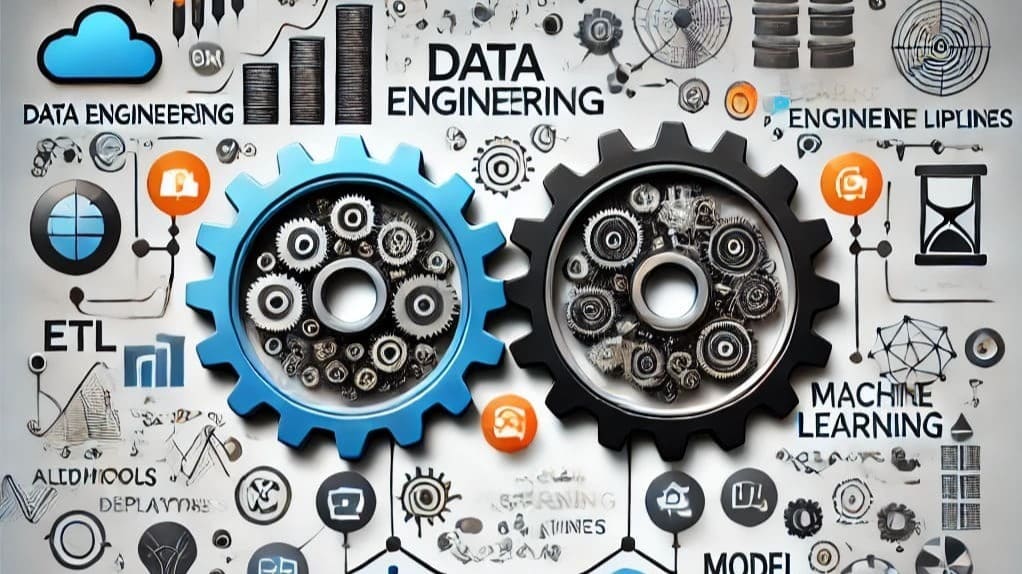
As AI works its way deeper into more industries, the roles of data engineer and ML engineer have grown increasingly intertwined. Both are essential to data-driven projects, but the boundaries between their responsibilities, tools, and workflows aren't always clear - and the overlap is widening. Here's where the lines sit, where they blur, and where the roles are heading.
What each role does
A data engineer builds and maintains the infrastructure behind data pipelines and storage: ingesting from many sources, cleaning and modeling at scale, ensuring datasets are reliable and available for downstream use, and keeping the warehouse and streaming systems healthy. The common toolkit is Apache Spark, Hadoop, Snowflake, Airflow, SQL, and Python.
A machine learning engineer develops, deploys, and maintains models: engineering features, training and evaluating models, packaging them for serving, and operating them in production with monitoring and retraining. The common toolkit is TensorFlow, PyTorch, scikit-learn, Docker, Kubernetes, and cloud platforms like AWS SageMaker.
Where the lines blur
Data preparation. Both roles clean and prepare data, but at different depths - data engineers do large-scale cleaning that serves many downstream consumers, while ML engineers dive into specific datasets to build features tailored to a model. Infrastructure. With the rise of MLOps, ML engineers increasingly own work that used to be data-engineering territory: automated pipelines for continuous training and deployment, and real-time streaming infrastructure to feed predictive models. Tooling. The gap narrows from both directions - data engineers adopt ML-specific tools like MLflow for model management, and ML engineers reach for data-engineering tools like Kafka for real-time ingestion.
Collaboration in practice
The division of labor is clearest in real projects. In predictive maintenance, data engineers build pipelines collecting IoT sensor data from factory machines into a real-time store, and ML engineers train a failure-prediction model on it to cut downtime. In e-commerce personalization, data engineers aggregate customer interaction data across channels, and ML engineers build recommendation systems on top to lift engagement. In fraud detection, data engineers streamline transaction pipelines for real-time availability, and ML engineers build the real-time anomaly-detection model that flags suspicious activity. In each case, the data engineer makes the data reliable and available; the ML engineer turns it into a prediction.
Where the roles are heading
Three trends are reshaping both jobs. Hybrid roles are emerging - "MLOps Engineer," "Data Science Engineer" - where one person needs skills across both domains. Automation and low-code platforms like Databricks and the cloud providers are absorbing some routine tasks from both sides, freeing people to focus on higher-level problems. And organizations increasingly value cross-functional teams where data and ML engineers collaborate closely, with shared knowledge and good communication as the differentiator.
The short version: data engineers build scalable data systems, ML engineers develop and deploy models, and the rise of MLOps and shared tooling is steadily blurring the boundary so that cross-functional fluency matters more than a clean title split. Collaboration between the two is what actually carries data-driven projects - the predictive-maintenance and fraud-detection examples work because each role does its half well. As AI adoption grows, expect the roles to keep blending the engineering foundations of data work with the model-building focus of ML.
Leave a Comment