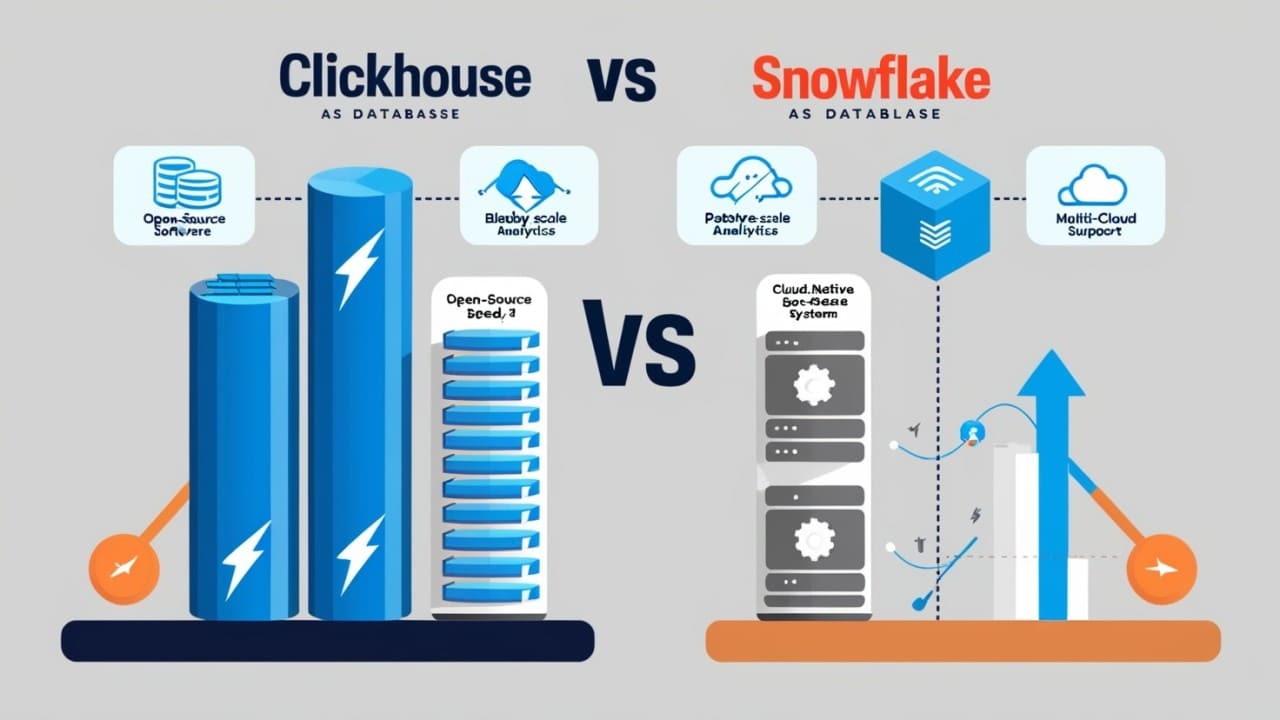
ClickHouse and Snowflake both run analytical queries over large datasets, but they were built for different jobs. ClickHouse is an open-source columnar database tuned for the fastest possible scans on append-heavy data. Snowflake is a fully-managed cloud data platform that separates storage from compute and trades raw speed for operational ease. The choice usually comes down to whether you optimize for query latency and cost-per-query or for not running a database at all.
ClickHouse
Originating at Yandex for web analytics, ClickHouse stores data in its MergeTree columnar format and executes queries with a vectorized engine that processes columns in batches. On the workloads it was designed for - aggregations over time-series, logs, clickstream, and other wide append-only tables - it answers in milliseconds and scans data faster than most warehouses, partly because its query planner is tightly coupled to storage. It scales horizontally across distributed clusters, and because it's open source, the software itself is free: you pay for the hardware and the people who operate it. That operational burden is the real cost - replication coordination, shard rebalancing, merge pressure, and schema migrations on large tables are all things you manage yourself unless you use ClickHouse Cloud.
Snowflake
Snowflake is cloud-native and fully managed, running on AWS, Azure, and Google Cloud. Its defining design choice is independent scaling of storage and compute: data sits in cloud object storage as immutable micro-partitions, and "virtual warehouses" (compute clusters) spin up against it on demand, so you can size or pause compute without touching storage. That makes scaling effortless and lets non-specialists get productive quickly without managing infrastructure. It integrates broadly with BI and data-engineering tools and handles mixed transactional-ish and analytical workloads competently. The trade is pricing: a pay-as-you-go credit model that gets expensive for large, continuous workloads, and less control for niche tuning.
Where each one wins
- Query speed on analytics. ClickHouse, clearly, for pure aggregation and scan workloads. Snowflake is solid but not in the same latency class for those shapes.
- Operational ease. Snowflake - fully managed, minimal administration. Self-hosted ClickHouse demands real expertise; ClickHouse Cloud narrows but doesn't erase the gap.
- Cost. ClickHouse is cheaper if you already have the infrastructure and the people to run it. Snowflake's per-credit billing favors spiky or intermittent workloads and punishes always-on heavy ones.
- Scaling. Snowflake's storage/compute separation makes elastic scaling trivial. ClickHouse scales well but the setup and maintenance are on you.
- Flexibility vs. ecosystem. ClickHouse gives deep control over configuration for custom cases; Snowflake gives a robust general-purpose platform that drops cleanly into enterprise tooling.
Which to choose
Choose ClickHouse when you need low-latency analytics on time-series or log data, are sensitive to cost-per-query at scale, and have the expertise (or will pay for ClickHouse Cloud) to operate it. Choose Snowflake when you want a managed, elastically-scalable warehouse that integrates with an existing enterprise stack and you'd rather pay more than staff a database team. Many organizations run both - Snowflake as the central governed warehouse and ClickHouse as a fast serving layer for high-volume, user-facing analytics - so the question is often "which one for this workload," not "which one overall."


Leave a Comment