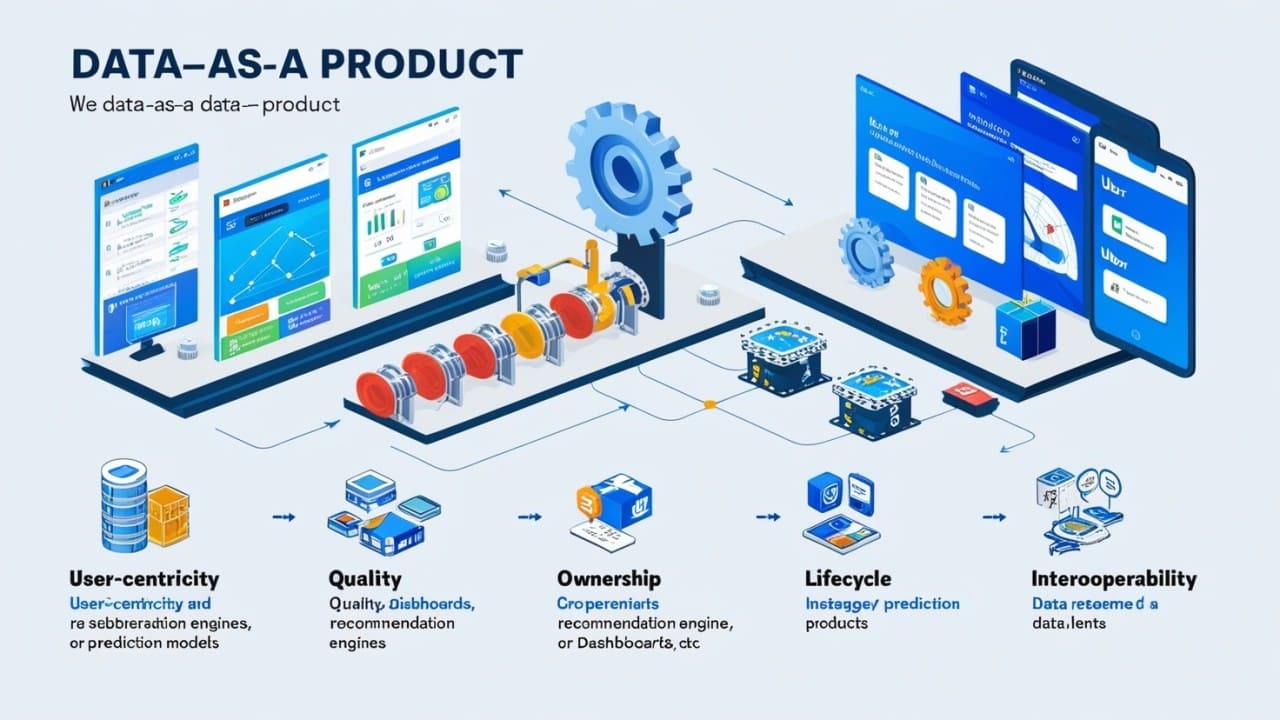
Treating data as a product means applying the disciplines of product development - ownership, quality standards, a lifecycle, users with real needs - to the datasets a company produces. It reframes data from an operational byproduct into something built and maintained for the people who consume it. For data engineers, that shift changes the job description as much as the architecture.
The core principles
- User-centric. A data product is a deliverable for someone specific - an analyst, a data scientist, an external partner - and it has to be accessible, reliable, and actually usable, not just technically correct.
- Clear ownership. Like any product, a data product has an owner - a team or person accountable for its creation, quality, and delivery - rather than being everyone's and no one's.
- Quality as a standard, not an afterthought. Clean, complete, consistent datasets that consumers trust, with monitoring and metrics so quality doesn't quietly degrade over time.
- Lifecycle management. Development, deployment, maintenance, and eventual retirement - with continuous iteration rather than build-once-and-forget.
- Interoperability. A data product earns its value by integrating cleanly with the tools, systems, and workflows already in place.
How it changes the engineer's job
The biggest shift is from builder to product owner. Pipelines and storage are still the work, but a product mindset adds engaging stakeholders to learn what data they actually need, shipping a minimum viable data product and improving it on feedback, and articulating the product's business impact to non-technical teams. Three habits follow from that:
- Scalability and reuse. Data products are built for many teams, not one-off requests - modular components that scale, with documentation and metadata good enough to enable self-service.
- Reliability by default. Proactive monitoring and alerting for uptime and accuracy, plus automated pipeline tests that catch errors before consumers do.
- Collaboration with consumers. Working directly with analysts, scientists, and business units so the product meets their requirements, with accountability shared rather than thrown over a wall.
What it looks like in practice
Netflix treats its recommendation system as a product: engineers keep it ingesting and analyzing huge volumes of viewer data in real time, with feedback loops that improve the engine as users interact with it. Shopify ships merchant analytics dashboards as a core offering - pipelines aggregate sales, traffic, and marketing data, surfaced as an intuitive product merchants use to make decisions. Uber runs its real-time ETA predictions as a standalone data product, with accuracy maintained by ingesting live traffic, GPS, and ride data, and success measured by rider satisfaction and operational efficiency rather than pipeline uptime alone.
Why it matters for engineers
The approach moves data engineers from backend support to strategic contributors. A product mindset lets them influence decisions through better data products, gain visibility for tangible user-facing results, and work in iterative cycles that reward experimentation. The cost is real - it asks engineers to learn stakeholder management, product thinking, and communication alongside the systems work - but it's the path from "the person who maintains the pipeline" to "the person who owns an asset the business depends on." As data becomes more central, that's less a trend than a durable change in how the role is defined.
Leave a Comment