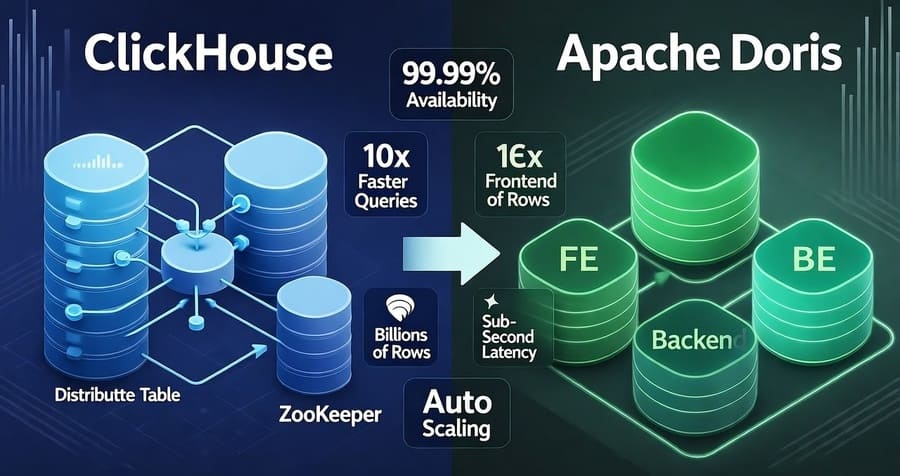
ClickHouse and Apache Doris are both open-source columnar databases built for fast analytics, and they're increasingly compared head-to-head because teams hitting ClickHouse's rough edges keep asking whether Doris solves them. The honest answer is that they optimize for different shapes of problem. ClickHouse is unmatched on raw single-table query speed; Doris trades a little of that for a friendlier experience on the multi-table, frequently-joined, frequently-updated workloads that real applications tend to have.
The single-table vs multi-table problem
ClickHouse's design rewards data that lives in one big, denormalized table. Aggregations over a single wide table are extraordinarily fast, which is why it dominates real-time analytics and observability. The friction appears when your data is naturally relational and you need joins across several large tables - historically ClickHouse made you denormalize aggressively to stay fast, pushing modeling complexity onto you. Doris was built to handle joins across normalized tables more gracefully, so you can keep a more natural schema without a steep performance cliff.
Architecture: simple vs flexible
ClickHouse favors a lean, performance-first architecture where you make deliberate choices (table engines, sort keys, materialized views) and are rewarded with speed. Doris leans toward operational flexibility - a more familiar MySQL-protocol interface, easier handling of updates, and a design that aims to reduce the tuning burden. The trade is classic: ClickHouse gives you more control and ceiling, Doris gives you fewer sharp edges out of the box.
Updates and consistency
A recurring pain point is mutable data. ClickHouse is optimized for append-heavy, largely immutable workloads; frequent updates and deletes go against its grain (though it has improved). Doris handles updates and stronger consistency more naturally, which matters for workloads where records change after they land - order status, user state, anything that isn't write-once.
Cost and operations
Both can be cheaper than a proprietary warehouse, but the costs sit in different places. ClickHouse's efficiency can mean less hardware for the same query speed, at the price of more engineering to model and tune. Doris aims to lower the operational and modeling burden, which can reduce the human cost even where raw hardware efficiency is slightly lower. Weigh both: the cluster bill and the engineering hours.
When ClickHouse still makes sense
For pure real-time analytics on large, append-only event streams - dashboards, logs, metrics, product analytics - ClickHouse remains the benchmark, and its speed advantage on single-table aggregation is hard to beat. If your workload fits that shape, the migration question may not apply to you at all. The ClickHouse course covers the MergeTree engines and materialized views that make it fast.
How to decide
- Append-only, single-table, raw-speed real-time analytics? ClickHouse.
- Normalized data with real joins, frequent updates, and a need to keep operations simple? Apache Doris.
- Want a MySQL-compatible interface and lower tuning burden? Doris leans your way.
The takeaway
Migrations between the two aren't a verdict that one tool is better - they're teams discovering their workload changed shape. The systems that started as single-table analytics often grow joins, updates, and relational structure, and at that point Doris's flexibility starts to outweigh ClickHouse's single-table speed. Match the engine to how your data actually behaves, not to which name is louder this year.



Leave a Comment