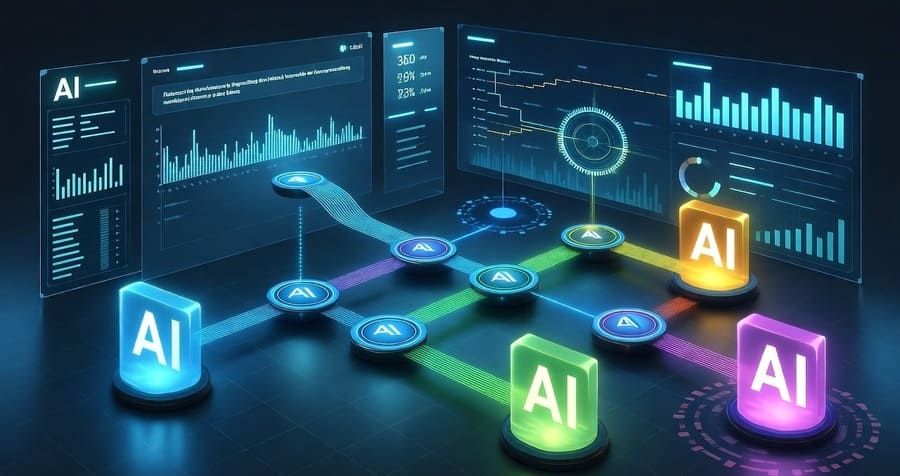
"Agentic AI" gets used loosely, so start with a working definition: an AI agent is a system that takes a goal, decides on a sequence of actions, uses tools to carry them out, observes the result, and adjusts - without a human approving each step. Traditional automation follows a script you wrote. An agent writes the script as it goes. In data engineering, that difference is starting to change which parts of the job are done by people and which are delegated.
What separates an agent from a cron job
A scheduled pipeline does exactly what it was told, the same way, every time - and fails the moment reality drifts from its assumptions. An agent is built around a loop: perceive the current state, reason about what to do, act through tools (a database, an API, a deploy command), then check whether the action worked and try again if not. The useful version isn't a chatbot bolted onto your warehouse; it's a constrained system with a clear goal, a defined set of tools, and guardrails on what it's allowed to touch.
Where agents are landing in the data lifecycle
The early wins are concentrated where work is repetitive but not quite mechanical enough for a static script:
- Ingestion and integration - adapting to a source's schema change, generating a connector for a new API, mapping fields between systems.
- Transformation and modeling - drafting SQL or dbt models from a described intent, then iterating against test results.
- Quality and observability - investigating an anomaly, tracing it upstream, and proposing or applying a fix rather than just firing an alert.
- Performance tuning - spotting a slow query or a skewed join and suggesting an index, a partition, or a rewrite.
- Orchestration - rerouting or retrying a failed run based on the cause rather than a fixed retry policy.
None of these replace a data engineer. They compress the time between a problem appearing and a credible first fix.
Multiple agents, narrow jobs
The pattern that's working in practice isn't one all-knowing agent - it's several specialized ones with narrow scopes (a "repair" agent, a "schema" agent, a "quality" agent) coordinating through a shared plan, each with limited permissions. Narrow scope is what makes them safe enough to trust: an agent that can only open a pull request is far less dangerous than one with write access to production.
The part nobody likes to talk about
Agents act, and actions in a data platform have consequences. An agent that "fixes" a pipeline by silently dropping rows has made things worse, confidently. The teams getting value treat safety as the design center, not an afterthought: agents propose changes that a human or a test gate approves; they operate in least-privilege roles; every action is logged and reversible; and high-blast-radius operations stay off-limits. The realistic posture today is agent-as-assistant - it does the legwork, a human or an automated check signs off.
An honest view of the limits
Agents still hallucinate, still take confidently wrong actions, and still struggle with context they weren't given. They're strong at well-bounded, well-instrumented tasks and weak where judgment, tribal knowledge, or ambiguous tradeoffs dominate. The "fully autonomous data platform" is a direction, not a product you can buy this quarter.
How to start without getting burned
Pick one painful, low-risk, well-instrumented task - triaging a class of pipeline failures, drafting first-pass models, investigating a specific anomaly type. Give the agent read access and the ability to propose, not apply. Measure whether it actually saves time. Expand scope only as trust is earned through results. The engineers who benefit from agentic AI aren't the ones who hand it the keys; they're the ones who delegate the legwork and keep judgment - and the production credentials - for themselves.
Leave a Comment