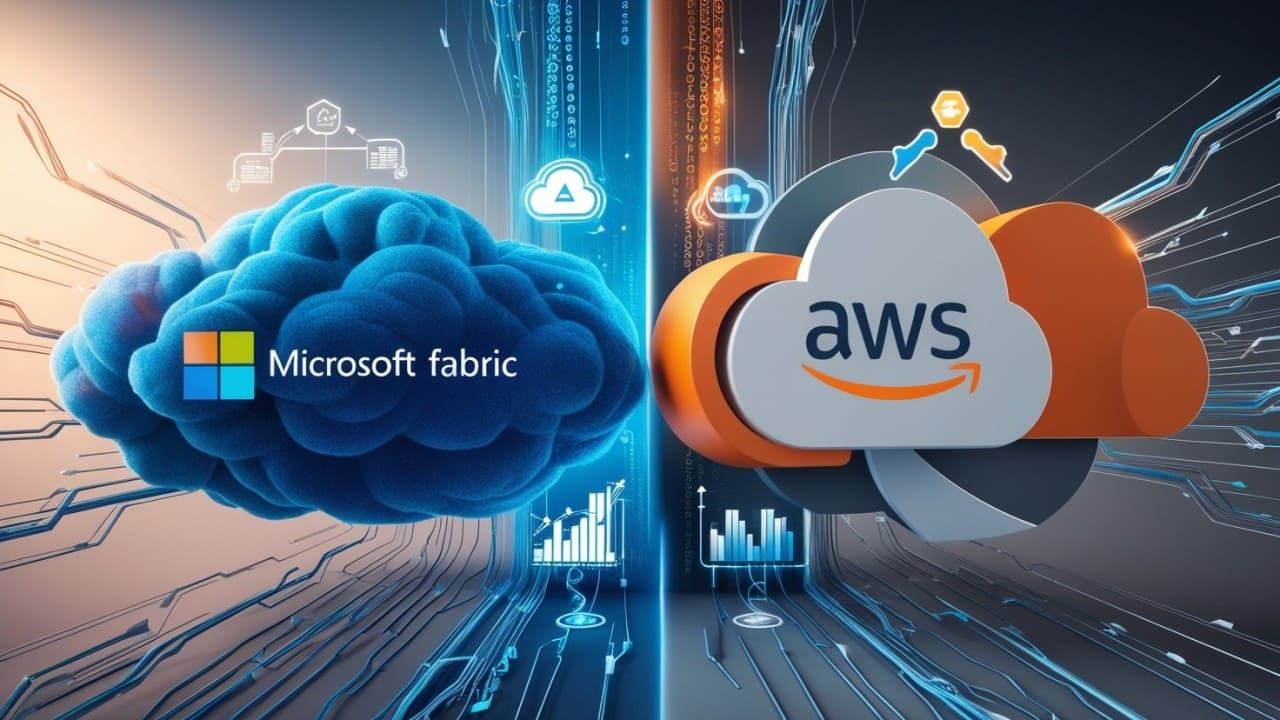
Microsoft Fabric vs AWS: a modern data platform comparison
Organizations need cloud platforms that can collect, store, process, and analyze large volumes of data. Microsoft Fabric is a unified analytics platform that builds on Microsoft's cloud-native data services and integrates deeply with Power BI and other Azure services. Amazon Web Services (AWS) offers a long-established suite of modular data services - Amazon S3, AWS Glue, Amazon Redshift, Amazon Kinesis, and others - that together form a comprehensive analytics ecosystem. Both aim to simplify data operations, but they tackle it in different ways.
Microsoft Fabric overview
Microsoft Fabric is an end-to-end analytics platform designed to unify data engineering, data integration, data warehousing, real-time analytics, and data science on a single software-as-a-service (SaaS) foundation. Key highlights:
- OneLake: a globally accessible data lake that underpins Fabric, providing a single logical storage layer for all analytics workloads.
- Integrated experiences: Data Engineering, Data Factory, Data Science, and Real-Time Analytics share a common environment and user interface.
- Deep Power BI integration: Power BI is part of Fabric, so dashboards and visualizations run natively atop Fabric's lakehouse and warehouse layers.
- SaaS model: Fabric is delivered entirely as a service, reducing infrastructure setup and management.
Core components
- Data Factory in Fabric: brings ETL/ELT pipelines into the unified environment, simplifying ingestion and integration.
- Data Engineering: Spark-based notebooks for large-scale data processing.
- Data Warehouse: a SQL-based analytical store for structured data, integrated with Fabric's lakehouse.
- Real-Time Analytics: streaming and event-based processing integrated with OneLake.
- Data Science: notebooks and ML frameworks within the Fabric ecosystem.
Advantages
- All-in-one environment: BI, data engineering, and data science collaborate in one platform with shared governance.
- Tight Power BI integration: direct connectivity to Power BI for real-time or near-real-time dashboards.
- SaaS simplicity: often simpler to start, with less DevOps overhead.
Considerations
- Azure-centric: Fabric fits best in Azure-centric or Microsoft-heavy environments.
- Licensing and cost: Fabric is subscription-based; evaluate how licensing scales with usage, especially for large data volumes.
- Ecosystem maturity: Fabric is newer than AWS's data services, so community support, third-party integrations, and patterns are still developing.
AWS overview
AWS offers a broad suite of data and analytics services. Instead of a single "fabric," it provides modular services that can be assembled into end-to-end solutions. Key data services include:
- Amazon S3 for object storage (the foundation of many AWS data architectures).
- AWS Glue for data integration (ETL/ELT jobs, data cataloging).
- Amazon Redshift for data warehousing.
- Amazon Kinesis for real-time data streams and analytics.
- Amazon Athena for serverless interactive querying over S3.
- Amazon EMR for Hadoop/Spark-based big data processing.
- Amazon SageMaker for data science and ML model deployment.
- Amazon QuickSight for BI and dashboards.
Advantages
- Broad ecosystem: with over 200 services, AWS handles use cases from traditional data warehousing to serverless streaming analytics.
- Scalability and flexibility: start small and scale individual services as demand grows.
- Maturity and community: a large developer community and extensive partner and third-party ecosystem.
Considerations
- Integration complexity: building an end-to-end pipeline often requires stitching together multiple services (S3, Redshift, Glue, etc.).
- Cost management: without careful planning, running multiple services can lead to cost sprawl; usage monitoring is essential.
- Overlapping services: AWS has many analytics offerings, and picking the right tool for each step can be challenging for newcomers.
Key comparison points
Data lake and storage. Fabric centers on OneLake - a single logical data lake for all data, managed in one environment with no separate buckets to track. On AWS, S3 is the storage foundation: highly scalable and cost-effective, but more manually managed.
ETL/ELT and data integration. Data Factory built into Fabric orchestrates pipelines with a point-and-click UI and unified security layer. On AWS, Glue or Data Pipeline provide integration, each requiring separate setup; the learning curve is steeper but customization is robust.
Data warehousing. Fabric's built-in Warehouse experience sits atop the same data lake and evolves Azure Synapse concepts within the Fabric environment. On AWS, Amazon Redshift is a mature warehouse with Redshift Spectrum to query S3, and Athena offers serverless SQL over S3.
Real-time analytics. Fabric's Real-Time Analytics handles streaming workloads in a single environment. On AWS, Amazon Kinesis (Data Streams, Data Firehose) or managed Kafka (Amazon MSK) handle streaming, with EMR or Glue Streaming jobs for processing.
Data science and ML. Fabric offers integrated notebooks and ML tooling, often supplemented by Azure ML for advanced orchestration and MLOps. On AWS, Amazon SageMaker is the flagship ML platform for data prep, training, and deployment, alongside options like EMR Spark ML.
Business intelligence and visualization. Fabric integrates deeply with Power BI. On AWS, Amazon QuickSight is the native BI tool, though many teams connect third-party tools (Tableau, Power BI, Looker) to AWS data stores.
Ease of setup vs flexibility. Fabric is SaaS-first with minimal startup overhead, but customization can be more limited. AWS is highly flexible but requires more orchestration and DevOps knowledge to configure and manage separate services.
Use case scenarios
- Small/medium companies with a Microsoft footprint - Fabric's SaaS model and native Power BI integration make it a fast, cohesive choice for teams already in the Microsoft ecosystem.
- Large enterprises requiring extreme customization - AWS's modular services let teams fine-tune each layer of the pipeline for specialized workloads.
- Rapid SaaS onboarding - Fabric minimizes infrastructure setup, getting analytics and dashboards running quickly with low DevOps overhead.
- Hybrid or multi-cloud - Organizations may blend both: AWS for large-scale data workloads, Fabric for BI through Power BI.
Cost and licensing
- Microsoft Fabric: subscription-based capacity model. Costs scale with the provisioned capacity unit rather than per individual service, which can simplify budgeting but requires sizing capacity to peak demand.
- AWS: pay-per-use per service (storage, compute, query volume, data transfer). Flexible and granular, but running many services together can lead to cost sprawl without active monitoring.
Conclusion
Microsoft Fabric and AWS both offer robust analytics capabilities with distinct approaches:
- Microsoft Fabric: focused on unification, simplicity, and a SaaS model that integrates deeply with Power BI. Well-suited to teams that value quick, cohesive experiences and are embedded in the Microsoft ecosystem.
- AWS: a mature, modular ecosystem offering broad flexibility with more moving parts. Suited to organizations that need to fine-tune specific services or have highly varied use cases.
Choosing the right platform depends on your existing tech stack, budget, required feature set, and team skills. Some enterprises blend both - using AWS for large-scale data workloads while integrating Microsoft Fabric for BI through Power BI. Understanding each platform's strengths and trade-offs helps set data initiatives up for success.
Leave a Comment