How AI Copilots Are Replacing Manual Data Pipeline Development
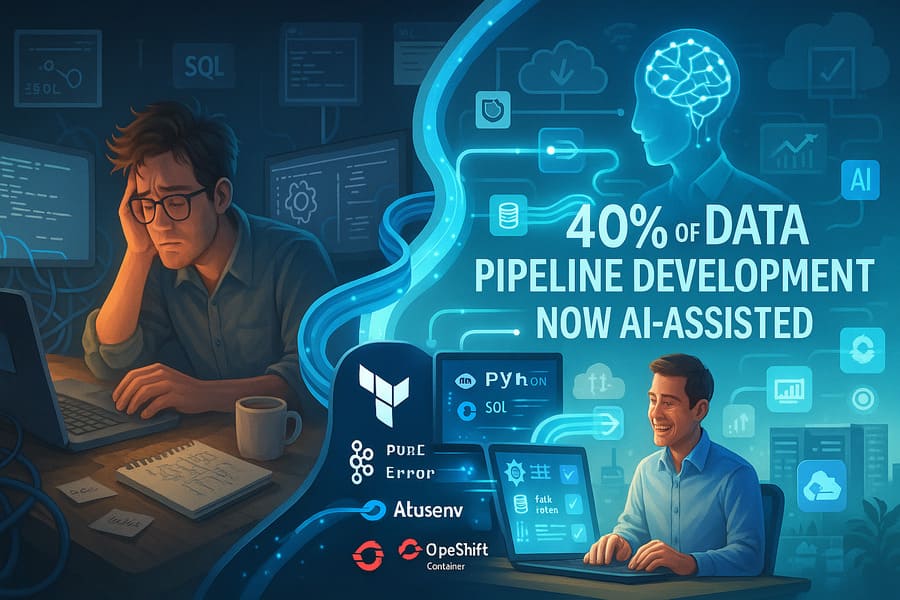
By one 2025 estimate, 40% of new data pipeline development now involves some form of AI assistance. Tasks that once consumed 60-70% of an engineer's time - writing SQL from scratch, mapping API endpoints, debugging transformation logic line by line - are increasingly handled by AI copilots that generate code and automate routine decisions.
This article covers where AI-assisted pipeline development helps, what the measurable results look like, and the trade-offs teams should weigh before adopting it.
From Manual to AI-Assisted Pipeline Development
Traditional Pipeline Development: The Pain Points
Pipeline development has historically been labor-intensive. Connecting to a new SaaS platform's API, transforming the data, and loading it into a warehouse traditionally involved:
- Manual API exploration: reading documentation, testing endpoints, and understanding data schemas
- Custom connector development: writing boilerplate for authentication, pagination, and error handling
- Schema mapping and transformation logic: manually defining how source data maps to target schemas
- Testing and validation: creating test cases and validation rules from scratch
For a complex SaaS source, a single new pipeline could take a team 3-4 weeks to develop. With AI assistance, comparable pipelines can be operational in 3-4 days.
The AI Copilot Approach
AI copilots in data engineering act as assistants that read context, generate code, and automate routine decisions. Unlike simple code generators, these tools draw on:
- Large Language Models (LLMs) trained on large codebases and documentation
- Domain-specific knowledge about data engineering patterns and best practices
- Real-time context awareness of existing infrastructure and schemas
- Iterative learning from a team's coding patterns and preferences
Key Areas Where AI Copilots Help
1. Automated SQL Query Generation and Optimization
One of the most immediate impacts is in SQL development. Modern tools can:
Generate complex queries from natural language:
-- Generated from: "Show me monthly revenue trends by product category,
-- including year-over-year growth rates"

WITH monthly_revenue AS (
    SELECT
        DATE_TRUNC('month', order_date) as month,
        product_category,
        SUM(revenue) as monthly_revenue
    FROM sales_data
    WHERE order_date >= '2023-01-01'
    GROUP BY 1, 2
),
yoy_comparison AS (
    SELECT
        month,
        product_category,
        monthly_revenue,
        LAG(monthly_revenue, 12) OVER (
            PARTITION BY product_category
            ORDER BY month
        ) as prev_year_revenue
    FROM monthly_revenue
)
SELECT
    month,
    product_category,
    monthly_revenue,
    ROUND(
        ((monthly_revenue - prev_year_revenue) / prev_year_revenue) * 100, 2
    ) as yoy_growth_rate
FROM yoy_comparison
WHERE prev_year_revenue IS NOT NULL
ORDER BY month DESC, product_category;
Optimize existing queries: AI copilots analyze query execution plans and suggest performance improvements, often reducing query execution time by 30-50%.
2. REST API Integration Automation
API integration, once a time-consuming manual process, benefits from AI assistance:
Intelligent connector generation:
# AI-generated connector for Salesforce API
import requests
from typing import Dict, List, Optional
import logging

class SalesforceConnector:
    def __init__(self, instance_url: str, access_token: str):
        self.instance_url = instance_url
        self.access_token = access_token
        self.session = requests.Session()
        self.session.headers.update({
            'Authorization': f'Bearer {access_token}',
            'Content-Type': 'application/json'
        })

    def get_records(self, sobject: str, fields: List[str],
                   batch_size: int = 2000) -> List[Dict]:
        """
        Fetch records with automatic pagination handling
        """
        records = []
        query = f"SELECT {','.join(fields)} FROM {sobject}"

        try:
            response = self._execute_soql(query, batch_size)
            records.extend(response.get('records', []))

            # Handle pagination automatically
            while not response.get('done', True):
                next_url = response.get('nextRecordsUrl')
                response = self._get_next_batch(next_url)
                records.extend(response.get('records', []))

        except Exception as e:
            logging.error(f"Error fetching {sobject} records: {str(e)}")
            raise

        return records
3. Schema Evolution and Data Transformation
AI copilots can read schema changes and generate transformation logic:
Automated dbt model generation:
-- Generated transformation model for customer lifecycle analysis
{{ config(materialized='table') }}

WITH customer_events AS (
    SELECT
        customer_id,
        event_type,
        event_timestamp,
        ROW_NUMBER() OVER (
            PARTITION BY customer_id
            ORDER BY event_timestamp
        ) as event_sequence
    FROM {{ ref('raw_customer_events') }}
),

first_purchase AS (
    SELECT
        customer_id,
        event_timestamp as first_purchase_date
    FROM customer_events
    WHERE event_type = 'purchase' AND event_sequence = 1
),

customer_metrics AS (
    SELECT
        c.customer_id,
        c.created_at as registration_date,
        fp.first_purchase_date,
        DATEDIFF('day', c.created_at, fp.first_purchase_date) as days_to_first_purchase,
        COUNT(ce.event_type) as total_events
    FROM {{ ref('customers') }} c
    LEFT JOIN first_purchase fp ON c.customer_id = fp.customer_id
    LEFT JOIN customer_events ce ON c.customer_id = ce.customer_id
    GROUP BY 1, 2, 3, 4
)

SELECT * FROM customer_metrics
Real-World Impact: Case Studies and Metrics
Case Study 1: E-commerce Data Platform Modernization
A mid-sized e-commerce company adopted AI-assisted pipeline development with the following results:
Before AI implementation:
- Pipeline development time: 2-3 weeks per new source
- Error rate: 15-20% of initial deployments required fixes
- Team productivity: 3-4 new pipelines per quarter
After AI implementation:
- Pipeline development time: 3-5 days per new source
- Error rate: <5% of deployments required fixes
- Team productivity: 12-15 new pipelines per quarter
Key success factors:
- Gradual adoption starting with SQL generation
- Team training on prompt engineering for data tasks
- Integration with existing CI/CD workflows
Case Study 2: Financial Services Data Mesh Implementation
A large financial institution used AI copilots to accelerate a data mesh initiative:
Challenges addressed:
- Standardization: consistent data product development across 20+ domains
- Compliance: maintaining regulatory requirements while increasing development velocity
- Skill gaps: enabling domain experts to create data products without extensive technical knowledge
Results:
- 50% reduction in time-to-market for new data products
- 80% improvement in code consistency across domains
- 90% of domain experts could independently create basic data transformations
The Technology Stack Behind AI-Assisted Development
Leading AI Copilot Platforms
GitHub Copilot for Data Engineering:
- Strong for Python, SQL, and YAML generation
- Tight integration with popular IDEs
- Continuously improving context awareness
Databricks Assistant:
- Native integration with the Databricks environment
- Specialized for Spark and Delta Lake operations
- Notebook-based development support
Snowflake Copilot:
- Optimized for Snowflake-specific SQL dialects
- Warehouse performance optimization suggestions
- Integration with Snowpark for advanced analytics
Custom LLM solutions:
# Example of custom AI assistant integration
from openai import OpenAI
import ast

class DataPipelineAssistant:
    def __init__(self, api_key: str):
        self.client = OpenAI(api_key=api_key)

    def generate_transformation(self, source_schema: dict,
                              target_schema: dict,
                              business_rules: str) -> str:
        prompt = f"""
        Generate a dbt transformation model that:
        - Transforms data from source schema: {source_schema}
        - To target schema: {target_schema}
        - Following business rules: {business_rules}

        Include appropriate data quality checks and documentation.
        """

        response = self.client.chat.completions.create(
            model="gpt-4",
            messages=[{"role": "user", "content": prompt}],
            temperature=0.2
        )

        return response.choices[0].message.content
Integration Patterns and Best Practices
Workflow integration:
- IDE-based assistance for real-time code generation
- CI/CD pipeline integration for automated testing and validation
- Documentation generation for maintaining pipeline lineage
- Code review automation using AI-powered analysis
Quality assurance framework:
# AI-assisted pipeline validation
validation_rules:
  code_quality:
    - ai_generated_code_review: true
    - automated_testing: true
    - performance_analysis: true

  data_quality:
    - schema_validation: true
    - data_profiling: true
    - anomaly_detection: true

  security:
    - pii_detection: true
    - access_control_validation: true
    - encryption_compliance: true
Challenges and Limitations
Technical Limitations
Context window constraints: current LLMs have limited context windows, making it hard to understand large, complex codebases in their entirety.
Domain-specific knowledge gaps: AI copilots handle general programming tasks well, but can struggle with highly specialized industry requirements or proprietary systems.
Code quality variability: generated code quality varies with prompt quality and context clarity.
Organizational Challenges
Skill evolution: teams need new skills in prompt engineering and AI tool management alongside traditional data engineering expertise.
Quality control: organizations need review processes to ensure AI-generated code meets production standards.
Dependency management: over-reliance on AI tools creates exposure if services become unavailable or change significantly.
Strategic Implementation Roadmap
Phase 1: Foundation Building (Months 1-2)
Tool evaluation and selection:
- Assess current development workflows and pain points
- Pilot 2-3 AI copilot solutions with small projects
- Establish baseline productivity metrics
Team preparation:
- Conduct prompt engineering training for data engineers
- Develop code review guidelines for AI-generated code
- Create testing frameworks for automated validation
Phase 2: Gradual Integration (Months 3-6)
Selective automation:
- Start with SQL query generation and API integration
- Implement AI assistance for documentation generation
- Expand to transformation logic development
Process optimization:
- Integrate AI tools with existing CI/CD pipelines
- Establish quality gates and validation checkpoints
- Develop internal best practices and guidelines
Phase 3: Advanced Implementation (Months 6-12)
Broader coverage:
- Extend AI assistance to complex pipeline architectures
- Implement automated testing and monitoring generation
- Develop custom AI models for organization-specific patterns
Continuous improvement:
- Collect and analyze productivity metrics
- Refine prompt templates and code generation patterns
- Establish feedback loops for continuous optimization
Measuring Success: Key Metrics and KPIs
Productivity Metrics
Development velocity:
- Time from requirement to production deployment
- Number of pipelines delivered per sprint/quarter
- Code lines generated vs. manually written
Quality indicators:
- Bug rate in AI-generated vs. manually written code
- Code review feedback frequency and severity
- Production incident rates
Resource utilization:
- Developer time allocation across different activities
- Infrastructure cost optimization through better code
- Team capacity for strategic vs. tactical work
Business Impact Metrics
Time-to-value:
- Reduced time to deliver new data products
- Faster response to changing business requirements
- Accelerated insights generation
Cost efficiency:
- Development cost per pipeline
- Maintenance overhead reduction
- Infrastructure optimization savings
What's Next for AI-Assisted Data Engineering
Emerging Trends
Autonomous pipeline management: future AI systems will not just generate code but monitor, optimize, and maintain pipelines with less human intervention.
Natural language data exploration: analysts will query warehouses in natural language, with AI translating intent into optimized queries and transformations.
Predictive pipeline optimization: AI will anticipate data volume changes, schema evolution, and performance bottlenecks, adjusting pipeline configurations ahead of time.
Technology Evolution
Specialized data engineering LLMs: models trained specifically on data engineering patterns, documentation, and best practices will give more accurate, contextually appropriate assistance.
Real-time collaboration: copilots will better account for team conventions, coding standards, and organizational patterns.
Integrated development environments: future IDEs will blend AI assistance with traditional development tools.
Summary
The 40% adoption rate of AI-assisted development in 2025 reflects a shift in how data teams operate, not just a passing trend.
Critical success factors:
- Start incrementally: begin with low-risk, high-impact areas like SQL generation and API integration
- Invest in team skills: prompt engineering and AI tool proficiency are becoming core data engineering skills
- Maintain quality standards: implement review and testing processes for AI-generated code
- Measure and optimize: track productivity gains while monitoring code quality and maintainability
AI copilots handle routine, repetitive tasks, which frees engineers to focus on architecture, complex problem-solving, and the work that drives business value. They amplify human expertise rather than replace it.
Further Reading and Resources:
Leave a Comment