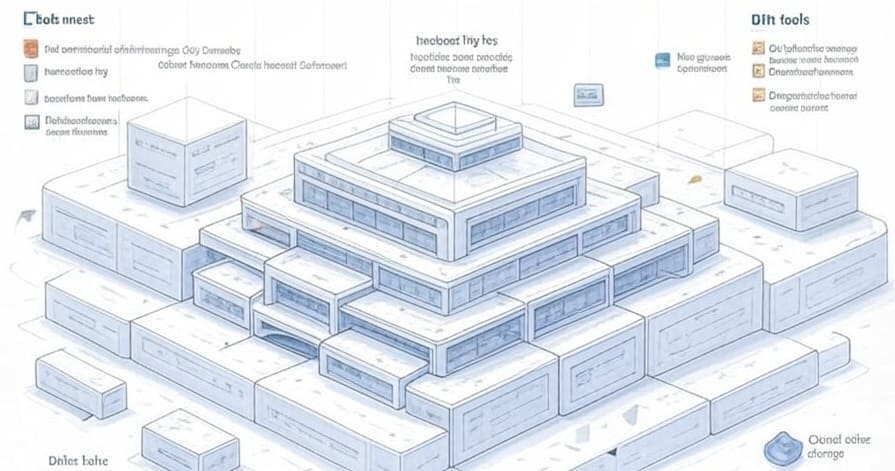
Data lakes on S3, ADLS, or GCS give you unmatched scalability and cost, but they historically couldn't serve as a single source of truth: no ACID transactions (so concurrent writes corrupt data), no schema enforcement, little performance optimization, awkward metadata management, and no time travel. Those gaps forced teams to build complex ETL moving data from lakes into warehouses, creating silos and latency. Delta Lake, the open-source storage layer created by Databricks, closes them - sitting on top of an existing lake and turning it into a lakehouse with the reliability of a warehouse and the economics of object storage.
Key features
ACID transactions. A transaction log records every change, so readers always see a consistent view even while writers modify the table, and a write that fails midway leaves the table in its previous valid state:
from delta.tables import DeltaTable
deltaTable = DeltaTable.forPath(spark, "/data/sales")
deltaTable.update(condition="date = '2023-03-15'", set={"status": "'processed'"})  # atomic
Schema enforcement and evolution. Enforcement rejects malformed writes that would corrupt the dataset; evolution lets the table adapt when the data model changes, via mergeSchema:
df_with_new_column.write.format("delta").mode("append") \
  .option("mergeSchema", "true").save("/data/sales")
Time travel. Query any prior version by timestamp or version number - invaluable for audits, rollbacks, and reproducible experiments:
spark.read.format("delta").option("timestampAsOf", "2023-03-12").load("/data/sales")
spark.read.format("delta").option("versionAsOf", 5).load("/data/sales")
Unified batch and streaming. The same table is both a streaming sink and a batch source, eliminating the separate real-time and batch pipelines older architectures required:
streamingDF.writeStream.format("delta") \
  .option("checkpointLocation", "/checkpoints/sales").start("/data/sales")
batchDF = spark.read.format("delta").load("/data/sales")   # same table, batch read
Optimization engine. Data skipping uses per-file statistics to skip files that can't match a filter; Z-ordering co-locates related data; and compaction combines small files:
OPTIMIZE sales ZORDER BY (customer_id, date);   -- multi-dimensional clustering
OPTIMIZE sales;                                  -- compact small files
Real-world patterns
Delta Lake anchors several common workloads. For data quality, validation rules run at ingestion - checking for negative prices, future order dates, or null product IDs - routing failures to a quarantine table so only clean data reaches the lake. For change data capture, the MERGE operation upserts a CDC feed cleanly:
target = DeltaTable.forPath(spark, "/data/customers")
target.alias("target").merge(source.alias("source"),
        "target.customer_id = source.customer_id") \
  .whenMatchedUpdateAll().whenNotMatchedInsertAll().execute()
For ML feature stores, features are written to versioned paths and exposed through a view, giving point-in-time reproducibility for training:
customer_features.write.format("delta").mode("overwrite") \
  .save(f"/data/features/customer_metrics/v={feature_set_version}")
spark.sql(f"CREATE OR REPLACE VIEW customer_features AS "
          f"SELECT * FROM delta.`/data/features/customer_metrics/v={feature_set_version}`")
Multi-hop architecture
The dominant Delta Lake pattern processes data through progressive refinement - Bronze (raw ingestion) → Silver (validated, conformed) → Gold (business-ready aggregates) - giving clear boundaries between data-quality levels:
# Bronze: raw, append with mergeSchema
raw_df.write.format("delta").mode("append").option("mergeSchema", "true").save("/data/bronze/sales")
# Silver: cleansed, validated, partitioned
validate_and_transform(spark.read.format("delta").load("/data/bronze/sales")) \
  .write.format("delta").mode("overwrite").partitionBy("date").save("/data/silver/sales")
# Gold: business aggregates via SQL CREATE TABLE ... USING delta AS SELECT ...
Optimizing for performance
- Right-size files. Aim for 100MB - 1GB; run
OPTIMIZEto compact small files (optionally scoped with aWHEREon recent partitions). - Partition by common filters.
partitionBy("year", "month")for the columns queries actually filter on - and don't over-partition. - Z-order the frequently-queried non-partition columns (
OPTIMIZE sales ZORDER BY (customer_id, product_id)). - Manage history. Set retention (
delta.logRetentionDuration) to control storage cost.
For data modeling, Delta supports both dimensional (fact + dimension tables, partitioned by a date key) and Data Vault (hub and satellite tables) styles - the choice depends on your history-tracking, query, and integration needs.
In the modern data stack
Delta Lake integrates across the ecosystem. dbt treats it as a materialization with merge incremental strategy:
models:
  - name: sales_daily
    config:
      materialized: incremental
      file_format: delta
      incremental_strategy: merge
      unique_key: [date_key, product_id]
Airflow orchestrates Delta ETL through SparkSubmit operators, and Terraform provisions the underlying versioned object storage with lifecycle rules. It runs natively on Databricks (best-optimized), on self-managed Spark 2.4.2+, Amazon EMR, Azure Synapse, and Google Dataproc. As an Apache-2.0 project under the Linux Foundation, it carries vendor-neutral governance, Delta Sharing for cross-organization data sharing, and connectors for BI tools and multiple languages.
Delta Lake vs. other table formats
Against Apache Hudi: both offer ACID transactions and time travel, but Delta has simpler APIs and tighter Spark integration with generally better query performance, while Hudi offers more granular record-level operations. Against Apache Iceberg: both focus on table management and ACID guarantees, but Delta has stronger streaming integration and more optimization features, while Iceberg has stronger partition evolution. Most organizations choose on their specific use cases and existing infrastructure rather than on a feature checklist.
By bringing ACID transactions, schema enforcement, optimization, and time travel to plain object storage, Delta Lake turns a simple data lake into a lakehouse - addressing the reliability gaps that long kept lakes out of critical enterprise workloads, without giving up their flexibility or cost.
Leave a Comment