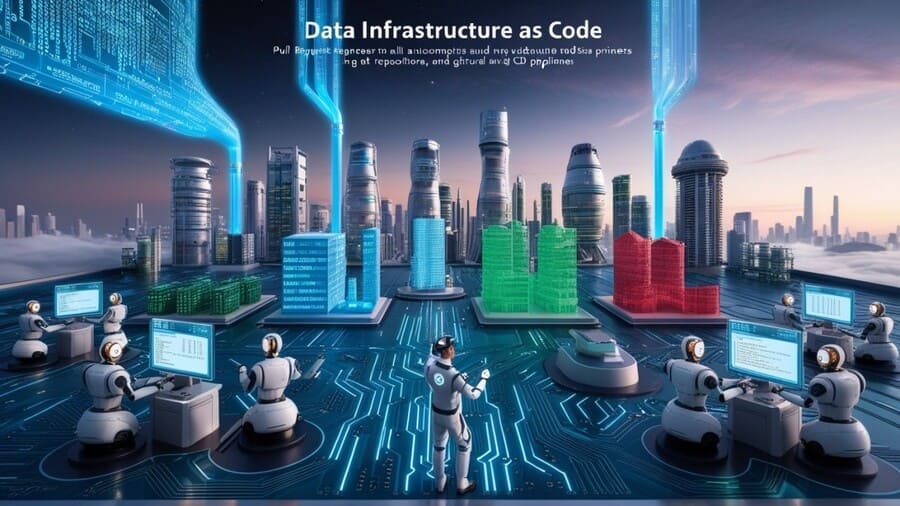
Most engineers know Infrastructure as Code for provisioning cloud resources. Data Infrastructure as Code extends the same discipline across the whole data platform - schemas, compute, access controls, data-quality rules, and observability all defined as version-controlled, executable artifacts rather than managed ad hoc. It's more than running Terraform to spin up a warehouse: the point is to treat every part of the platform with the same rigor applied to application code, and get consistency, governance, and faster delivery as a result.
What it extends beyond basic provisioning
Schema evolution and management. Database objects defined declaratively (SQL DDL, YAML, JSON) in version control, applied incrementally through migration frameworks like Flyway, Liquibase, or dbt, with state-comparison engines detecting drift between desired and actual state and CI/CD pipelines validating changes before deployment - schemas reviewed, tested, and released like code.
Compute resource automation. Beyond provisioning, the ongoing management: workload-aware scaling driven by query patterns, scheduled cost-optimization analysis, dev/test/prod parity, and resource policies expressed as executable code rather than runbooks.
Access control and security. Security baked in through automation rather than periodic review - identity lifecycle tied to HR systems, just-in-time elevated access through approval workflows, automated security-policy enforcement, and continuous compliance monitoring that flags drift from baselines.
Implementation patterns
GitOps for the whole platform. Everything - infrastructure, schemas, pipelines, policies - in version-controlled repositories; every change is a pull request with automated validation; approved changes deploy through multi-stage pipelines; drift detection alerts on or remediates unauthorized changes. Teams that adopt this report large drops in deployment-related incidents and markedly higher release frequency, with audit trails as a free byproduct.
Schema evolution framework. A central schema registry with versioning, compatibility rules enforced as code, automated impact analysis for downstream effects, and phased deployment orchestration across systems - which removes most schema-driven pipeline failures and eliminates weekend "migration events" through incremental automated deployments.
Dynamic access control. Roles, policies, and permissions as YAML, purpose-based request/approval/provisioning workflows, continuous comparison of actual versus defined permissions, and synchronization with corporate identity providers - cutting access provisioning from days to minutes and keeping regulated environments continuously compliant.
Observability automation. Metrics, alerts, and dashboards declared as code, automatic instrumentation that discovers new components, predefined responses for common issues, and closed-loop tuning from operational patterns - which shortens mean time to detection and closes the monitoring gaps new services usually open.
The enabling tools
- Provisioning: beyond Terraform and CloudFormation - Pulumi (infrastructure in general-purpose languages), Crossplane (Kubernetes-native), and the cloud CDKs (TypeScript, Python).
- Schema management: Sqitch, Flyway, Liquibase, dbt, and SchemaHero (Kubernetes-native).
- DataOps platforms: Datafold (data diff and catalog), Prophecy (low-code with Git), Dataform (YAML-based SQL pipelines).
- Policy and governance: Open Policy Agent (policy enforcement), Immuta and Privacera (access governance), Collibra and Alation (API-driven cataloging).
What it buys you
The payoff shows up in four places: faster delivery (new capabilities in days, self-service within guardrails, easy environment create-and-teardown for experiments); reliability (environment consistency that kills "works in dev, not in prod," fewer manual errors, reusable standard patterns); governance (complete audit trails, automated policy enforcement, simpler compliance demonstrations); and resource efficiency (right-sized infrastructure, automated scale-down of idle resources, less time on maintenance).
A practical rollout
Start with a foundation: move existing infrastructure definitions into Git, add CI/CD for infrastructure changes, define reusable component templates, and train the team. Then automate schema and pipelines - schema version control, automated testing of schema changes, data-quality rules as code, and standardized pipeline templates. Next bring access and security under code - model roles and permissions, automate the access-request workflow, add continuous compliance checks, and integrate with identity providers. Advanced automation is ongoing: predictive scaling, self-healing responses, comprehensive observability, and feedback loops that feed operational data back into the platform.
The hard parts
The benefits are real but so are the obstacles. The biggest is organizational, not technical - moving off manual processes is a cultural shift that demands new skills, and you have to document the manual processes before you can automate them. Technical complexity follows: tool integration is fiddly, some legacy systems resist automation, and testing infrastructure changes needs its own approaches. And there's a balance to hold - too much automation removes necessary flexibility, so teams need escape hatches for exceptional situations and governance that still accommodates innovation. As data volumes grow, manual processes stop scaling, and the practical question shifts from whether to automate the platform lifecycle to how comprehensively.
Leave a Comment