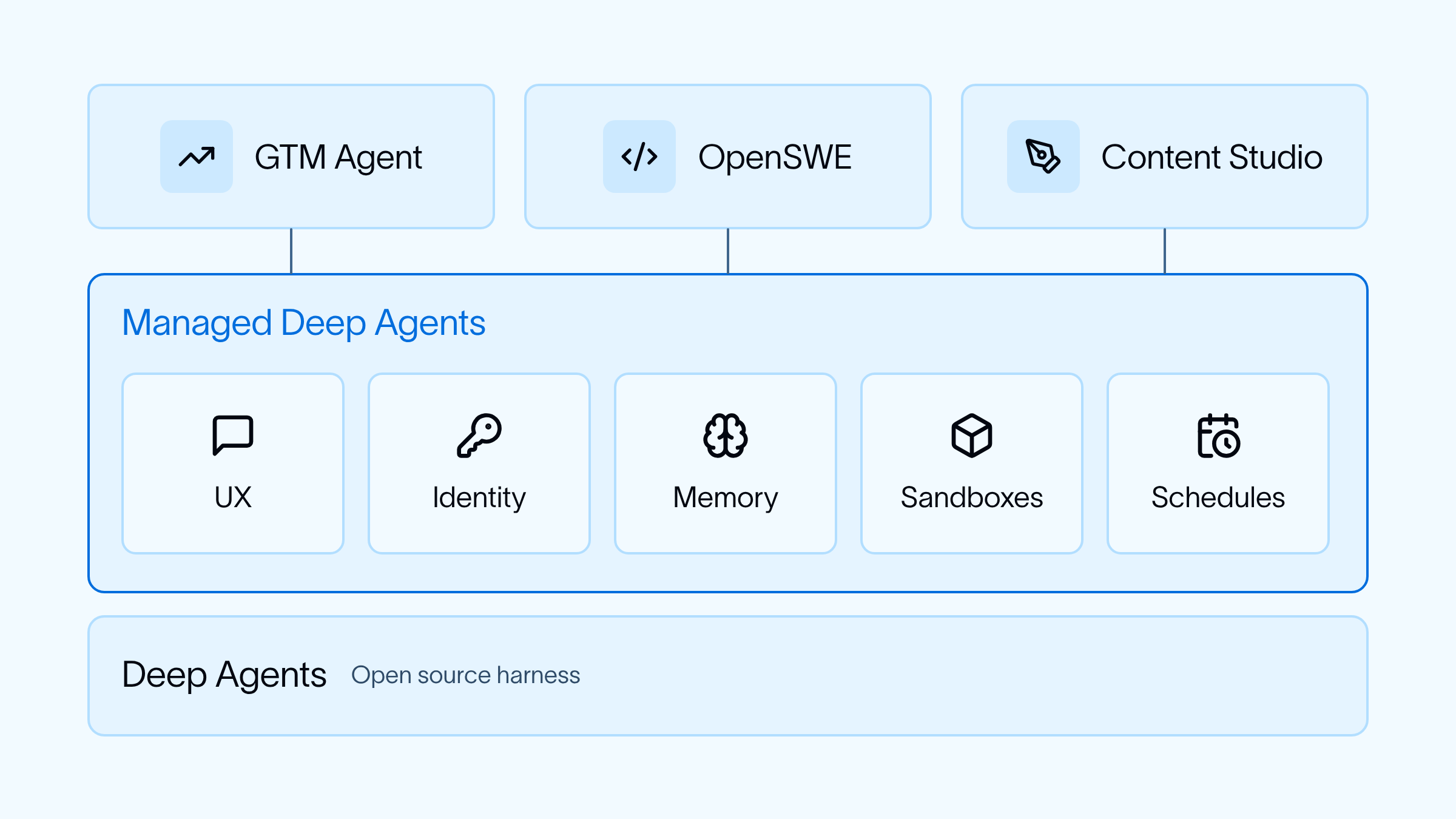
The five components of building a "company harness"
Learn how LangChain built internal agents across marketing, sales, and engineering, and how they have completely changed how those teams work.
Learn how LangChain built internal agents across marketing, sales, and engineering, and how they have completely changed how those teams work.
Agents waste time and context on clumsy searches, oversized results and stale data. Learn the retrieval techniques LangChain's Deep Agents harness uses to get the right context in.
LangSmith LLM Gateway is in public beta: spend caps, rate limits, model fallbacks and PII redaction for production agents, without provider lock-in.
How Numan built Nu, an AI health coach, on LangGraph and LangSmith with per-category evals, simulated conversations, and safety gates on a regulatory line.

What we shipped at Interrupt NYC and London: LangSmith AI Search, Engine v2, Trajectories, Custom Apps, Fine-Tuning, and Managed Deep Agents v0.9.

Where to start with agent evals, offline vs online evals, evaluator types, LLM judges, benchmarks with Harbor, multi-turn evals, and keeping costs down.
Long-running agents degrade as context piles up. Learn how offloading, summarization, skills, subagents, and memory keep your agent's context window focused.
Open models like GLM-5 and MiniMax M2.7 now match closed frontier models on core agent tasks — file operations, tool use, and instruction following — at a fraction of the cost and latency. Here's...
Today we’re launching Deep Agents deploy in beta. Deep Agents deploy is the fastest way to deploy a model agnostic, open source agent harness in a production ready way.
Stale code samples are a docs problem nobody prioritizes. Here's how we used the Deep Agents CLI to automate migrating inline code into testable, CI-ready examples