One of the more instructive AI-product case studies is Boss.cc, which went from a shelved crypto dashboard to a working AI idea-validation engine in under two weeks. The interesting part for data engineers isn't the speed - it's what the build reveals about where the hard problems in agentic products actually live. They are not where beginners expect.
The pivot
The starting point was a common one: a half-built product with no traction and a founder asking whether to keep going. That question - "is this idea worth pursuing?" - turned out to be more valuable than the original product. The pivot was to build a tool that answers it: feed in a startup idea and get back a structured, multi-perspective evaluation instead of a friend's polite encouragement. The failed project became the first test case for the new one.
The architecture
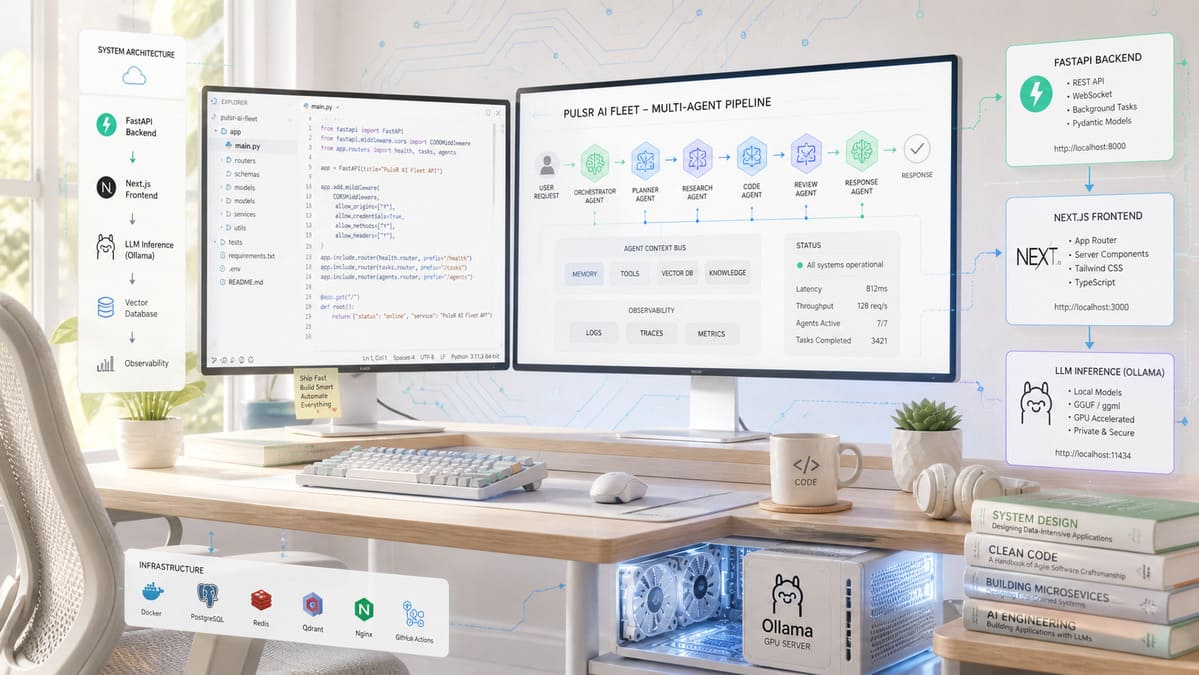
The core is deceptively simple: several specialized "evaluator" agents, each given a focused brief - market opportunity, competition, technical feasibility, monetization, and an overall synthesis. Each agent receives the idea plus, where useful, live search context, and returns a score with reasoning. A final step aggregates the individual judgments into one verdict with a recommendation band. The design choice that matters is the separation: one prompt asked to "evaluate this idea" produces mush; several agents each owning one lens produce a panel review where each catches what the others miss.
The evaluation pipeline
Reliability came from treating the agents like any other untrusted component: structured outputs (each agent must return a score and reasons in a fixed shape), validation of those outputs before aggregation, and graceful handling when an agent returns something malformed. This is ordinary data-engineering discipline applied to LLM calls - schemas, validation, error handling - and it's what separated a demo that worked once from a product that worked repeatedly. The model is the easy part; the pipeline around it is the engineering.
The hard part: prompt engineering
The single biggest time sink wasn't architecture or infrastructure - it was getting the prompts to produce consistent, useful, honestly-critical output. Models default to flattery; coaxing a genuinely skeptical evaluation that still scores fairly took iteration. Each agent's brief had to be specific enough to stay on its lens, constrained enough to return parseable output, and calibrated so scores meant the same thing across ideas. The lesson: in an agentic product, prompt design is product design, and it deserves the same iteration and testing as code.
What a build like this would do differently
The honest retrospective points at a few things: invest in the evaluation harness earlier (you can't improve prompts you can't measure), define the output schemas up front rather than discovering them mid-build, and resist adding agents for their own sake - each one adds latency, cost, and a new failure mode. The temptation in agentic systems is always "add another agent"; the discipline is keeping the set minimal and each member earning its place.
The lesson for data engineers
Building an AI-agent product turns out to be mostly the work data engineers already know: schemas, validation, pipelines, error handling, and observability, with an LLM call where a deterministic function used to be. The novel parts - prompt engineering and managing non-deterministic components - are real, but they sit on top of fundamentals, not in place of them. The engineers best positioned to build these products aren't the ones chasing the newest model; they're the ones who can wrap a non-deterministic component in enough engineering discipline to make it dependable. A two-week build is possible precisely because most of the toolkit is the one you already have.

Leave a Comment