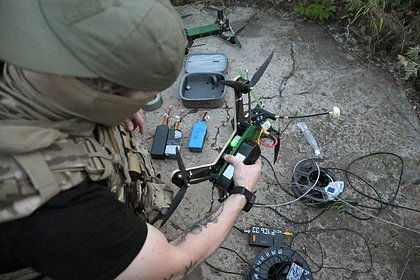
Russia is actively developing and fielding AI-powered autonomous drone systems, but their use is almost entirely confined to the military. That’s according to Maxim Kondratiev, founder of a drone training center and academic at the Russian Engineering Academy. In an interview, he said civilian applications remain rare, while the military pushes ahead with two distinct technical approaches.
The first approach centers on navigation. Drones use optical cameras mounted on their underside to scan the terrain below, matching it against maps to determine position without relying on GPS. The second approach is automated target recognition and tracking—systems that can spot, identify, and lock onto objectives without human input. Kondratiev noted that long-range remote control from elsewhere in Russia depends heavily on available communication links. A domestic Starlink rival, the Rassvet system from bureau 1440, currently operates only about 10 satellites; building out a full constellation will take years.
To bridge that gap, Russia is deploying mesh networks formed by chains of Geran-series drones. Dozens of these aircraft fly in formation, creating a continuous communications relay that extends control far beyond the horizon. Kondratiev stressed that government investment remains laser-focused on scaling up military-grade tech. Separately, the defense ministry reported that its Molniya-2 drone uses AI software to counter radio interference and track targets with machine vision, even in contested signal environments.
Source: Lenta.RU