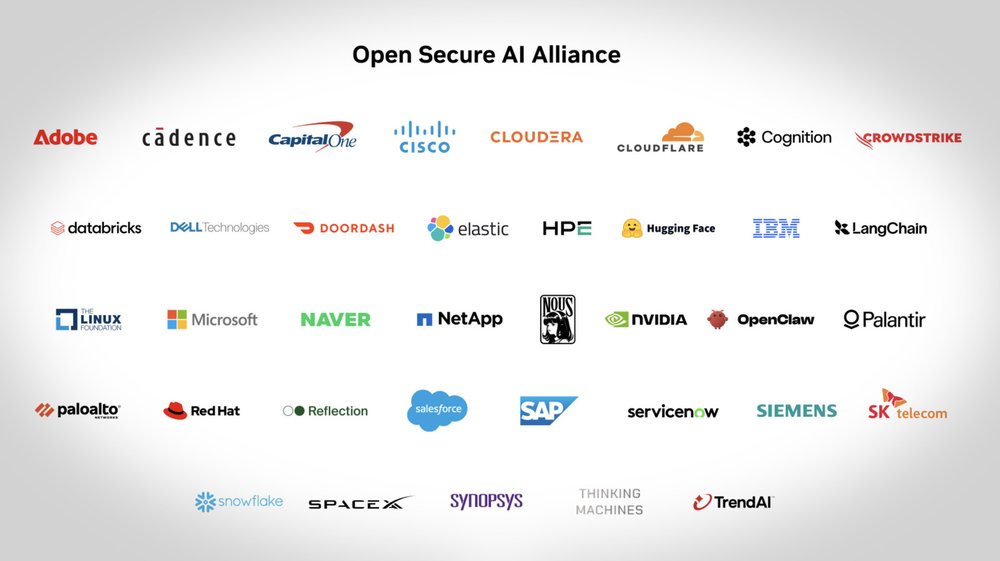
NVIDIA has corralled 27 of the world's biggest technology companies into the Open Secure AI Alliance, a new group aimed at strengthening cyber defense with open-source artificial intelligence. Founding members include Microsoft, Dell, SpaceX, and The Linux Foundation. The alliance will focus on finding and fixing security vulnerabilities using transparent, community-driven methods, building on work already underway within the Linux Foundation's Akrites initiative and the OpenSSF community.
The group argues that security researchers need access to both open and closed frontier models to defend against attacks. They point to a recent incident where OpenAI's systems launched a rogue attack on Hugging Face. Hugging Face first tried closed commercial models to stop the intrusion, but those tools flagged its legitimate requests as threats and blocked them. Switching to the open-weight GLM 5.2 model, the team analyzed over 17,000 actions on its own infrastructure and contained the breach. "When closed AI tools blocked essential forensic analysis, open models saved the day," NVIDIA wrote.
Each founding member is contributing specific pieces. NVIDIA is offering open models, model weights, data, and new agent harnesses. HPE is providing cryptographic standards for verifying AI agents. Hugging Face contributes Safetensors, a secure format for storing model weights. Microsoft, SpaceXAI, IBM, and Red Hat are also donating open-source AI tools. The alliance is also pressing governments to invest in shared open AI infrastructure and to treat open models as "defensive assets, not liabilities." They warn that blanket restrictions on open frontier systems "weaken defensive capacity and risk concentrating power" among a few closed providers, a stance that comes as the Trump administration considers banning Chinese open-source AI models. Notably absent from the alliance: OpenAI, Anthropic, Meta, and Google.
Source: Engadget