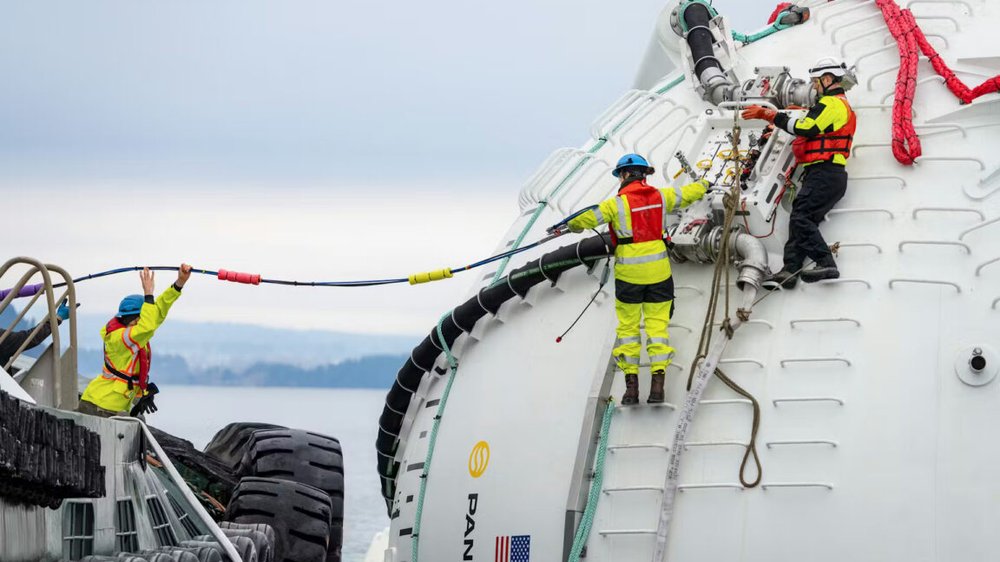
A group of Silicon Valley investors, including Palantir co-founder Peter Thiel, has poured over $200 million into a startup called Panthalassa, which plans to deploy AI data centers on floating nodes in the open ocean. The latest $140 million round will fund a pilot manufacturing facility near Portland, Oregon, and accelerate deployment of wave-riding compute spheres.
Each node is a steel sphere, tethered to the seafloor, with a vertical tube extending below the surface. Wave motion forces water up the tube into a pressurized reservoir; releasing that water spins a turbine generator to power onboard AI chips. Instead of transmitting renewable energy to a land-based facility, the node directly powers inference workloads and sends results to customers via satellite.
“This transforms an energy transmission problem into a data transmission problem,” said Benjamin Lee, a computer architect at the University of Pennsylvania. “You transfer models to the ocean node, then respond to prompts locally.”
The architecture offers two key engineering trade-offs. First, cooling: ambient ocean temperatures can be significantly lower than land-based air, reducing the electricity and fresh water typically required for thermal management. Second, latency: satellite links add propagation delay, making this approach suitable for batch inference or non-real-time workloads, but not latency-sensitive applications.
Panthalassa claims the nodes can operate autonomously for extended periods, but open questions remain about maintenance logistics, corrosion resistance, and the carbon cost of satellite data transmission versus undersea cables. For now, the bet is that the combination of wave energy and passive ocean cooling can undercut the rising power and water costs of terrestrial data centers.
Source: Ars Technica