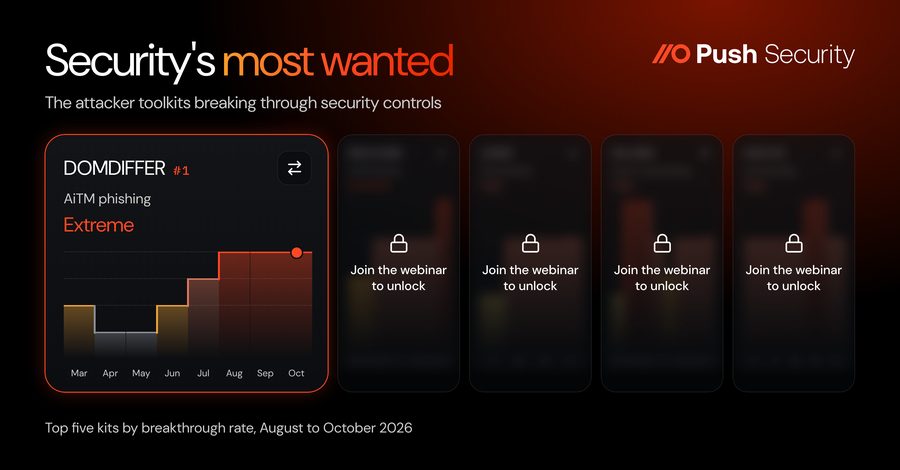
A phishing kit called DOMDIFFER ranked first for breakthrough rate every month from August to October 2026, getting past email security, web filtering and safe browsing 2-4x as often as the next kit, according to Push Security.
Push Security measures breakthrough rate as the share of attacks that reach the user after passing email security, web gateways and safe browsing. The firm says a high breakthrough rate signals a kit that upstream controls are missing, and that low counts in email or proxy logs don't prove a kit is rare.
DOMDIFFER, an adversary-in-the-middle kit targeting corporate Google and Microsoft accounts, was first seen in February 2026. Push Security believes it grew out of the reverse proxy kit NakedPages, with which it shares infrastructure in several places. The kit went quiet in spring and returned over the summer. Most detections in the ranking period came from fake calendar event lures.
One attack starts with a fake Google Voice voicemail notification. The link passes a bot check that turns scanners away, then shows what appears to be Google's sign-in page - not a screenshot, but Google's real page mirrored from the attacker's browser.
DOM mirroring is one of four ways AiTM kits relay a sign-in, alongside reverse proxy, replica pages and pixel streaming. Because the attacker's browser performs the real sign-in, the kit sends Google genuine browser signals and handles new sign-in steps without extra code. Replica pages remain the most common class, but DOM mirroring is the newest and fastest growing in 2026; Laurseraph, BlueKit and PhantomDOM also use it.
Push Security notes passkeys stop AiTM phishing where enforced, but kits mix AiTM with payloads passkeys don't touch, such as device code phishing or remote access tool installs, and pick the payload to match the visitor's platform. The other four top kits will be revealed in a December 2 webinar.
Source: The Hackers News