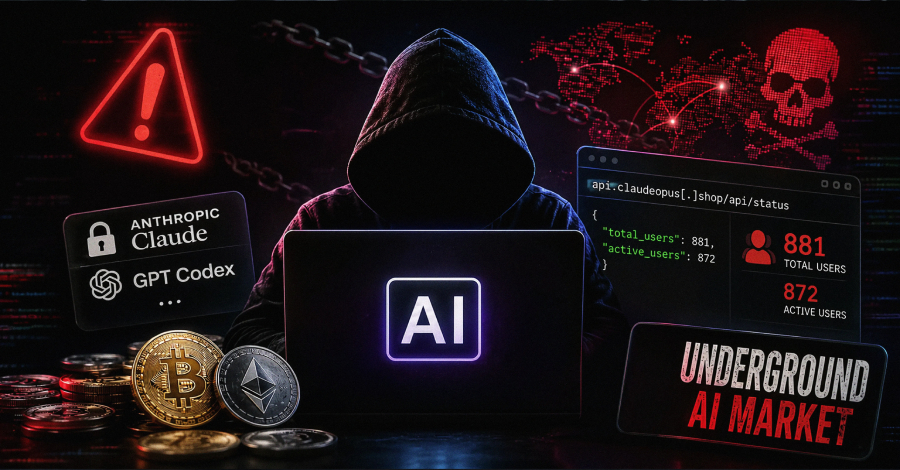
Cybersecurity researchers have uncovered multiple underground services advertising cut-rate access to AI models on cybercrime forums and messaging platforms. One such service, Poison Claude, claims to offer cheaper access to Anthropic's large language models, including Opus 4.8, 4.7, 4.6, and Sonnet 4.6.
According to Okta researchers, Poison Claude explains its low prices by exploiting free bonus credits, such as the $100 AWS Bedrock credit. The service states it pools these accounts and routes user requests to one under the hood, charging 5-15% of the official per-token price. Payments are made in cryptocurrency, and customers receive an API key compatible with Anthropic's API, with instructions to configure their environment to use Poison Claude instead of Anthropic's official endpoint.
A configuration error exposed the service's status endpoint, revealing 881 total and 872 active users. The issue was fixed after disclosure. The main domain sits behind Cloudflare's CDN, which has since placed a phishing warning on it, but declined to act on the API domain. Another gray-market service, Ecomagent.in, has an estimated 970 users and offers similar discounted access to Anthropic and OpenAI models via a custom endpoint.
Okta warns that when services act as gateway proxies, operators have full visibility into all prompts, creating a real privacy risk—operators could leak or sell that data. The findings come amid growing Chinese demand for U.S.-based models that are blocked or banned there, with relay platforms enabling local developers to access them. Earlier this year, Anthropic accused three Chinese firms of illegally extracting Claude's capabilities. Reuters also reported that Chinese military researchers used OpenAI and Anthropic models to train domestic AI systems.
Separately, evidence shows bad actors abusing free trials to create synthetic identities at scale using disposable domains. Okta notes that bot activity is rising, especially with AI agents, and residential proxies make malicious traffic harder to block.
Source: The Hackers News