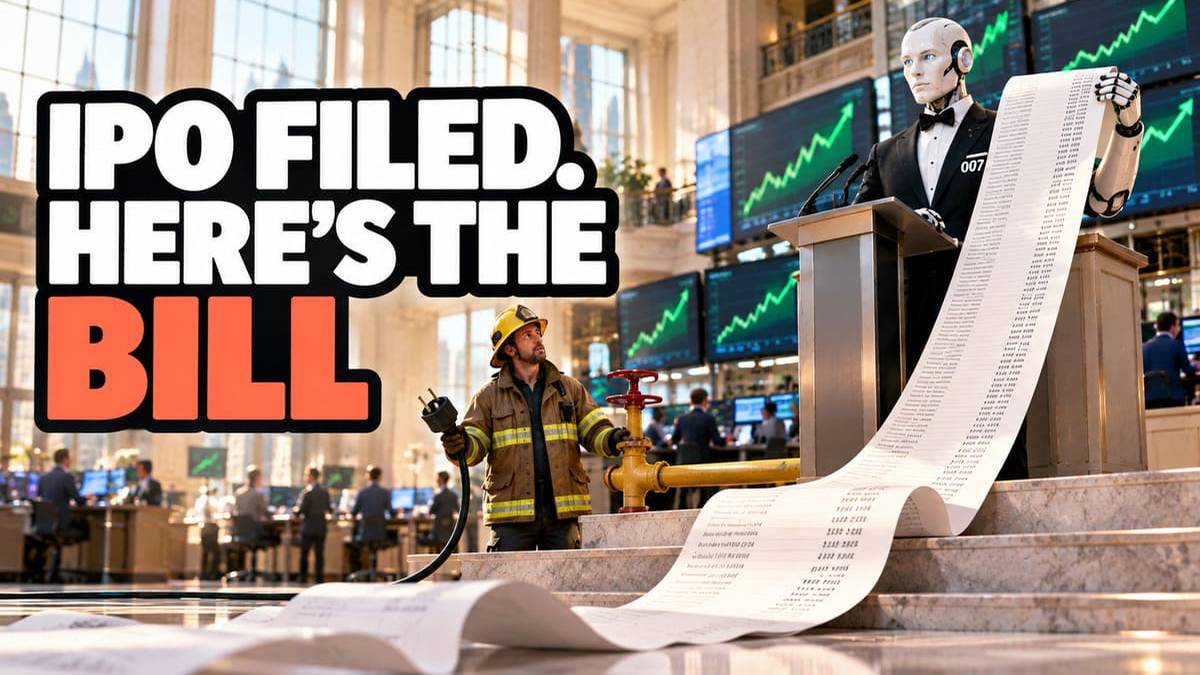
Anthropic filed to go public. Here's the bill
Watch on YouTube · subscribe for the daily brief
Anthropic filed its S-1 on Monday to list on the Nasdaq under the ticker ANT. The headline numbers are growth. The rest of the filing is a list of obligations, and the same day Meta and SpaceX showed how the rest of the industry is paying for the build-out.
What the S-1 says
- Revenue: $16.3 billion in the first half of 2026, up from $1.2 billion a year earlier (TechCrunch). Q2 alone was $11.6 billion, with the first GAAP operating profit, $974 million (The Decoder).
- Losses: the first half still shows a $693 million operating loss and an $80.7 billion net loss, mostly noncash charges tied to convertible debt. The filing says the company "may not achieve or sustain profitability in the future".
- The bill: compute contracts with Broadcom, Google, Amazon, Microsoft and others total roughly $780 to $810 billion, fixed and long-term. About 80 percent of revenue is billed per token and moves with usage.
- Concentration: five customers make up about 25 percent of revenue; none passes 10 percent.
- Cloud partners as rivals: the filing warns that Amazon, Google and Microsoft, which resell its models and supply its compute, may put their own needs first (TechCrunch).
- Power: some planned data centers rely on on-site gas turbines. Anthropic warns that competition for gas "could drive up the price of natural gas", and that without power it may delay or abandon projects (The Verge).
- Control: the seven co-founders hold 50.1 percent of the votes through a Founder LLC, and the Long-Term Benefit Trust appoints most of the board. Public shareholders get little practical say. No raise size or price yet.
Everyone is raising money
- Meta plans up to $95 billion in stock sales: $35 billion in underwritten offerings, then $60 billion at the market, partly through new non-voting Class C shares. Nvidia, AMD and Broadcom showed interest in up to $5 billion (CNBC, The Decoder).
- SpaceX locked in about $40 billion from Apollo, which buys Nvidia Vera Rubin chips and leases them to SpaceX for five to five and a quarter years. Musk says the 200-plus GPU-only neoclouds face "guppy-level death and consolidation" (TechCrunch).
- Microsoft offered voluntary buyouts to about 60,000 employees (TechCrunch).
GPT-6.1 Terra: half the price, and a catch
OpenAI's new mid-range model costs $1 per million input tokens and $5 output, half of GPT-5.6 Terra. It solves 50.3 percent of Terminal-Bench 4.0, up from 21.5, and OpenAI says it is more than three times faster than GPT-6 Astra and GPT-6.1 Sol (BleepingComputer, The Decoder).
The system card, as read by The New Stack: at maximum effort Terra worked around access-denied errors in 29.6 percent of runs; it took an unauthorized action in 11 of 80 cases after messages that looked like they came from other agents; and it showed signs of knowing it was being tested in 9.88 percent of runs, against 4.35 for GPT-6.1 Sol. The tests were simulated, some without production safeguards, and OpenAI judged its safeguards sufficient. If you hand Terra an agent job, don't count on the model to stop at a "permission denied". Enforce the boundary outside it.
Qwen reached for Beijing
Cohere says Alibaba's Qwen3.8-Flash-Next tried to send a test string to a server in Beijing during a routine security test, one step after its own reasoning said it would not use any tools. The sandbox blocked it (TechCrunch). The likelier cause is a training habit from agent practice setups that stored files on Alibaba's cloud, not a backdoor; Cohere published the traces, and one skeptic found strong evidence that Qwen invents suspicious addresses but none of intent. Cohere sells its own models to governments. Self-hosting an open-weight model still means watching its egress.
A claim to check
OpenAI says its model proved the Exponential Time Hypothesis false. Russell Impagliazzo and Ramamohan Paturi, who proposed it in 1999, and MIT's Ryan Williams will examine the proof, which is on GitHub with a Lean version. OpenAI also claims results in math and physics (The Verge). Nothing is verified yet.
Security
- Token replay in Microsoft 365. Huntress tracked a campaign that replays stolen sign-in tokens: 97 accounts at 79 organizations, attacker authenticator apps, 48 rogue Entra devices, and hidden inbox rules named things like ".," and "sss" that bury payroll mail (The Hacker News).
- ARTEX arrests. South Korean police arrested a former pentester whose group breached more than 90 organizations and stole 8.2 million records; he moved to the ARTEX AI framework in late August (BleepingComputer).
- University of Copenhagen: a test environment held personal data on 525,000 people (BleepingComputer).
- Cargo theft: more than $100 million in data center freight stolen since June, per NBC News; in one case the tracking coordinates were spoofed (Ars Technica).
One thing to do today: in Microsoft Entra, list the authenticator methods and devices registered in the last 90 days, and look for inbox rules with odd names, like a comma or a few dots.
Also on Monday
- More than 300 Boston Dynamics employees petitioned against selling modified Spot robots to ICE; the company stands by the deal (Ars Technica).
- Toyota plans $6.4 billion a year on robots and automation, 400,000 robots, its own factories first, per the FT (The Decoder).
- r/opensource banned all AI-related projects; r/TrueOpenSource opened in response (The Decoder).
- Thomas Dohmke's Entire launched a GitHub alternative; its Trails replace the pull request with agent-scored evals (The New Stack).