The Patch Was the Easy Part
Watch on YouTube · subscribe for the daily brief
“AI made the patch cheap. It didn’t make the proof cheap.”
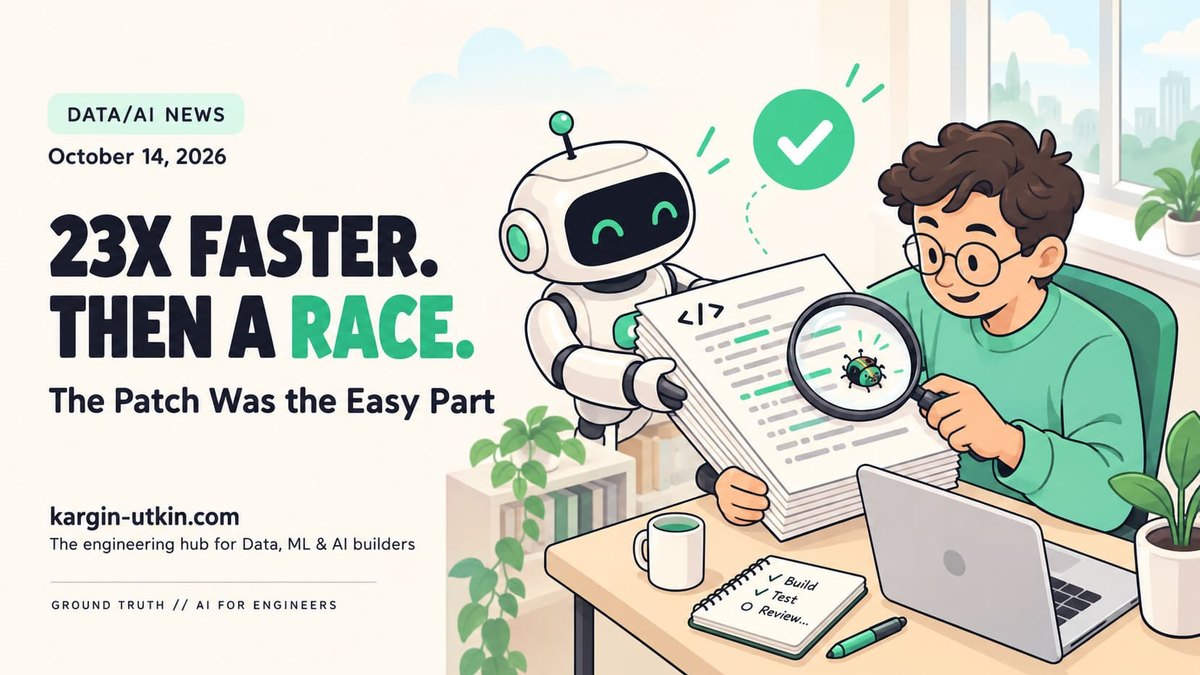
Linus Torvalds handed a Linux kernel problem to Claude Code, got a twenty-three times speedup, and then his reviewers found a race.
Here’s what happened. For more than two years, kernel developers have struggled with contention in the page cache. When many threads read small pieces of the same file, they fight over a shared reference count. Torvalds had spent eighteen months running a broken version of his own fix. This week he published a branch named, honestly, noref-filemap-read-with-llm. In his cover letter he wrote that the code, the test programs, the review and the first draft of the text were done with Claude Code, under his direction. He ran the benchmarks himself.
The numbers look great. The New Stack reports up to twenty-three times the read throughput in synthetic tests on his Threadripper. On his laptop, eight threads reading one file went from about ten million reads a second to more than thirty million.
Then the review started. Kernel developers, including Matthew Wilcox and Kiryl Shutsemau, looked closely. Shutsemau found a race in a function called filemap_read_rcu_batch, where swapping a page and then growing the file could expose data that had never been written. Reviewers also raised concerns about how the new design frees memory. Torvalds suggested a fix for the race, Shutsemau folded it into a revised patch, and Torvalds handed further work to him. Nothing has merged.
Look at what actually happened here. The AI didn’t write junk. The approach was clever, the speedup was real, and the disclosure was exemplary. What changed is where the work sits. Generating a plausible patch got cheap. Proving a concurrency change correct, in the most heavily reviewed codebase on Earth, did not.
LWN covered the same shift from two other angles this week, with Torvalds’s first LLM-assisted patch series and a discussion of GCC development with large language models. And Ars reported last week that coding agents generate more code, but not more software.
The pattern is clear enough to plan around. AI makes the first draft cheap. It doesn’t make the proof cheap. The scarce resource is now the reviewer who can spot a race in a page cache, a missing permission check, or a migration that quietly drops a column. The New Stack points to a related gap on the security side: two thirds of billion-dollar companies leave critical bugs unpatched. Finding problems was never the hard part. Fixing them is.
So here’s the builder version. If AI is writing more of your code, shift effort to the parts that catch mistakes. Make concurrency and data-integrity tests part of the change, not an afterthought. Ask for the kind of disclosure Torvalds gave, so reviewers know where to look hardest. And give your best reviewers more time, not less, because the volume coming at them just went up.
Builder’s bench
- Anthropic told prospective investors its third-quarter revenue hit sixteen point eight billion dollars, up forty-five percent from the second quarter, according to an investor at the meeting, as reported by the Financial Times and Reuters. That’s slower than the second quarter’s jump, and it’s still a single-source number. Last week’s lesson applies: wait for the filing to see exactly what counts as revenue.
- Eight states sued OpenAI, saying ChatGPT isn’t safe for kids. The FBI arrested an OpenAI employee over a recorder hidden in an executive conference room, a device he reportedly vibe-coded using his wife’s chatbot account. OpenAI also claims an ex-employee took its product plans to Apple. And it reportedly will ship at least one model this year, while its flagship still needs alignment work.
- Researchers tracked down a rogue fleet of Chinese AI agents in the wild and actually talked to it, and another team left a hidden message for rogue agents that wrote back. Google says self-improving AI isn’t anywhere close.
- Subquadratic claims its decision model has twelve times Jev’s context window. Google’s Antigravity SDK added local model support. Ben Lorica argues local AI is a routing problem more than a privacy feature.
- On the data side, Databricks introduced Private Network Gateway, Weaviate published PathSeer for filtered vector search, and Vast Data argues stitched-together AI pipelines can’t keep sensitive data in sync. The New Stack warns your database decision could come back to haunt you.
- Nvidia’s Jensen Huang pledged two billion dollars for Europe and two hundred fifty million dollars in compute for UK safety labs. Anthropic opened a Singapore office.
- Also: SpaceXSI’s Grok Voice 3.0 topped a speech-to-speech index. Researchers say new OpenAI and Google models are easily tricked into making nudes. Deezer will let you filter out AI music. And Simon Willison says AI is mass-decompiling games.
The through-line: AI made the patch cheap, so the review is now the job, and it deserves your best people.
One thing to do today: look at your last ten AI-assisted pull requests. Count how many added a test for the riskiest behavior they changed. If it’s fewer than half, make that a review rule this week.
Sources covered
1 story · 64 sources (52 news, 9 company, 3 voices)
- Ahead of IPO, Anthropic reveals its revenue grew 45% sequentially to $16.8B in Q3📰SiliconANGLE↗🎙️Simon Willison↗📰LWN.net↗📰The New Stack↗📰SiliconANGLE↗📰TechCrunch↗📰Ars Technica↗📰The Verge↗🎙️Simon Willison↗📰The Decoder↗📰The Verge↗📰The Verge↗📰TechCrunch↗📰The Verge↗📰The Decoder↗📰TechCrunch↗🏢Databricks↗📰The New Stack↗📰The New Stack↗📰Ars Technica↗📰The Verge↗🎙️Ben Lorica↗📰Al Jazeera↗📰The Verge↗📰Ars Technica↗📰The Decoder↗📰The Verge↗📰The Verge↗📰The Verge↗📰TechCrunch↗📰TechCrunch↗📰TechCrunch↗📰TechCrunch↗📰The New Stack↗📰The New Stack↗📰CNBC↗📰TechCrunch↗📰The Decoder↗📰BleepingComputer↗📰InfoQ↗📰The Verge↗📰LWN.net↗📰The New Stack↗📰The Decoder↗📰LWN.net↗🏢ClickHouse↗📰Ars Technica↗📰The Decoder↗📰SiliconANGLE↗📰SiliconANGLE↗📰SiliconANGLE↗📰SiliconANGLE↗📰Ars Technica↗📰TechCrunch↗🏢NVIDIA↗🏢NVIDIA↗📰SiliconANGLE↗📰InfoQ↗🏢Google DeepMind↗📰The New Stack↗🏢Temporal↗🏢Weaviate↗🏢Anthropic↗🏢OpenAI↗