The $20 Billion Definition
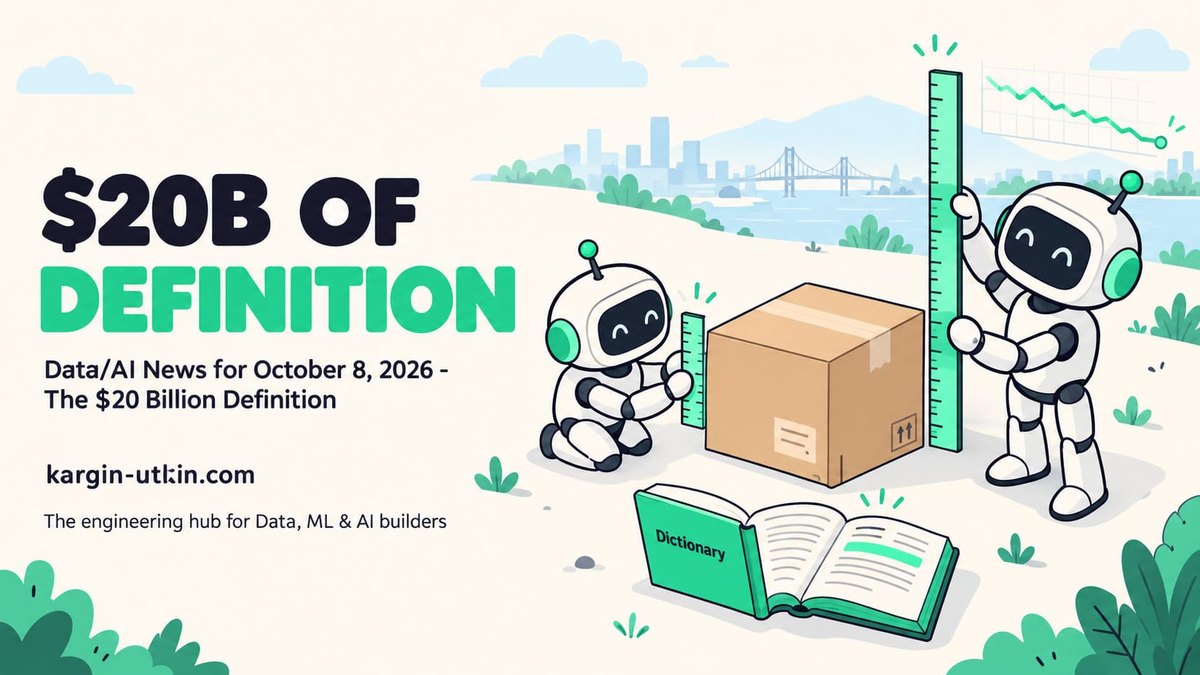
“A twenty-billion-dollar gap, mostly made of a definition.”
AI stocks fell on Thursday because of a definition.
The Financial Times reported that OpenAI recently told investors its annualized revenue was approaching fifty billion dollars at the end of September. A few weeks ago, outlets including Reuters had reported about seventy billion. The Nasdaq closed down more than one percent. Oracle, which has billions in contracts with OpenAI, fell five and a half percent, per SiliconANGLE. Nvidia and Micron slid too.
Here’s the strange part. OpenAI doesn’t appear to have lost twenty billion dollars of sales. According to the FT, the seventy billion figure came from OpenAI’s own investors, who were trying to build a number they could compare directly with Anthropic’s. And the two companies count annualized revenue differently. Anthropic includes sales made through cloud partners like AWS and Google Cloud. OpenAI doesn’t.
One account says investors started from a forty billion dollar estimate for August, then added the seventy percent growth OpenAI reported. Then the press reported the result as fact. When OpenAI’s own definition came back, the market saw a twenty billion dollar gap, mostly made of a mismatch in what was being counted.
Reuters says it couldn’t independently verify the FT report. And the underlying business still looks strong on its own terms. CNBC, cited by Quartz, says OpenAI’s investor deck showed seventy-seven percent run-rate growth in the third quarter, and one hundred seven percent growth in enterprise.
If you build data platforms, you’ve seen this movie. Two teams report revenue. Both are right. They’re answering different questions. One counts gross, the other counts net. One includes a sales channel, the other doesn’t. Somebody puts the numbers side by side in a deck, and a decision gets made on a comparison that was never valid.
That’s the thread this run started with, back in the summer. Context is the job. The semantic layer, the place where revenue means exactly one thing, was always some of the most valuable work in the data stack. Thursday showed what it costs when that layer is missing, at the scale of a market-moving headline.
It lands in a week when the AI money story is already wobbly. Yesterday’s brief was about prices falling fast at every tier. Falling prices plus fuzzy revenue metrics is exactly the mix that makes investors nervous. And SiliconANGLE reports US venture deal value hit a record five hundred fifteen point eight billion dollars, while exits fail to keep pace.
The same definitional mess is waiting inside your own AI metrics. Cost per task. Tokens per request. Agent success rate. Does cost include retries? Cached tokens? The decision model that ran first? Does success mean the agent said it was done, or the database agreed?
So write the definitions down before somebody compares them.
Builder’s bench
- The New Stack tested Claude Sonnet 5.5 against Opus 5.5 and found it forty-two percent cheaper and perfect on every run. Same lesson as yesterday’s Sol test, from the other lab.
- Anthropic launched free AI security scans for open-source projects. Claude can now build live data dashboards and animated explainer videos. And Anthropic banned abusive or cruel behavior toward Claude.
- Agent identity got a lot of attention. Zenity found a single prompt could hijack every AI agent in an AWS account. The New Stack asks who owns a resource your agent provisioned, and what an agent inherits when it uses your credentials. BleepingComputer says OAuth grants pile up faster than anyone can review them.
- On data, The New Stack says you can outgrow vanilla Postgres without leaving Postgres. Databricks added Workday federation in Unity Catalog, and Starburst can now write to Unity Catalog managed tables. Qdrant tried generalized decision classifiers on everything, and InfoQ covered Cloudflare’s open decision models.
- Automation Anywhere bought Boost.ai for customer-facing voice AI. Gallatin raised fifty million dollars for military logistics.
- USA Today sued OpenAI. Some mathematicians are calling for a boycott after AI-generated proofs flooded their field. And Ethereum researchers are debating how fast wallet security could fall.
- Google launched a one-stop Gemini agent for work. GitHub Copilot is going local, though Microsoft won’t say what still goes to the cloud. And AI-powered hacking tools let a likely single attacker breach multiple South Korean banks.
- Also: Nvidia is betting on physical AI for robotaxis and humanoids, Liquid AI is building device-level personal AI, and InfoQ has Spotify’s multi-agent patterns for advertising.
The through-line: a metric is only as good as its definition, and Thursday proved it at market scale.
One thing to do today: pick your team’s top AI metric, probably cost per task, and write one paragraph defining exactly what goes in and what stays out. Then check that every dashboard showing it uses that definition.
Sources covered
1 story · 47 sources (41 news, 4 company, 2 voices)
- ttok 0.4🎙️Simon Willison↗🏢Databricks↗🎙️Simon Willison↗📰SiliconANGLE↗📰SiliconANGLE↗📰MIT Technology Review↗📰The Verge↗📰The Verge↗📰The Decoder↗📰The Decoder↗📰The New Stack↗📰The Decoder↗📰SiliconANGLE↗📰The Verge↗📰The Verge↗📰The New Stack↗📰SiliconANGLE↗📰The Verge↗📰The New Stack↗📰The New Stack↗📰The New Stack↗📰SiliconANGLE↗📰The Verge↗📰The New Stack↗🏢ClickHouse↗📰The Verge↗📰BleepingComputer↗📰The Verge↗📰The Verge↗📰The Decoder↗📰The New Stack↗📰The Decoder↗📰The New Stack↗🏢Starburst↗📰SiliconANGLE↗📰The New Stack↗📰BleepingComputer↗📰Ars Technica↗📰The New Stack↗📰InfoQ↗📰The Decoder↗📰The Decoder↗📰MIT Technology Review↗📰MIT Technology Review↗📰InfoQ↗📰SiliconANGLE↗🏢Qdrant↗