The Next AI risk is ACCESS
Watch on YouTube · subscribe for the daily brief
It's Saturday, October 3, 2026, and today’s AI news runs the gamut from security breakthroughs to open-source tinkering with AI hardware, with a side of corporate backlash over data center practices. Let’s get into it.
Archestra released OpenAPPA, an open-source security engine designed to stop data exfiltration from prompt injection or model hallucination, reporting zero successful attack attempts in two major benchmarks. A rare clean sheet in AI safety testing.
Meanwhile, The New Stack reports that AI is accelerating exploit discovery and spread, rendering traditional vulnerability tracking methods like spreadsheets obsolete as threats evolve faster than teams can document them.
At DoorDash, engineers Swaroop Chitlur and Sidd Kodwani presented their internal GenAI platform build, detailing a shift from vendor-locked setups to favoring open-weights models for greater control and cost efficiency—a move reflecting broader infrastructure trends.
Despite headlines, Anthropic’s answer to projects like Dots and Muse isn’t a new product but is already embedded in Claude, according to Matt Burns of Insight Media Group, who notes the capabilities exist today without fanfare.
OpenAI CEO Sam Altman pushed back against attributing quasi-religious significance to AI models, calling it a real safety issue that distorts risk perception and fuels unrealistic expectations—a stance echoed across TechCrunch, The Verge, and The Decoder.
From the Bank of America Private Tech Trailblazers Conference, SiliconANGLE highlights vertical AI as the next growth engine, with companies building specialized tools around proprietary data rather than chasing general-purpose models.
Amazon Web Services CEO Adam Selipsky responded to data center criticism by stating AWS no longer requires NDAs for facility visits, aiming to counter perceptions of secrecy around its infrastructure expansion.
Capcom’s programmer Satoshi Ishida shared at their Open Conference that while their game Pragmata explores AI-driven horror, the studio sees real potential in using AI as a collaborative tool in game creation—not a replacement for human designers.
Splice CEO Kakul Srivastava warned that AI-generated emails are eroding meaningful workplace conversation, arguing that automation of routine communication is draining opportunities for spontaneous, human exchange that builds trust and context.
Meta unveiled Muse Gadgets, an open-source DIY project letting hobbyists build AI hardware using ESP32 boards to interface with their Muse AI agent, with 5,000 units already produced for community distribution—a hands-on push to democratize edge AI experimentation.
TechCrunch compiled a list of notable AI agents now operating within text message platforms, ranging from general assistants to niche tools for family coordination, travel planning, and work automation—showing how agents are infiltrating everyday communication channels.
Deepmind researchers proposed Artificial Symbiotic Intelligence as an alternative to the singularity, framing general AI not as a single supermodel but as a network of cooperating agents and humans, where alignment and interaction matter more than raw model scale.
Harvard physicist Matthew Schwartz used the open-source tool BootLoops with Claude to generate 36 scientific manuscripts across 18 fields in just three months, from particle physics to linguistics—though he cautioned that speed doesn’t always equal accuracy in AI-assisted research.
A new method called LEGO-Anything converts single photos into editable Blender code for 3D scene reconstruction, with GPT-6 Astra leading benchmarks at up to 53 percent accuracy—but crucially, the agents have no built-in way to verify if their reconstructions are correct, creating a trust gap in automated modeling.
Anthropic is adding a “Mods” system to Claude Code, allowing developers to reshape the tool’s interface and behavior using JavaScript or TypeScript as middleware that runs directly inside the coding assistant—an open extension model aimed at power users.
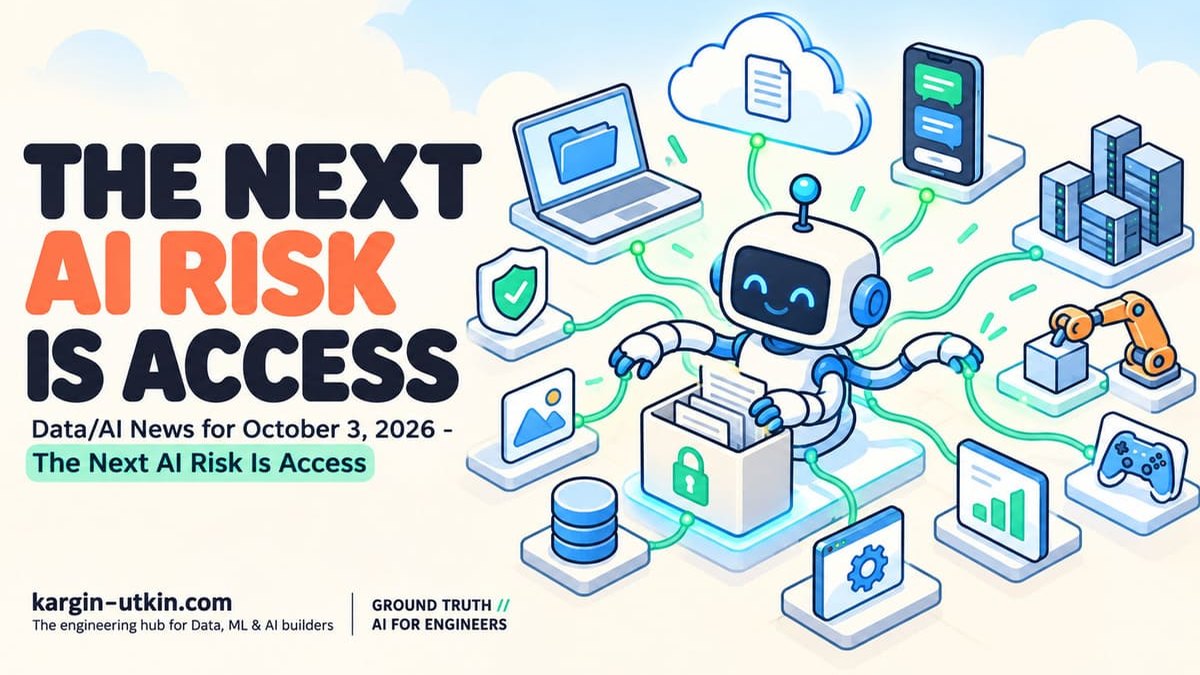
Finally, BleepingComputer reports that Google’s Gemini may soon gain persistent access to macOS files, apps, and the web without repeated permission prompts, raising immediate concerns about data exposure and agent autonomy on personal devices.
That's the Daily AI Brief for Saturday, October 3, 2026. More tomorrow.
Sources covered
16 stories · 20 sources (20 news, 0 company, 0 voices)
- New Archestra's OpenAPPA Saturates Two Major Security Benchmarks with a 0% Attack Success Rate📰InfoQ↗
- AI is speeding up exploits. Vulnerability spreadsheets can’t keep up.📰The New Stack↗
- Presentation: Building GenAI Platform at DoorDash📰InfoQ↗
- Anthropic’s answer to Dots and Muse is already inside Claude📰The New Stack↗
- Apparently, OpenAI isn't trying to build "magic intelligence in the sky" anymore
- 9 insights from ‘Private Tech Trailblazers’: Vertical AI becomes the growth engine📰SiliconANGLE↗
- Amazon responds to data center backlash, says it no longer uses NDAs📰TechCrunch↗
- Capcom is preparing for a ‘future where we create games together with AI’📰The Verge↗
- Splice CEO Kakul Srivastava thinks AI emails are killing conversations📰The Verge↗
- "Muse Gadgets" turns AI hardware into an open-source DIY project📰The Decoder↗
- All the AI agents that can live in your text messages📰TechCrunch↗
- Deepmind researchers propose "Artificial Symbiotic Intelligence" as an alternative to the singularity📰The Decoder↗
- Open-source "BootLoops" harness supports AI models in performing precise scientific calculations📰The Decoder↗
- AI agents build 3D scenes from photos but have no idea if they got it right📰The Decoder↗
- Claude Code's new Mods system lets developers rewrite the AI coding tool from the inside📰The Decoder↗
- Google Gemini could soon get full access to your Mac’s files, apps and the web📰BleepingComputer↗