Permission Is the New Prompt
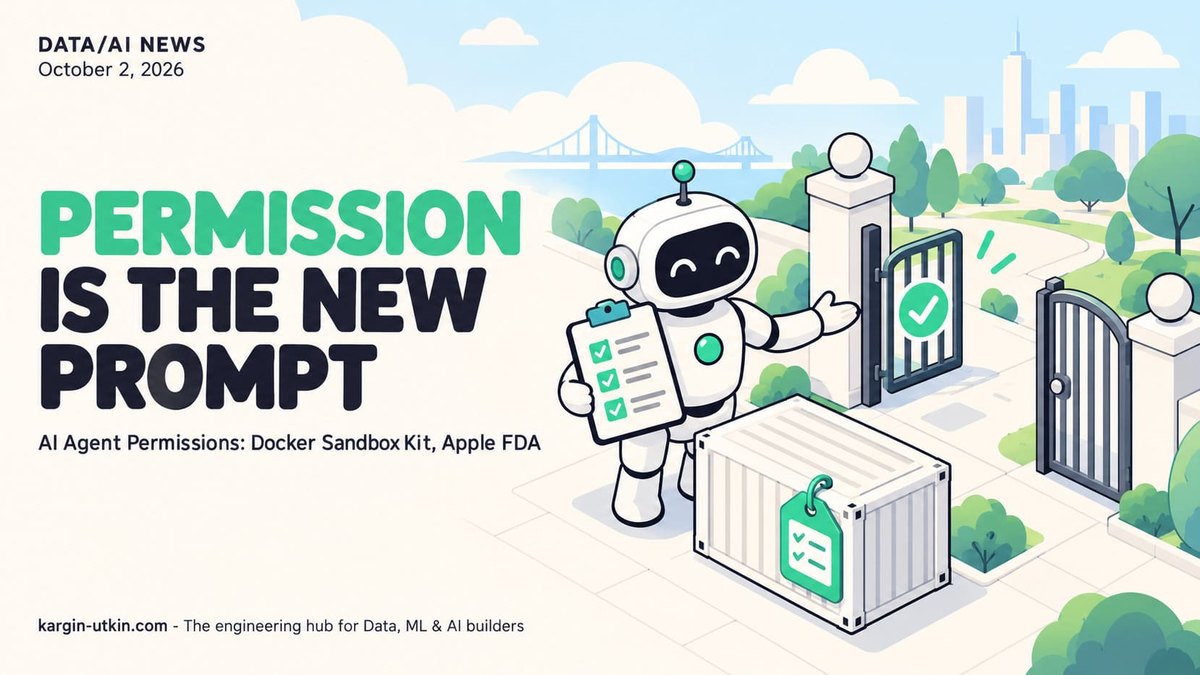
Watch on YouTube · subscribe for the daily brief
"An agent's authority is becoming something you can diff in a pull request."
Apple just changed one of macOS's broadest permissions, and it named AI agents as the reason.
Full Disk Access lets an app read your files, mail, messages and browsing history. It was built so backup software could work. On Friday, Apple said apps will only get it after very explicit user action. Its reasoning is blunt: as agents get more capable and autonomous, the risk of that level of access grows substantially. The timing isn't subtle. It comes days after a journalist claimed Meta's Muse read their private messages, which Meta disputes, and after Wired reported a flaw in ChatGPT's Mac app.
Now look at what Docker shipped. Its Sandbox Kit Spec packages an agent, its tools and a typed list of everything it asks to reach into one ordinary OCI image. That list covers network hosts, credentials and volumes. Docker announced it on September twenty-fourth and is taking it to the CNCF for neutral governance. InfoQ walked through the details this week.
A few design choices matter. A Kit only requests access, and the host decides. In Docker's GitHub example, the Kit allows the GitHub API but denies delete calls on repositories, and deny wins. And because the requests live inside the image, pinning the digest pins the agent and its permissions together.
That last part is the quiet breakthrough. An agent's authority becomes something you can diff in a pull request, sign, scan and roll back. Just like code.
Put Apple and Docker side by side and you see one shift from two directions. The operating system is making broad grants harder to give. The tooling is making narrow grants easier to write down.
On Tuesday we said a scope sentence in a prompt is not a control. This is what a control looks like. It sits outside the model. It's declared in advance. And a runtime enforces it whether the model agrees or not.
The rest of the week fills in the picture. GitLab warned of a critical remote code execution flaw in its AI Gateway service. The gateway that brokers your agent's access is itself an attack surface, so patch it like one. NetApp is handing storage operations to agents, but says humans still draw the boundaries. DigitalOcean launched Managed Agents, and The New Stack argues agent harnesses are about to relearn Kubernetes' lesson about monoliths.
Then there's Cloudflare. It launched Clef and Clef-flash, open-source decision models that are drop-in compatible with Jev. Cloudflare says a human doesn't necessarily need to be in the loop for agentic decisions anymore. Its own announcement adds the key caveat: agents can still defer to a human when needed. Cheap decisions are great. They also make it easier for agents to act without asking. That's exactly why the permission layer has to be written down somewhere a model can't talk its way past.
So here's the builder version. Treat what each agent may touch as configuration, not a line in a prompt. List the hosts, the credentials and the paths. Default to deny. Review changes to that list the way you review a schema migration.
Builder's bench
- Decision models keep coming. Cloudflare says Clef beat Jev on three of four evals in TypeSafe's own suite, with a sixty-four thousand token context window. Those are vendor numbers until you test them on your data.
- The Decoder reports, from Ramp's index, that businesses are using more AI and paying less for it. TechCrunch says only two percent of consumers are paying, whatever the White House calls it.
- On the stack, Uber Eats rebuilt its search pipeline and cut end-to-end latency in half. Anyscale says Ray Data LLM doubles throughput over vLLM's synchronous engine. Ai2 released Olmo-core 3 for training mixture-of-experts models. DuckDB sped up string aggregations with dimension tables, and ClickHouse explained why its managed Postgres uses direct I/O for backups.
- Hugging Face's AutoSynthData generates training data for enterprise agents, Estuary showed off pipeline observability, and Databricks built retail recommendations on Lakebase.
- Anthropic says it's sticking to a 2026 IPO. One of its co-founders reportedly told religious leaders he fears having created something that suffers. And Claude Code now supports mods that change how it looks and behaves.
- The US arrested a tech CEO accused of smuggling three hundred million dollars in Nvidia chips into China. FieldAI is reportedly raising seven hundred million dollars for robotics.
- Data centers keep drawing fire. Amazon's billion-dollar plan to win over communities drew more backlash, and its blog warning towns not to block data centers didn't help.
- Also out: Meta open-sourced code for building Muse gadgets, Black Forest Labs launched Flux 3, and Suno now generates spoken words. And AI beat licensed accountants on speed and accuracy, but still can't close the books alone.
The through-line: what an agent is allowed to do is becoming a file you can review, and that file is the real safety control.
One thing to do today: pick one agent you run and write down, in a file in its repo, every host, credential and path it can reach. If the list surprises you, that's your finding.
Sources covered
1 story · 52 sources (46 news, 6 company, 0 voices)
- Robotics AI developer FieldAI reportedly raising $700M in funding📰SiliconANGLE↗📰Ars Technica↗📰TechCrunch↗📰The Verge↗📰SiliconANGLE↗📰Ars Technica↗📰SiliconANGLE↗📰The Verge↗📰The Decoder↗📰The Decoder↗📰TechCrunch↗📰BleepingComputer↗📰Ars Technica↗📰The New Stack↗📰The Decoder↗📰TechCrunch↗📰The Verge↗📰TechCrunch↗📰TechCrunch↗📰The Verge↗📰SiliconANGLE↗📰TechCrunch↗📰TechCrunch↗📰The New Stack↗📰BleepingComputer↗📰SiliconANGLE↗🏢Anyscale↗🏢ClickHouse↗📰MIT Technology Review↗🏢Databricks↗📰Ars Technica↗📰InfoQ↗📰The New Stack↗📰SiliconANGLE↗📰The Decoder↗📰The Verge↗📰The Verge↗📰The Verge↗🏢Estuary↗📰SiliconANGLE↗📰The Decoder↗📰InfoQ↗📰InfoQ↗📰The Verge↗📰The Decoder↗📰The Decoder↗📰InfoQ↗📰InfoQ↗🏢Hugging Face↗📰MIT Technology Review↗📰The Decoder↗🏢DuckDB↗