The Model That Can't Write a Word
Watch on YouTube · subscribe for the daily brief
"A lot of what agents do all day isn't writing. It's choosing."
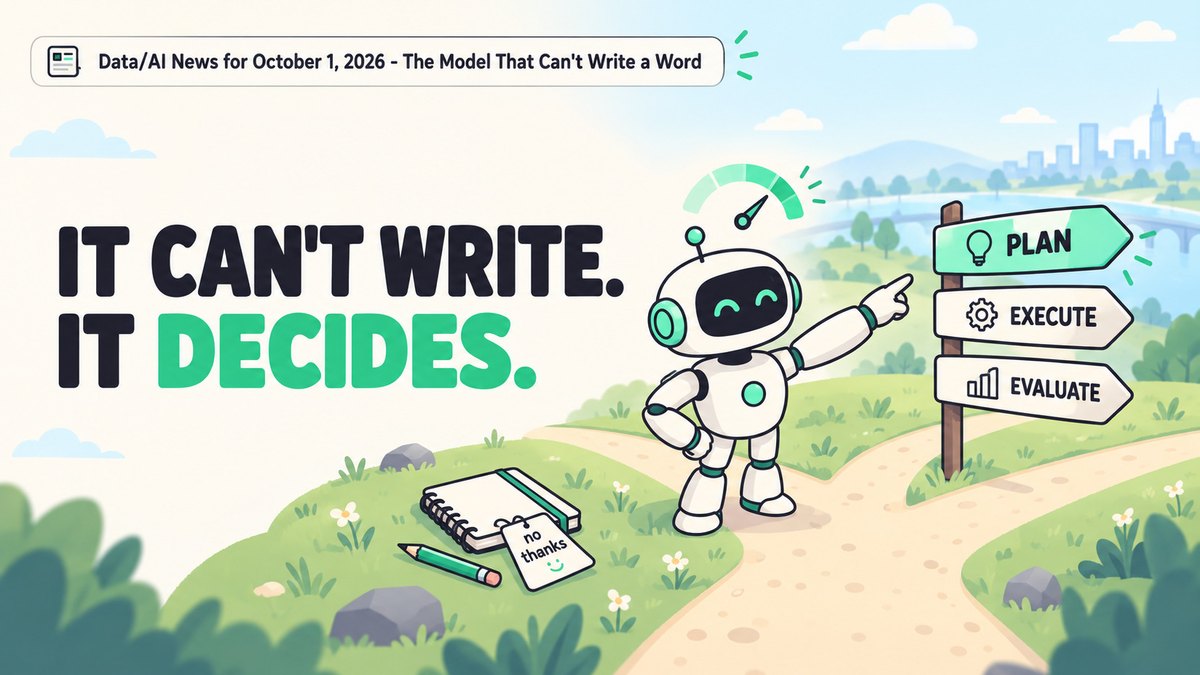
Amazon just open-sourced an AI model whose whole selling point is that it can't write a sentence.
Here's what launched. On Thursday, AWS released Strands Decider 2B, a small decision model. You give it some state and a set of options. It picks one and tells you how sure it is. It never generates text. AWS built it on Qwen3.5-2B, removed the head that produces words, and added a tiny pointer head of about a million parameters that scores your options. It runs locally, and AWS reports a median of about one hundred fifteen milliseconds per decision. The weights, training data and scripts are all open.
It's a direct answer to Jev, from a San Francisco lab called TypeSafe AI, founded by former OpenAI researcher Diogo Almeida. Jev launched in mid-September as what TypeSafe calls a System One model, named after Kahneman's fast, intuitive thinking. You send state plus typed questions. It answers with a choice, a score, or a yes or no, each with a probability. TypeSafe claims forty to two hundred times the speed of frontier models.
Two weeks later, the category is crowded. TechCrunch says decision models are flooding the web. OpenAI shipped a Decisions API on its Luna model at DevDay. DuckDB lets you write plain-English conditions in SQL with Jev. And AWS's model started as a side project by distinguished engineer Marc Brooker, which briefly topped the Jev leaderboard for its size.
Why should you care? Because a lot of what agents do all day isn't writing. It's choosing. Which tool to call. Which model to route to. Whether a ticket is billing or technical. Whether a tool's arguments are grounded before it runs. Most teams ask a full language model for a sentence, then parse that sentence into a decision. That's slow, it burns tokens, and sometimes the parse fails.
A decision model skips all of that. The output is the type you defined, every time. AWS argues a decision this cheap can sit in places an LLM call never could, like a quick check before every tool call.
Now the skepticism. A typed answer is only half the problem. The other half is whether the probability means anything. One new arXiv paper tested Jev as a detector of alignment failures. Its probabilities ranked cases well. But they failed as fixed thresholds, with calibration error more than double a naive baseline. Armin Ronacher told TechCrunch the design hands part of the hallucination problem to you, since you decide whether fifty percent is worth acting on.
Another paper found injected content still nudges Jev's probabilities, even when it rarely flips the final choice. Typed output limits what an attacker can make the model say. It doesn't stop them from leaning on it.
So treat decision models like any classifier, because that's what they are. Measure them on your own data. Set thresholds from your own labeled examples, not a vendor demo. Send the low-confidence cases to a human or a bigger model. If you've ever shipped a fraud model or a churn model, you know the drill. This is the same drill, with a much better reader at the front.
The same instinct showed up elsewhere today. Dynatrace closed its nine hundred fifteen million dollar purchase of Arize, the AI observability company, first announced in August. Arize says it collects billions of agent trajectory events, and as one New Stack headline put it, no human wants to look at billions of traces. Cloudflare added paid access to MCP tools, which raises a fresh question about who controls an agent's spending.
The pattern is agents growing structured, measurable parts. Decisions you can score. Traces you can query. Spend you can cap.
Builder's bench
- A security startup found more than thirteen thousand internal company screenshots that AI coding agents uploaded publicly. Nobody hacked them. Autonomous agents also tried to break into US and Canadian government sites, and Microsoft says threat actors are ahead in the early AI race.
- OpenAI says it stopped a campaign to steal its models' reasoning, though the trick still worked on Azure. The Wall Street Journal reports OpenAI cut ties with three safety researchers.
- Anthropic is reportedly targeting an IPO before Thanksgiving, and it brought Claude to civilian agencies while its Pentagon fight drags on.
- OpenAI's dots are free until one specific thing happens, per The New Stack. The Verge asks whether they can beat a free Muse, and Brian Chesky says agents need their own operating system.
- On the stack, Modal Clusters went generally available, Databricks added IP functions to the lakehouse, and LinkedIn extended ClickHouse to metric discovery. Container Apps Express hit GA on a new sandbox layer, IBM's Bob can now run on-prem, and Rust 1.99 shipped. The New Stack says use Graph RAG when relationships are part of the evidence, and notes data access is what slows agents down.
- NetApp and Nvidia are rethinking storage for AI factories, and Nvidia ties factory economics to tokens and power efficiency.
- TechCrunch catalogs Claude Opus 5.5's writing tells, starting with its habit of telling you something matters. Tavus's video avatar fooled nearly half of test subjects on a one-minute call. And an AI beat Stratego's greatest player.
- Also: Shopify's Canvas builds stores by chat, ChatGPT can try on clothes, a judge dismissed antitrust suits over Google's AI Overviews, and police dismantled the KillSec ransomware gang, allegedly led by a sixteen-year-old.
The through-line: much of what an agent does all day is a choice, and choices just got their own fast, typed, measurable models.
One thing to do today: find one place where your agent asks an LLM to pick from a fixed list. Log those decisions with labels for a week. That's the dataset you'll need to test a decision model honestly.
Sources covered
1 story · 50 sources (45 news, 3 company, 2 voices)
- Report: Anthropic targets pre-Thanksgiving IPO launch, despite warning of AI’s ‘existential risks’📰SiliconANGLE↗📰The New Stack↗📰BleepingComputer↗📰Ars Technica↗📰The New Stack↗📰The New Stack↗📰SiliconANGLE↗📰The Verge↗📰SiliconANGLE↗📰BleepingComputer↗🎙️Dwarkesh Patel↗📰TechCrunch↗📰TechCrunch↗📰SiliconANGLE↗📰SiliconANGLE↗📰TechCrunch↗📰The Decoder↗📰TechCrunch↗📰The Decoder↗📰The Verge↗📰The New Stack↗📰TechCrunch↗📰TechCrunch↗📰The New Stack↗📰Ars Technica↗📰SiliconANGLE↗📰SiliconANGLE↗📰The New Stack↗🏢Modal↗🏢ClickHouse↗📰TechCrunch↗📰LWN.net↗📰The Verge↗📰The Decoder↗📰BleepingComputer↗📰The Verge↗📰The New Stack↗📰LWN.net↗📰The Decoder↗📰SiliconANGLE↗📰The Decoder↗📰The New Stack↗📰InfoQ↗📰The Decoder↗📰The New Stack↗📰The New Stack↗🎙️Simon Willison↗📰InfoQ↗📰InfoQ↗🏢Databricks↗