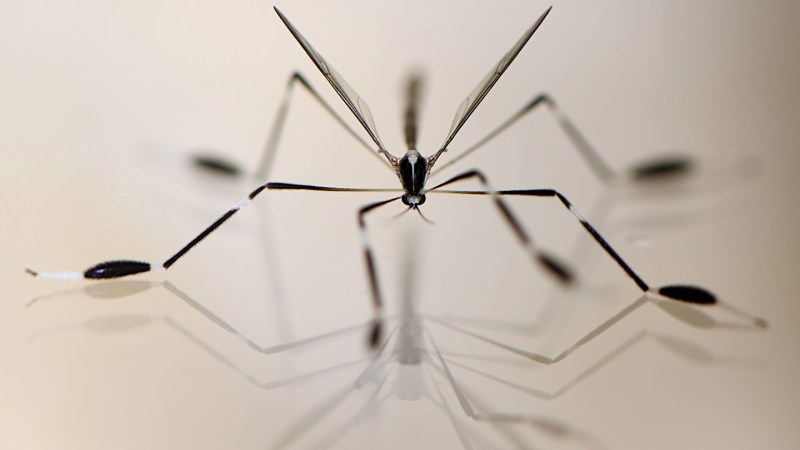
DENVER — Sometimes the most efficient optimization isn't found in code, but in biology. At the American Physical Society's Global Physics Summit this March, UC Berkeley physicist Sarahi Arriaga-Ramirez presented findings on the Eastern phantom crane fly that could reshape micro-air vehicle design.
These insects conserve energy by letting their legs do the work. While they flap wings to ascend in still air, wind tunnel tests show they lock wings still in updrafts, splaying legs into an inverted cone. This creates drag-based lift, similar to a dandelion seed. Arriaga-Ramirez notes the flies mature for only a week without eating, making energy conservation non-negotiable.
To quantify the aerodynamics, the team 3D printed scaled models and dragged them through mineral oil. This substitution accurately simulated viscosity at smaller scales, generating precise data on fluid interaction. Results showed a narrower leg cone reduced drag by 20 percent compared to a flatter arrangement, allowing the insect to modulate lift based on wind force.
For engineers, the implication is clear: adaptive hardware can outperform rigid control systems. The team prototyped drones using shape memory alloys that bend legs via electric current, mimicking active biological control. Alternatively, flexible joints allowed passive adjustment where increased wind speed automatically narrowed the leg cone.
The result is remarkable stability. Even when airflow disturbs the vehicle, the passive mechanical response maintains equilibrium without complex computational overhead. As we push for longer-endurance autonomous sensors in 2026, copying the crane fly's low-power physics might prove more effective than adding more battery capacity. It suggests a future where mechanical intelligence reduces the data load on flight controllers.
Source: Science News