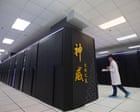
In a significant shift in the global supercomputing hierarchy, China's LineShine computer has surpassed its US counterparts to become the world's most powerful supercomputer. Notably, LineShine's architecture differs from other high-performance computers as it relies entirely on conventional central processing units (CPUs) rather than graphics processing units (GPUs) commonly used for artificial intelligence workloads. This design choice allows LineShine to achieve 2.198 exaflops, performing over 2 quintillion calculations per second, while consuming approximately 42.2 megawatts of electricity. The Top500 rankings, which measure supercomputer performance, highlight LineShine's debut at the top, displacing the US's El Capitan. Supercomputers of this scale can significantly accelerate research in fields like medicine, climate modeling, and materials science. The EU has also announced plans to invest €20bn in building supercomputing sites, aiming to develop next-generation AI models and reduce reliance on US and Chinese technology. As the supercomputing field continues to evolve, engineers must balance performance requirements with power consumption and environmental considerations, making innovative system design decisions crucial for future advancements.
Source: The Guardian