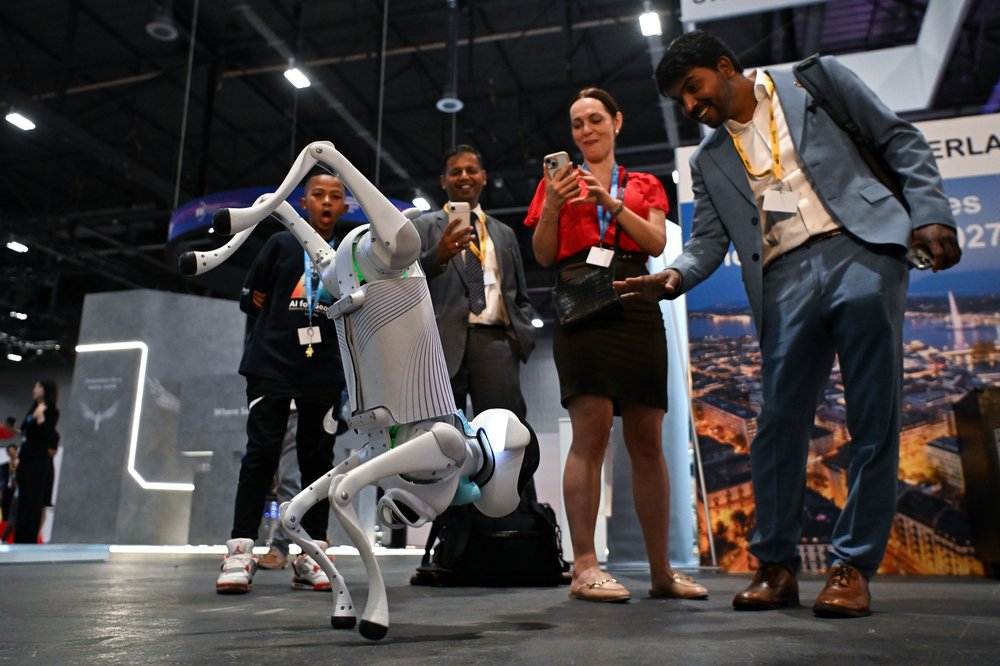
Weaving past live coding demos, an obstacle course of gadgets, and attendees with glowing green headphones piping in UN panel discussions, you finally find a spot to breathe—only to land on a rotating seating contraption called UFOTECH that looks more like a giant lazy Susan than a networking bench. This was the scene at the AI for Good summit, hosted by the UN’s International Telecommunication Union, where private and public sector representatives gathered to debate how to steer artificial intelligence toward human benefit rather than harm.
While Silicon Valley executives testify to U.S. lawmakers about superintelligence risks and the White House tightens chip export controls, this 10-year-old summit focuses on loftier goals. “Our conviction that artificial intelligence, deployed responsibly, could help solve humanity’s most pressing problems—from hunger to disease to a warming planet,” ITU Secretary-General Doreen Bogdan-Martin said in her keynote. But a persistent undercurrent of worry ran through the 106,000-square-meter convention center: that unchecked corporate monopolies are already hardwiring inequality and eroding rights. Giulio Coppi of Access Now warned that humanitarian organizations have become too reliant on big tech, pointing to opaque, multimillion-dollar contracts. “You can’t even explain what’s inside your tech stack,” he said.
The summit grappled with infrastructure politics—who gets compute power and who gets left out. Harvard engineering professor Vijay Janapa Reddi noted that “good” is too vague a standard for engineers. “A plane that flies for five minutes ain’t no good,” he said. Speakers argued that compute is now a development issue, not just a tech one. Syed Munir Khasru of the Institute for Policy, Advocacy, and Governance called it “development infrastructure.” Others pushed for smaller, local language models running on cheaper hardware to serve markets beyond the richest. Meanwhile, on the convention floor, Tesla Cybertrucks and UN rescue helicopters shared space with humanoid robots sprinting between booths—a stark reminder that the technology is already racing ahead of any consensus on what “good” actually means.
Source: Wired