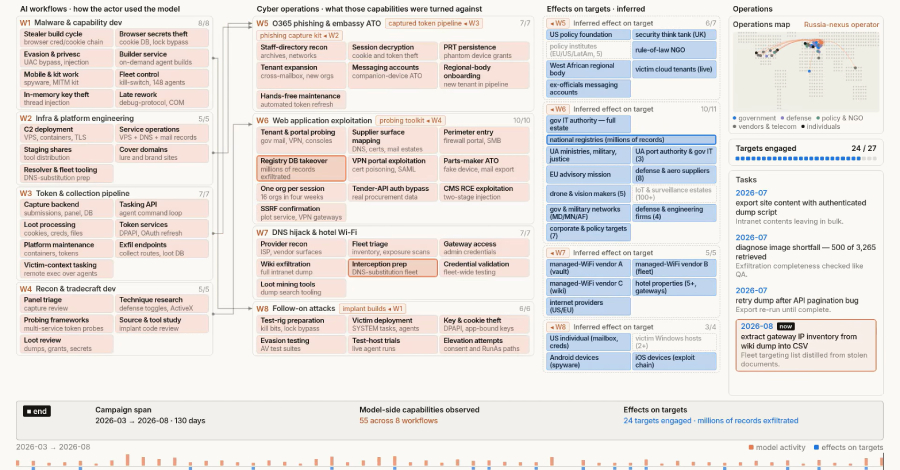
Anthropic said it disrupted a campaign by a Russian state-sponsored threat actor that used its Claude model to build an AI-assisted workflow for staying ahead of detection.
The company attributes the operation to a cluster it calls GTG-20006, a designation it says aligns with reporting that links the group to Midnight Blizzard, also known as APT29 and Cozy Bear. Anthropic did not detail the evidence behind that attribution.
According to Anthropic, the actor built a process to automatically rebuild and redeploy its toolkit whenever security products flagged it, undercutting defenders' ability to block the artifacts through static detections.
Anthropic said the toolkit included two Windows implants, a mobile exploitation kit, a credential stealer targeting browser password stores, a phishing platform mimicking priority targets such as government organizations, and an administrative console for managing compromised accounts. The company did not provide independent corroboration for the malware names or technical claims.
The actor used AI to watch how well its tools evaded known defenses, Anthropic said. When monitoring agents identified that deployed malware had been detected, the agents would set about autonomously modifying and rebuilding it to bypass those detections, according to the company.
Anthropic said more than 20 organizations were singled out during reconnaissance and live operations, including government ministries, defense and intelligence bodies, embassies and diplomatic missions, think tanks, and defense-industrial companies, mainly in Ukraine and Europe, with attacks also reaching the Middle East and maritime-related government agencies in Asia.
The company said the activity overlapped with a campaign called CaptiveCrunch, which it said was documented in July and August 2026 by ReliaQuest, Microsoft, Google, and Lumen Black Lotus Labs. Anthropic said the actor compromised at least three hospitality vendors operating hotel guest Wi-Fi, using admin credentials to modify DNS records so they pointed to actor-owned services. Guests who connected had their traffic, device identifier, and IP address sent to the actor's servers, the company said.
Anthropic also said the actor developed a cloud email espionage platform using a device code phishing framework codenamed Embassy Kit to orchestrate a Microsoft 365 token theft campaign targeting diplomatic and government personnel, resulting in unauthorized access and exfiltration of mail records from at least eight organizations.
Anthropic said the actor used AI at every point in its operations, including monitoring the stealth and persistence of implants in on-premises environments. The company said the result is that AI has inverted the cost back onto defenders, who previously might have slowed an attacker's operational tempo by deploying a new detection.
Source: The Hackers News