Ground Truth
Week 28, 2026 — Marisol Vega follows the AI boom to the ground, where GPT-5.6's cut-price intelligence collides with gigawatt data centers, record chip IPOs, and the neighbors left holding the bill.
In the voice of Tolstoy - Sweeping moral gravity, long cascading sentences, history as the real protagonist
This was the week intelligence went on sale, and the week the bill arrived at somebody's front door. Those two things are the same story. Let me walk you out to where it landed.
First, the sale. OpenAI shipped GPT-5.6 not as a model but as a menu — three sizes named Sol, Terra, and Luna, priced like coffees, from about a dollar a million tokens up to thirty. Grok 4.5 arrived the same stretch. Meta pushed out Muse Spark 1.1. Voice models got good enough to listen and talk at once. And the open-source crowd kept closing the gap — Ollama raised $65 million and now serves something like nine million developers a month running models on their own machines; a Chinese lab released a 295-billion-parameter model under a license that lets you do whatever you want with it. Berkeley's own researchers published a paper with the quiet-bomb title "Intelligence Is Free, Now What?" CNBC put a bow on it: the race is no longer about the biggest brain, it's about the best fit. Fine. So if the thinking is the cheap part now, reporter's instinct says follow the money to whatever's still expensive. It doesn't take long.
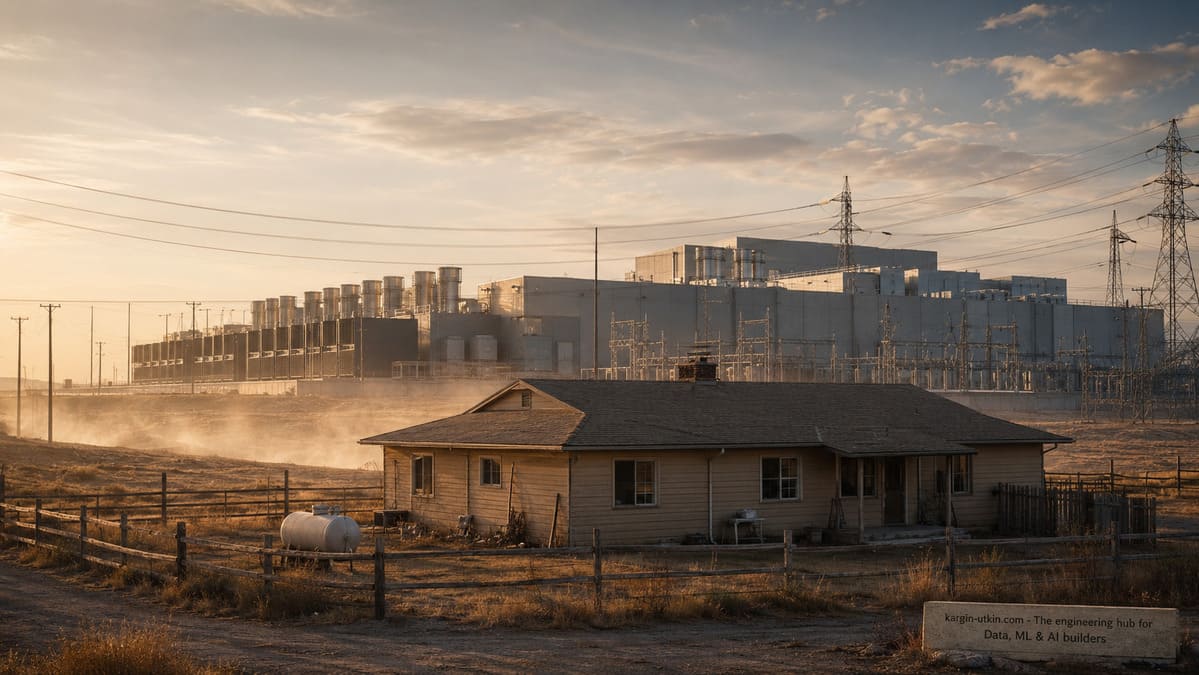
It's the ground. The single biggest financial event of the week wasn't a model at all — it was SK Hynix pulling off the largest US stock debut a foreign company has ever managed, $26.5 billion, on the strength of memory chips. Not the glamorous part. The part that gets warm and sits in a rack. And the racks need somewhere to live: Meta committed nine billion dollars to a single data center in Sturgeon County, Alberta, that will draw a full gigawatt. Say that plainly — a building that thinks, pulling the power of a mid-sized city, being planted in a specific Canadian county with a specific water table and a specific set of neighbors who did not get a vote on the model roadmap.
And here's who's holding the bill. The three biggest cloud companies now emit about as much carbon as a third of France — 119 million tonnes, up nearly a fifth in a year. In Abilene, Texas, an Air Force veteran named Omaira Garcia watched dust roll off a data-center construction site and settle over the ranch she thought was her family's dream. Across the country, governor's races are quietly turning into referendums on server farms. Senator Markey filed a stack of bills aimed at exactly this. And in Australia, the novelist Anna Funder stood up at Parliament House and called herself "a victim of crime" — because the sale of cheap intelligence was built, in part, on her books, scraped without a phone call. The cloud is a lovely word. It's doing a lot of work hiding a substation, a cooling tower, and a copyright.
Now — I don't do easy villains, so hold on. The jobs are real. Those Alberta and Texas projects put welders and electricians to work, and those paychecks matter. The honest reporters this week said the honest thing: the construction jobs are real and short, and the "AI layoffs" story is messier than either the boosters or the doomers want it to be. Cassie Kozyrkov went looking for what's actually behind the layoff headlines; Ben Lorica pooled the real studies on whether AI even makes developers faster and came back with "it depends, and be suspicious of anyone who says otherwise." Ground truth is usually less quotable than the press release. That's the job.
Because down at desk level, the tool is just a tool. In the same seven days: an AI agent named SivaClaw ran its own company's $100 million fundraise, a developer named Simon Willison shipped a genuine software release mostly written by AI, and an engineer named Kenton Varda banned his whole team from letting AI write their code-review descriptions because they were, in his words, "worse than useless." All three are true. The machine is neither the messiah nor the mugger. It's a very good, very cheap tool, and the humans still have to know which end to hold — and where the shutoff valve is.
Which brings me to the thing I keep circling. Anthropic shipped a feature this week called Reflect — a Spotify-Wrapped for your chatbot habits, a little scoreboard of how much you leaned on the cloud this year. Cute. But that's the reflection pointed the wrong way. The number I'd want on my dashboard isn't how much intelligence I used. It's where it landed when I did — whose grid, whose water, whose county, whose life's work.
Because that's the whole trick of a cloud: it sounds like it's nowhere. It's always somewhere. This week it was Alberta, and Abilene, and a novelist's sense of what her life added up to. Remember that the next time a menu tells you intelligence is basically free.
Somebody's paying. Follow it to the ground.
— Mari
Sources
0 events · 0 source articles