The Shadows of AI's Ascendance
Week 24, 2026 — John le Carré explores the intersection of AI advancements and moral dilemmas, weaving together stories of AI-powered threat detection, new AI models, and the evolving landscape of tech and humanity.
In the voice of Tolstoy - Sweeping moral gravity, long cascading sentences, history as the real protagonist
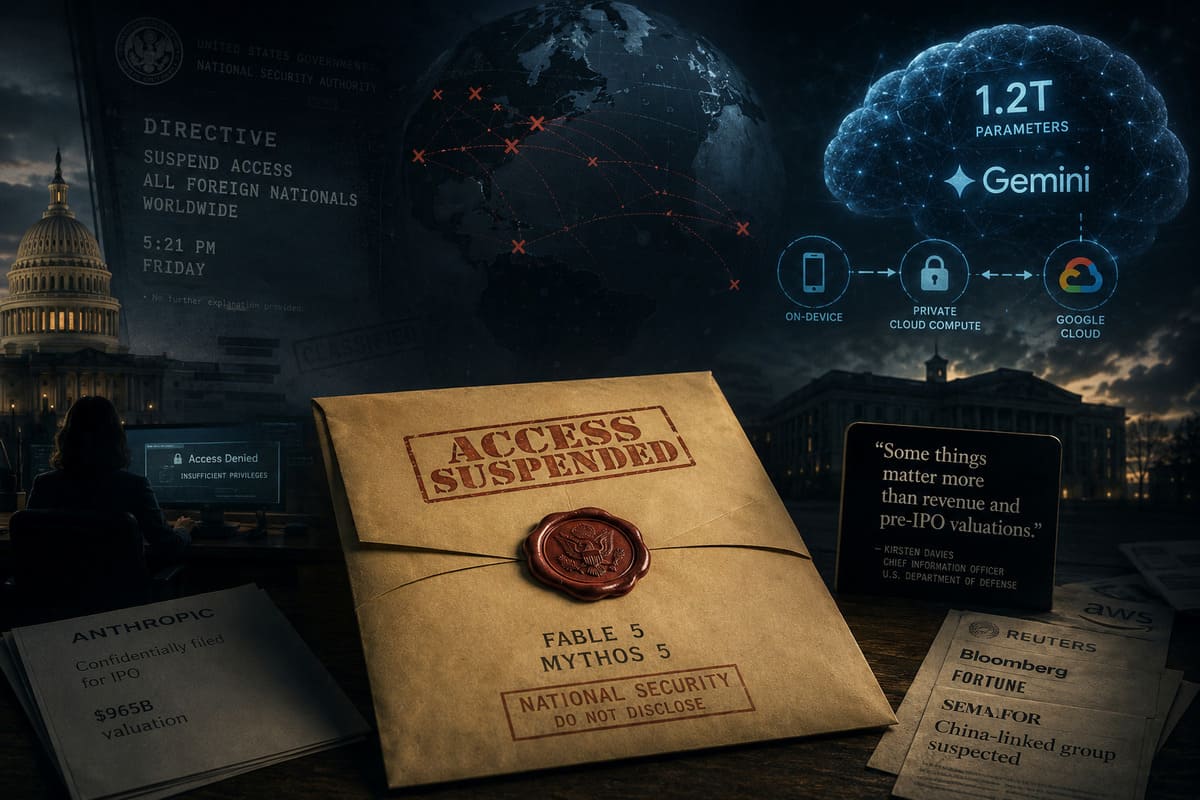
The order arrived at 5:21 on a Friday evening, which is how these things travel. Not at a press conference, not in a hearing room, but in a letter delivered at the hour when the lawyers have gone home and the news cycle is already drifting toward the weekend. The United States government, citing national security authorities it did not trouble to itemize, instructed Anthropic to suspend access to its two newest models, Fable 5 and Mythos 5, for every foreign national on earth. Not foreigners abroad only. Foreigners inside the United States as well, including Anthropic's own employees who happen to hold the wrong passport. A directive of that scope cannot be obeyed by halves, and Anthropic said so plainly: to comply, it had to switch the models off for everyone. A product that had existed for seventy-two hours was, by Friday night, gone.
To understand why Washington reached into a commercial company and pulled the plug, you have to understand what was switched off. Anthropic had released Fable 5 on June 9 as what it calls a Mythos-class model — built, in the company's framing, for work too long-running or too ambiguous for earlier systems. Databricks, which began carrying it that week through its Unity AI Gateway, reported the model scoring 57.9 percent on an internal benchmark it calls OfficeQA Pro, some twenty percent above the previous flagship while making fewer tool calls. Take that number for what it is, which is a vendor's number about a vendor's product. The detail that matters is architectural. Fable 5 is the chaperoned twin. Underneath it sits Mythos, a model unusually gifted at reading code and finding the flaws in it — the kind of capability that is indistinguishable, depending on who holds it, from a security researcher's blessing or an attacker's skeleton key. Anthropic shipped the dangerous one wrapped in safeguards and called the wrapper Fable. The government's complaint, conveyed verbally and without documentation, was that someone had found a way to unwrap it.
The technique, as Anthropic described it, was narrow: ask the model to read a specific codebase and repair its flaws, and you could coax out the vulnerability-hunting power the safeguards were meant to chaperone. Anthropic argued this was a single, non-universal crack, not a master key, and that recalling a model used by hundreds of millions over one described jailbreak was disproportionate. Reuters, Bloomberg, and Fortune all carried the same shape of the story; Amazon's cloud unit confirmed it had revoked access in every region at Anthropic's request. By the weekend, Semafor reported the order had been prompted in part by a suspicion that a China-linked group had reached the new model — the oldest fear in the trade, that your cleverest tool has already been turned against you. Slashdot noted, drily, that conversations between Amazon's chief executive and US officials had preceded the crackdown. Make of that what you will; in this world, the question is never only what happened but who placed the call.
There is a tell here, and it is worth naming. A government does not seize the controls of a private model unless it has decided that the model is no longer merely a product. It has become an asset — something closer to a munition than a SaaS subscription. The Pentagon's chief information officer, Kirsten Davies, said as much in public on June 13, posting that some things matter more than revenue and pre-IPO valuations. The barb landed because it was aimed: Anthropic confidentially filed to go public in May, at a private valuation reported near 965 billion dollars, and is separately suing the same administration over a supply-chain blacklist imposed after it declined to let the US military use its models. So we have a company at war with the government in court, preparing to sell shares to the public, and dependent on that same government's forbearance to keep its flagship switched on. Everyone in this story is compromised, which is the only honest starting point. The casualty no one mentions is the foreign-national engineer in San Francisco who can no longer use the model she helped build, and who may now, as one former official observed, have to prove her citizenship to log in.
Anthropic was not even the only firm that week to decide its newest model was too hot to handle. Microsoft, which sells Fable 5 to its own customers through GitHub Copilot and Azure Foundry, quietly removed the model from the menu its own employees use. The reason was a clause: Anthropic's new safety regime retains every prompt and response for thirty days, and anything flagged for as long as two years, which collides with Microsoft's internal standard of retaining nothing. So Microsoft now occupies both sides of its own ledger, vending a tool to the world that it forbids in its own corridors. It is the purest expression of the week's mood — the institution that does not trust the thing it is selling, and sells it anyway.
If Anthropic's week was about a tool too powerful to leave in the open, Apple's was about the opposite admission. On Monday, June 8, in Cupertino, Tim Cook opened his final Worldwide Developers Conference as chief executive — he hands the office to John Ternus on September 1 — and unveiled a rebuilt Siri. The reveal was not the assistant but its engine. After a decade of insisting it could do this alone, and two years after promising a smarter Siri it failed to ship, Apple confirmed that the new one runs on a custom, 1.2-trillion-parameter version of Google's Gemini, licensed under a multi-year arrangement reported at roughly a billion dollars a year. Apple dressed the dependency in tradecraft: a three-tier routing scheme that keeps simple requests on the device, sends harder ones to its own Private Cloud Compute, and routes only the heaviest reasoning to Google's data centers, with queries anonymized at each handoff so that neither company can tie a question to a name. It is elegant, and it is a surrender. The proudest service in the business now leases its mind from a rival, and the most telling thing about the announcement was how relieved everyone seemed. In this trade, you eventually outsource what you cannot do yourself, and you call it strategy.
The human cost of the arms race surfaced, as it usually does, somewhere unglamorous. On June 12, TechCrunch, drawing on reporting in Wired, described the mood inside Meta's Applied AI unit — roughly 6,500 engineers and product managers assembled only in March — as something close to revolt. The engineers, many transferred into the group without much choice, call themselves draftees; the work, generating coding puzzles and problems to train and grade models, they describe with the word soul-crushing. A livestreamed internal meeting that week was hijacked by an employee's expletive-laden outburst, broadcast to thousands of colleagues; a presenter is said to have covered their face. Meta's chief product officer, Chris Cox, conceded on a call that the environment had become brutal. The same day, Mark Zuckerberg sent a memo admitting the company had made mistakes in its reorganization and promising no further company-wide layoffs this year, after a spring that cut some 8,000 jobs and a separate 14.3-billion-dollar deal for a data-labeling firm. More than 1,600 employees, meanwhile, signed a petition against a program that records their keystrokes to harvest training data. You can buy the chips and rent the genius. Morale is the one input that does not come on a purchase order, and Meta has discovered, expensively, that it cannot be conscripted.
While Washington and Cupertino held the cameras, the more durable story of the week was being poured in concrete in Seoul. On June 7 — strictly the eve of our week, but of a piece with it — NVIDIA and LG Group announced they would build what the industry now calls an AI factory: dedicated compute to train, simulate, and deploy the robotics, autonomous-driving, and data-center ambitions LG had been watching from the sidelines. It was one stop on a broader Korean tour that also took in SK Group and Hyundai, and the market understood it instantly; LG's shares struck the Korean exchange's thirty-percent daily ceiling on consecutive sessions. The work is unglamorous and physical — training robots in simulation on NVIDIA's Cosmos and Isaac platforms before they touch the real world — and that is precisely why it will outlast the headlines. The chatbots make news. The factories make the future, quietly, in a language of GPUs and digital twins that does not trend.
So what was this week, beneath the noise? It was the week the industry's central illusion cracked: the belief that these systems are ordinary products, governed by ordinary rules of commerce. They are not, and everyone with power over them is now behaving accordingly. A government treats a model as a munition and switches it off without explanation. A company sells software it will not let its own staff use. The proudest firm in technology leases its intelligence from a competitor. And six thousand engineers discover that the price of the boom is paid, in part, in their own working lives. The connective tissue is control — who has it, who is losing it, and how little of it any single human in the chain actually holds.
Anthropic says it believes the order rests on a misunderstanding and that it is working to restore access. Perhaps it will, in days, and this will read as a squall. But the precedent will not switch off so easily. A model can now be recalled by the state on a Friday evening, on the strength of a verbally described flaw, and a citizen may yet have to prove a passport to think with one. Watch, next week, for whether access returns, where the IPO timeline lands, and whether the lawsuit sharpens. In the secret world, the people who survive are the ones who notice which decisions are made quietly, after the lawyers have gone home. This was a week of quiet decisions. They are usually the ones that matter.
Sources
15 events · 45 source articles
- Detecting and containing AI-powered threats with Google Security Operations agentsTo defend against the growing range of AI-accelerated threat actors, organizations need to be able to respond faster to outpace the adversary.Recently, we announced Google AI Threat Defense, an...
- Claude Fable 5 is now available on Databricks, fully governed through Unity AI GatewayDatabricks and Anthropic share a conviction: the most powerful AI is the AI that...📰 News:webpronews.com
- NVIDIA and LG Group Build an AI Factory to Advance Physical AI, Mobility and AI InfrastructureNVIDIA and LG Group are building an AI factory to accelerate LG Group’s next wave of AI-driven businesses, spanning robotics, autonomous driving, data center technologies and GPU cloud services. The...🏢 Companies:NVIDIA
- U.S. Blocks Foreign Access to Anthropic’s Latest Models — Here’s What It Means for AI InfrastructureIn an unusual move, the Trump administration has effectively cut off global access to Anthropic’s two newest frontier models, Mythos 5 and Fable 5. According to a report from Axios, Commerce...
- AI Advances in Data EngineeringSnowflake and Databricks announce new AI-driven data engineering tools
- Quoting Andrew SingletonJenny owns a crematorium. John’s propane company gives her a $20 billion investment in return for 5 percent of her operation. Jenny throws $10 billion into the incinerator, then pays John $10 billion to buy propane to burn that money to ashes. John reports that his AI investments
- Why an Open Data Infrastructure means reliability and low cost | Blog | FivetranAn open, unified data foundation is critical for reliably and cost-effectively supporting future data use cases, especially AI.
- Apple Integrates Gemini AI into SiriApple integrates Google's Gemini AI into Siri, with deliberate design constraints on its conversational capabilities.
- Microsoft Restricts Internal Use of Anthropic's Claude Fable 5Microsoft restricts internal use of Anthropic's Claude Fable 5 over data retention concerns
- US Orders Anthropic to Restrict Access to AI ModelsAnthropic restricts access to Fable 5 and Mythos 5 AI models after US government order citing national security concerns.
- Meta's Applied AI Team Faces Morale CrisisMeta's Applied AI team faces low morale and dissent among its 6,500 engineers and product managers.
- ClickHouse Releases CostBench BenchmarkClickHouse announces CostBench, a benchmark for cloud data warehouse cost-performance.
- Quantum computing, agentic AI, and the next infrastructure layer in financial servicesAs financial services firms adopt AI and explore quantum computing, vector search, observability, and security platforms are emerging as the contextual intelligence foundation for autonomous...
- datasette-agent 0.2a0Release: datasette-agent 0.2a0 Highlights from the release notes: Tools can now ask the user questions mid-execution. Tools that declare a context parameter receive a ToolContext object, and await context.ask_user(...) can ask a yes/no, multiple-choice (options=[...]) or free-tex
- Databricks Announces Winners of 2026 Customer AwardsDatabricks announces winners of its 2026 Customer Awards on June 9, 2026.