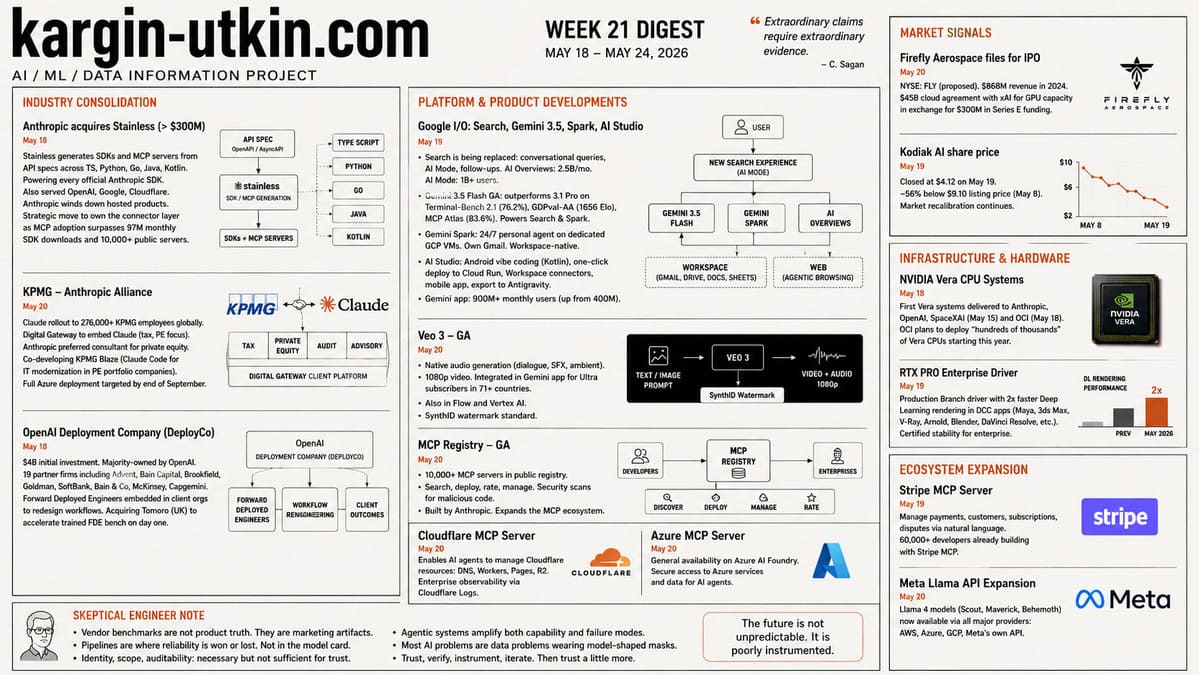
The Connector Layer Becomes a Control Point
Week 21, 2026 — Anthropic buys the plumbing, Google replaces the search box, and SpaceX files the biggest IPO in history on the back of a compute lease. One story, three desks.
In the voice of The Skeptical Engineer - Senior IC voice, dry, has seen this exact hype cycle three times before
Week 21 · May 18 – May 24, 2026
The week's organizing fact is consolidation. Big Four firms locking in single-vendor AI relationships. A foundation model company buying the plumbing under its own developer ecosystem. A search company telling 2.5 billion people the search box they've used for twenty-five years is being replaced by an agent. A rocket company filing to go public on the back of a $45 billion compute lease to its closest model-maker rival. None of it is unrelated.
Monday, the eighteenth. Anthropic acquired Stainless for terms it didn't disclose, though The Information had earlier reported the deal at more than $300 million. Stainless, founded in 2022 by ex-Stripe engineer Alex Rattray and backed by Sequoia and a16z, generates SDKs and MCP servers from API specs across TypeScript, Python, Go, Java, and Kotlin. It powered every official Anthropic SDK from the early days of the Claude API — and also served OpenAI, Google, and Cloudflare. Anthropic is winding down the hosted Stainless products; customers keep the SDKs they've already generated. The strategic read is the one that matters: as MCP adoption pushes past 97 million monthly SDK downloads and 10,000+ public servers, the connector layer between enterprise APIs and AI agents has become a control point. Anthropic just took that layer in-house and out of competitors' supply chain at the same time. Pulling a key supplier away from your rivals is an old move; doing it to the connector layer of the protocol you yourself authored is a newer one.
The same day, NVIDIA's first Vera CPU systems landed. Ian Buck — NVIDIA's VP of Hyperscale and HPC — hand-delivered them to Anthropic in San Francisco, OpenAI in Mission Bay, and SpaceXAI in Palo Alto on Friday the fifteenth, with a delivery to Oracle Cloud Infrastructure in Santa Clara on Monday. Vera is NVIDIA's first custom CPU, purpose-built for agentic AI workloads where reasoning models generate Python and call tools rather than retrieving prepared answers. OCI's Mahesh Thiagarajan told NVIDIA the company plans to deploy "hundreds of thousands" of Vera CPUs starting this year. NVIDIA's CPU business is positioned, in Jensen Huang's framing, as its next multi-billion-dollar segment — which says something about where the company believes its growth ceiling sits when GPU margins eventually compress.
Tuesday, the nineteenth, was Google I/O. A lot of news at once, but the architectural piece is this: Google is replacing the search box. TechCrunch's headline — "Google Search as you know it is over" — was the right register. The new Intelligent Search Box accepts longer conversational queries, eliminates mode selection, supports follow-ups in AI Mode. AI Overviews now reach 2.5 billion people monthly; AI Mode passed 1 billion. This summer, a generative interactive interface built by Google DeepMind on Gemini 3.5 Flash rolls out free to everyone. The classic ten blue links remain on the page, but as Google's spokesperson clarified, follow-up questions and the AI Mode button hand you into the agent stack. The structural read is the one that should worry publishers: if "searching the web" increasingly means agents browsing on behalf of humans, the referral economy that funded the open web for two decades is on a faster timeline to its endgame than most thought.
Google also launched Gemini Spark — its first 24/7 personal agent, built on Gemini 3.5 and the Antigravity harness, running on dedicated Google Cloud VMs so it works whether your laptop is open or not. Beta to Google AI Ultra subscribers next week. Spark's distinctive advantage: it has its own Gmail address, and connects natively to Workspace from the first session. Third parties come in through MCP later. Sundar Pichai called it "your personal AI agent that helps you navigate your digital life." Spark follows Claude Cowork and the ChatGPT agent into a category that didn't have a name a year ago.
The model family underneath all this is Gemini 3.5, with 3.5 Flash generally available today. Google's published benchmarks have it outperforming Gemini 3.1 Pro on Terminal-Bench 2.1 (76.2%), GDPval-AA (1656 Elo), and MCP Atlas (83.6%). It's the default in the new Search experience and powers Spark. Google also previewed Gemini Omni, a unified multimodal model that generates video from any input, and shipped substantial updates to Google AI Studio: native Android vibe coding in Kotlin, one-click deploy to Cloud Run (first two apps free), Workspace integrations so AI Studio apps can read Sheets and Drive directly, an AI Studio mobile app, and export to Google Antigravity for local development. AI Studio is positioning itself as prompt-to-production, not prototype-and-stop.
The Gemini app, Google said, has gone from 400 million monthly users at last year's I/O to more than 900 million today. ChatGPT runs around 900 million weekly. The two are now near-equivalent at the top of the chart by different denominators.
Tuesday also brought the KPMG-Anthropic alliance. Claude is being rolled out to all 276,000+ KPMG employees globally — one of the largest enterprise AI deployments in professional services to date. The Digital Gateway client platform will embed Claude (initial focus: tax and private equity), Anthropic named KPMG its preferred consultant for private equity, and the two are co-developing offerings including KPMG Blaze, which embeds Claude Code into IT modernization work for PE portfolio companies. Full implementation on Microsoft Azure is targeted for end of September. This is the second Big Four AI tie-up for Anthropic in two weeks — PwC was the prior. The pattern: every major consulting firm now needs a single anchor frontier-model relationship as a market signal, and Anthropic is collecting two of the four. Deloitte and EY's choices are the obvious next data points.
A related Anthropic line: Claude Managed Agents expanded the same day with self-hosted sandboxes in public beta and MCP tunnels in research preview. The orchestration loop stays on Anthropic's infrastructure; tool execution moves to the customer's own perimeter. This is what enterprise actually buys — the audit-logged side of agentic AI.
Mid-week, Singapore. OpenAI announced OpenAI for Singapore at the ATx Summit on May 19, formalized via MOU with the Ministry of Digital Development and Information on May 20. S$300 million-plus commitment. The centerpiece is OpenAI's first Applied AI Lab outside the United States, with 200+ Forward-Deployed Engineer roles to be staffed over the next few years. The collaboration includes the Ministry of Education and GovTech (with stated work on AI-enabled Mother Tongue language learning), a Singapore chapter of the OpenAI Academy, Codex for Teachers hackathons, and an FDE training program for mid-career engineers. OpenAI also published "The next phase of OpenAI's Education for Countries" at the Education World Forum in London on the 20th. Singapore joins Malta (last week) in the country-tier of OpenAI's strategy. The pattern reads as small, capable, digitally-mature governments being courted with capital deployments as the new shape of soft power.
Wednesday, the twentieth, was SpaceX's S-1 filing — and Anthropic's quarterly compute bill becoming public. SpaceX filed for a $1.75 trillion IPO on NASDAQ under ticker SPCX, targeting June 12 with a $75 billion raise. The largest IPO in U.S. history if it lands. Buried in the recent-developments section: Anthropic has signed Cloud Services Agreements paying SpaceX $1.25 billion per month through May 2029 for compute capacity across the Colossus 1 and Colossus 2 supercomputer campuses in Memphis. Roughly $15 billion a year. Up to $45 billion over the term. Either party can terminate on 90 days notice. The original Anthropic-SpaceX partnership announcement was May 6; what Week 21 added was the dollar figure, in SEC-filed black and white.
Two things to sit with. First: xAI, owned by SpaceX after the merger earlier this year, just rented its first-generation training cluster — built originally to train Grok — to xAI's most direct frontier-model competitor. Musk explained the reversal on X: "No one set off my evil detector," he said of meeting senior Anthropic staff. (His February characterization of Claude as "misanthropic and evil" did not feature in the post.) Second: SpaceX's xAI segment posted an $818 million revenue and a $2.5 billion operating loss in Q1. The Anthropic contract at full run rate represents roughly $3.75 billion of quarterly revenue — more than four times what the AI division most recently generated. The deal is doing two jobs at once: funding the AI buildout three times over while underwriting the IPO narrative that SpaceX is an AI infrastructure company, not only a rocket company.
The contract's 90-day exit clause is the part to watch. $45 billion of "secured" revenue that either party can walk away from in three months is a different financial instrument than $45 billion of secured revenue you can't. Investors evaluating SPCX will need to price that flexibility.
Friday, the twenty-first, was a heavy day on the data side. The U.S. General Services Administration announced its 21st OneGov agreement, with Snowflake. New federal users get 20% off compute, 26.67% off storage, and potential discounts up to 50% as usage scales, available through September 30, 2027. The deal positions Snowflake alongside Microsoft, SAP, Palo Alto Networks, OpenAI, Anthropic, and Perplexity on the federal AI procurement list. GSA Administrator Edward Forst framed it as breaking down "long-standing silos" — federal-agency-speak for the perennially unsolved problem of cross-agency data sharing. Whether a procurement framework solves it is the open question; it has not been solved by the last several attempts.
Databricks published two Genie use-case posts the same week. Kim Hatton's May 22 piece on financial services made the "Last Mile of Data Democratization" argument: enterprise data platforms have democratized access for analysts and data scientists, but business leaders still depend on intermediaries because they lack SQL fluency or BI training. Genie's natural-language interface aims to close that gap on governed data. The other Databricks post — "From What Happened to What Will Happen" — covered a multi-agent prediction system combining Genie with TabPFN (a tabular foundation model from Prior Labs, connected to Unity Catalog as an external MCP server) for predictive questions over Lakehouse data. The pattern across both is Databricks consolidating around Genie as the natural-language layer the way Microsoft consolidated around Copilot Studio as the agent layer.
Speaking of which: Microsoft Copilot Studio's computer-using agents reached GA on May 13 and the press wave hit this week with a May 22 deep-dive that's worth registering. Microsoft is the first major hyperscaler to ship computer-use at full GA across all commercial Power Platform geographies. GA models are OpenAI CUA and Claude Sonnet 4.5; Sonnet 4.6 and Opus 4.6 are still marked Experimental. The competitive frame: as of May 22, Anthropic's own computer-use offering is in paid-plan beta and Google's Gemini Computer Use is in public preview. For enterprises that need a contractual SLA, Purview audit logging, and broad geographic availability, Microsoft is the only production-ready option. That lead will erode, but the lead is real today.
Friday also brought Nasdaq eVestment + Snowflake Cortex — a Snowflake blog case study on agentic AI for institutional asset managers. eVestment's AI-ready datasets, which launched in October 2025 covering 27,500+ institutional strategies and 25,500+ investor profiles, are now integrated through Snowflake Cortex with conversational query and Next Best Action scoring. The use case is mandate-discovery automation: which investors are under-allocated in core fixed income with open mandates, ranked and scored daily. Familiar pattern for the week: a data provider plus a cloud-warehouse-plus-AI-stack producing what used to be a $250-an-hour analyst's morning of work in seconds.
dbt Labs published "AI-ready data in practice: what dbt Semantic Layer and dbt's MCP server and agent skills do for your team" — the cleanest statement so far of the three-layer agent stack dbt is converging on. Semantic Layer holds the definitions of what your data means (metrics, dimensions, entities). The MCP server exposes that structured context to agents so they don't have to guess. Agent skills are workflow instructions — proven recipes for common dbt tasks (writing tests, debugging failures, defining metrics, handling migrations) that load on demand. The thesis: text-to-SQL on a complex enterprise schema fails in ways that look like success, while structured semantic context plus skill-scaffolded agents fail visibly when they fail. dbt's own April benchmark put the Semantic Layer near 100% accuracy for covered queries against text-to-SQL's substantially-lower numbers on the same data. The thesis is being argued aggressively because dbt is in a contested market segment.
DuckDB Labs and LanceDB announced the Lance lakehouse format extension for DuckDB on May 21. Lance, originally designed by LanceDB for AI workloads — vectors, multimodal, rich table operations — is now queryable from DuckDB SQL via the lance extension. The benchmark numbers, particularly on cold runs, suggest Lance is a serious alternative to DuckDB's own format for vector and hybrid search. The broader pattern: open lakehouse formats are proliferating (DuckLake reached 1.0 in April, Iceberg keeps evolving, Lance entering the SQL ecosystem) and the consolidation pressure is on the proprietary warehouses, not on the open formats.
MotherDuck posted what is probably the most useful thing I read this week: "The agent writes the SQL and the data viz now — here's what's still your job." The headline number: a very hard natural-language-to-SQL benchmark went from 30% to 93% accuracy with Gemini Flash, not by changing the model, but by changing the data layer it queries — proper modeling, cleaned semantics, governed metrics. The argument generalizes: model accuracy on enterprise data isn't a model problem anymore, it's a data-layer problem, and data engineers are not being deprecated by NL2SQL — they're being moved upstream of it. Worth reading in full.
Apache Airflow appears in this week's brief, but the AI survey-pipelines post Airflow published is actually from April 15 — Week 16 — using the 2025 community survey (5,818 responses, 168 questions, the largest data-engineering survey on record). The new apache-airflow-providers-common-ai provider for Airflow 3 is real and important; the timing in the brief was wrong. The only Airflow news this week is Niko Oliveira joining the PMC on May 21, which is internal governance and not worth dwelling on.
Vercel shipped three meaningful things to the AI Gateway and Chat SDK in the May 18-21 window. Grok Build 0.1 from xAI went live on AI Gateway — the beta agentic coding model that powers xAI's Grok Build CLI app. Reasoning effort is non-configurable; there's no non-reasoning mode. Qwen 3.7 Max from Alibaba went live the same week — designed as an agent foundation with long-horizon tool-calling, frontend prototyping, and complex multi-file engineering. And Chat SDK added built-in support for AI SDK tools via a single createChatTools call that exposes every adapter as a toolset for an agent, with presets and approvals built in. Vercel is positioning AI Gateway as the model-routing and observability layer; Chat SDK as the agent-orchestration layer above it. The bundle thesis is clear.
One item from the brief that doesn't belong in this digest: the GeForce NOW 007 First Light bundle and Forza Horizon 6 launch (May 21) is cloud gaming. Not AI. Sixth consecutive week the brief has tried to include a GeForce NOW item, which means it's probably time for the brief generator's prompt to be tightened. Flagged again here so the pattern is visible.
Stepping back. Three structural moves to register from this week alone. First, Anthropic is buying the plumbing under the agent economy it largely defined (MCP, Stainless) while simultaneously becoming the model anchor for two of the Big Four (PwC last week, KPMG this week). Second, Google is rewriting how 2.5 billion people search and shipping a personal agent at the same time — the search-era inflection point most observers expected in 2027 or 2028 turns out to have been this week. Third, SpaceX is going public on the strength of a $45 billion compute lease to Anthropic, which means the largest IPO in U.S. history is being underwritten in part by the AI infrastructure economy Anthropic itself is helping to consolidate.
These are not three stories. They are one story told from three desks. The frontier-model layer, the search and agent layer, and the compute and capital layer are visibly fusing into a single industrial structure with maybe six companies in the front row and not much daylight between them.
Next week is Snowflake Summit. Daniela Amodei on the opening keynote with Sridhar Ramaswamy. Expect more of the same shape — another large enterprise locking in another single-vendor frontier AI relationship, on stage.
The desk gets quiet on Sundays. The story does not.
Sources
15 events · 33 source articles
- AI-ready data in practice: What dbt Semantic Layer and dbt's MCP server and agent skills do for your teamClean data is just the start. See how dbt's semantic layer, MCP, and agent skills give AI the business context it needs.
- Databricks Genie Enhances Data Access and AnalyticsDatabricks announces Genie, enhancing data access and analytics in various industries.
- Vercel CLI Updates AnnouncedVercel AI announced updates to its CLI and services in May 2026
- Ask Your Survey Anything: Building AI Analysis Pipelines with Airflow 3The 2025 Airflow Community Survey collected responses from nearly 6,000 practitioners across 168 questions. You can open a spreadsheet and filter, or write SQL by hand. But what if you could just ask...
- Google Search Rebuilds Its Core Pipeline: From Blue Links to Conversational AgentsAt I/O 2026, Google made its most direct statement yet on the architectural shift of its flagship product: Search is moving away from the classic blue-link retrieval model and toward a conversational...
- Agentic AI in Financial Services: How Nasdaq eVestment Drives Faster Investment InsightsDiscover how Nasdaq eVestment uses agentic AI, Snowflake Cortex and trusted institutional data to help asset managers accelerate prospecting, improve win rates and drive faster investment insights.📰 News:getdbt.com🏢 Companies:Snowflake
- New AI Models Available on Vercel AI GatewayVercel AI releases new AI models on its AI Gateway on May 20 and 21, 2026.
- Breaking Down Data Silos: A New Path to Making AI-Driven Government a RealityThe U.S. General Services Administration (GSA) announced a new OneGov agreement with Snowflake, to empower federal workers to break down data silos, enhance mission effectiveness and accelerate IT...
- Test-Driving the Lance Lakehouse Format in DuckDBLance is an open lakehouse format with a design geared toward AI workloads. LanceDB and DuckDB Labs have partnered to bring you fast vector and hybrid search directly from DuckDB SQL, without leaving...
- Vera Arrives: NVIDIA’s First CPU Built for Agents Lands at Top AI LabsThe first NVIDIA Vera CPUs arrived at three of the world's leading AI labs on Friday — Anthropic in San Francisco, OpenAI in Mission Bay, SpaceXAI in Palo Alto — followed by a delivery to Oracle...📰 News:techcrunch.com🏢 Companies:NVIDIA
- Vercel AI Updates Chat SDKVercel AI updates Chat SDK with new features on May 20, 2026.
- OpenAI Expands AI Initiatives in Education and SingaporeOpenAI expands AI education initiatives and launches a multi-year AI partnership in Singapore
- Google AI Studio updates integration with Google Cloud servicesGoogle announced updates to AI Studio and Google Cloud integration at Google I/O 2026🏢 Companies:Google Cloud AI
- ‘007 First Light’ Coming to GeForce NOWNVIDIA's GeForce NOW adds '007 First Light' and eight new games.🏢 Companies:NVIDIA
- Using AI for Data EngineeringMotherDuck discusses AI in data engineering, using Substrait over SQL and context management with the Ralph Loop.🏢 Companies:MotherDuck