Dispatches from a Department of Unrelenting Progress
Week 20, 2026 — Kafka navigates the latest in AI advancements, data center scrutiny, and tech industry developments.
In the voice of Kafka - Bureaucratic nightmare, helpless protagonist, the system that cannot be appealed to
The file arrives. I open it. I will say only what is in it, and try not to dramatize the saying.
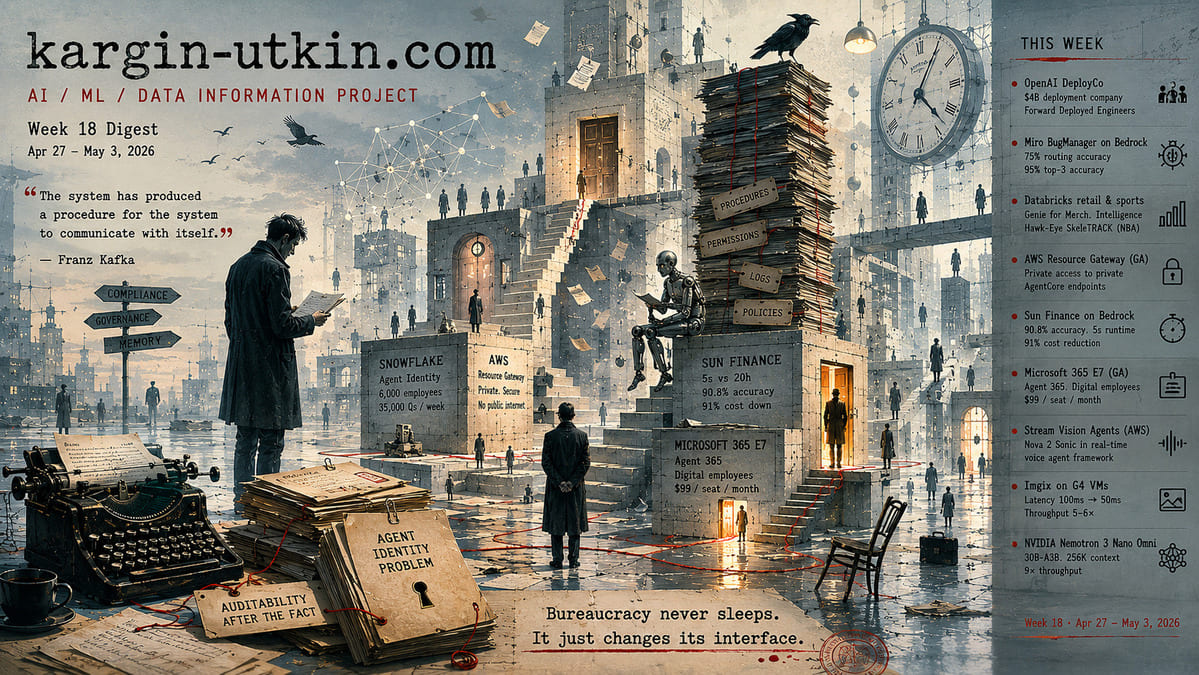
Monday, the eleventh. OpenAI launches what it is calling the OpenAI Deployment Company — DeployCo, in the corridors. Four billion dollars of initial investment, nineteen partner firms (Advent, Bain Capital, Brookfield as principals; Goldman, SoftBank, BBVA, B Capital, Emergence, Warburg Pincus, WCAS as founders; Bain & Co, Capgemini, and McKinsey on the consulting side). Majority-owned and controlled by OpenAI. The product is Forward Deployed Engineers — specialized OpenAI staff embedded inside client organizations to redesign workflows from the inside. As part of the launch, OpenAI is acquiring Tomoro, a UK shop with experience deploying AI at Tesco, Virgin Atlantic, and Supercell, to give DeployCo trained FDEs on day one. The framing is honest about what it is: a consulting business, with the foundation model maker as the parent. PwC the week before, DeployCo this week — the shape of the next phase is visible.
The same day Miro published a deep-dive on the engineering blog. They built a system called BugManager on Amazon Bedrock — RAG over Bedrock Knowledge Bases pulling from Jira, GitHub PRs, Confluence; Amazon Nova Pro for the multimodal parts (screenshots, videos in bug reports); Claude Sonnet 4 for the classification across roughly 100 internal teams. The numbers, after deployment: 75% top-1 routing accuracy (a 70% improvement over their previous fine-tuned NLP baseline), 95% top-3 accuracy, six times fewer team reassignments, five times faster median time-to-resolution. They estimate misrouting was costing them 42 years of cumulative engineer-time per year. That number does what good case studies do — it makes the abstract problem concrete.
Tuesday. Two Databricks pieces land within hours of each other. One is on retail markdown optimization — Sarah Duffy arguing that the difference between a strategic price adjustment and a forced markdown is mostly data latency, and that Databricks Genie for Merchandise Intelligence closes that gap by letting Chief Merchandising Officers query trends, inventory, and pricing in natural language instead of waiting on weekly batch reports. The other is on Sports Intelligence: a lakehouse architecture built around Sony Hawk-Eye's SkeleTRACK system, which replaced Second Spectrum as the NBA's tracking provider in March 2023 and now captures 29 skeletal joints per player at 60Hz for all 13 people on the floor. Corey Abshire, Kush Patel, and Nick Ragonese co-authored. Hawk-Eye produces the optical data; Databricks is the place to land, model, and query it.
Also Tuesday: Amazon Nova 2 Sonic appears in an AWS Machine Learning blog post on real-time voice agents, packaged with a new open-source framework called Stream Vision Agents. (Worth noting that Nova 2 Sonic itself was announced at re:Invent in December — speech-to-speech model, seven languages, polyglot voices, 1M context window. The news this week is the Stream integration, not the model.)
Two more from Databricks, May 12: a clinical operations intelligence post and an open-source Site Feasibility Workbench for trials. The framing is grim — nearly half of investigator sites miss enrollment targets — and the proposed remedy is a lakehouse-grounded site selection model that uses historical performance data instead of intuition.
Amazon Nova 2 Sonic appearing here, Claude Sonnet 4 running Miro's bug router, Gemini 3.1 Flash-Lite (last week's GA) inside retail-bot pipelines — the multi-model enterprise pattern is no longer a forecast. It's just the wiring.
Wednesday, the thirteenth. NVIDIA's blog covers Hermes Agent — and here's a thing to be careful about. Hermes Agent was not built by NVIDIA. It was built by Nous Research, the lab behind the Hermes, Nomos, and Psyche model families. NVIDIA's contribution is a hardware story: Hermes runs well on RTX PCs, RTX PRO workstations, and DGX Spark — that's what the announcement is. The agent itself launched in February, picked up 140,000 GitHub stars in three months, and as of last week is the top-ranked agent on OpenRouter by daily token volume — around 224 billion tokens a day. It's MIT-licensed, self-hosted, fully local, with persistent cross-session memory and a self-writing skill system. The brief I received misattributed the framework to NVIDIA, which is a meaningful error: Hermes is community-built and provider-agnostic, and that is half the point of it.
The same day, three OpenAI Academy installments appeared in the How [function] teams use Codex series — for sales, business operations, and finance. The "Work with Codex from anywhere" post landed the day before. The thread running through all of it: Codex is not just for engineers anymore. The Academy materials show finance analysts using it on reconciliations, sales ops on territory modeling, business ops on vendor data clean-up. The friction of "ask the developer" is being routed around inside the customers themselves.
Confluent on the same day published a blog with InfiniteWatch — a New York startup founded in October 2025 by former CoverWallet leadership, building what they call AI-native customer interaction intelligence. Two products: a Session Replay Agent and a Voice Agent. They analyze more than two million customer interactions a month and use Confluent's event streams as the backbone, with ClickHouse on the analytical side. Pre-seed of four million dollars from Base10 Partners in December. Small company, real architecture, names worth knowing if conversational interaction analytics is a category you watch.
Thursday. Google Cloud's blog covered Imgix moving to G4 VMs (RTX PRO 6000 Blackwell GPUs). Eight billion image transformations a day. Median latency from 100ms to 50ms — half. Throughput per node up five to six times. They did it without rewriting their core logic, using NVIDIA's nvJPEG for decoding, DeepStream for video, and CUDA libraries for the rest. The detail that struck me: this isn't a training story; it's an inference-at-scale story for a workload most people don't think of as AI — image resizing and reformatting. Blackwell as plumbing.
Friday, the fifteenth. AWS publishes a Machine Learning blog post on document-level ACLs for S3 knowledge bases in Amazon Quick. The feature itself shipped in April; this post is the walkthrough. Two configuration modes: a global ACL file (centralized, slower to update — large knowledge bases require reindexing the affected prefix), or per-document metadata files (granular, reindexes only the changed document). The constraint worth flagging: ACL configuration is permanent at knowledge-base creation time. You can't enable it later; you can't disable it once enabled. Documents without an ACL entry are not ingested. The deny-by-default model has real consequences for migration planning.
A Databricks post the same day covered ABAC row filtering and column masking — now generally available in Unity Catalog, along with Governed Tags and automated Data Classification. Attribute-Based Access Control means policies live at the catalog level and key off tags, so one policy can govern many tables rather than each table carrying its own filter UDF. The shift matters because the per-table approach was producing the predictable failure mode: subtle inconsistencies in masking logic across teams, stale rules on older tables, gaps surfacing only during audits.
Australia, somewhere in the same week. The federal budget contained a capital gains tax reform — replacing the 50% discount with an inflation-indexed model — which tech founders read as a hit on equity-based compensation and a problem for talent recruitment. They responded with AI-generated memes of Prime Minister Albanese as "47% co-founder" (the marginal rate). Jacques Greeff, the founder of Kinso, was quoted on the talent-recruitment difficulty; the Tech Council of Australia welcomed the venture-capital portions of the reforms and went quiet on the CGT part. The Prime Minister, asked about the memes, thanked the founders for the "very nice photos." A genuinely funny moment from a sector that does not generate many of them.
Late in the week. OpenAI and Malta announce a partnership called AI for All — every Maltese resident or citizen (roughly 574,250 people) gets one year of free ChatGPT Plus after completing an AI literacy course run by the University of Malta. The Malta Digital Innovation Authority handles distribution. This is the first country-level partnership of its kind, part of the broader OpenAI for Countries program. The OpenAI blog post is dated May 18, but the news cycle began on the sixteenth via Engadget and Dataconomy. Worth watching: whether the literacy-course requirement gets honored or quietly waived once enrollment lags, and whether other small EU countries are next.
The continuing backstory. Data center opposition is the news that won't go away. Heatmap reported in early May that at least 20 proposed projects were canceled in the first quarter alone after local pushback — beating the previous quarterly record. Total canceled over the past three years: about $85 billion. State-level moratorium bills introduced in 11 states; dozens of municipalities have moved ahead with local pauses on their own. Northern Virginia's Data Center Alley won't see new project starts until 2032 because of energy scarcity. The Maine LD 307 veto was a month ago, but the council Governor Mills formed in its wake will issue recommendations in early 2027. The boom and the backlash are both real, both growing, and increasingly the same story.
There was also a GeForce NOW item for Subnautica 2 launching day-one on the service. Cloud gaming; not AI; filed where it belongs.
I close the file. The hum of the machines does not stop, but I have stopped listening to it for the moment, which is its own small mercy. A new dispatch will arrive on Monday. Until then.
Sources
15 events · 30 source articles
- AI Technology Advances: New Tools and ApplicationsSeveral companies announce new AI tools and applications for various industries.
- Teams Use Codex for TasksOpenAI shows how various teams can use Codex for tasks.
- InfiniteWatch + Confluent: Turning Customer Interaction Data into Real-Time IntelligenceInfiniteWatch is building an AI-native customer interaction intelligence platform that unifies these streams into a continuous, real-time understanding of customer behavior and operational state. At...
- Data Centers Face Growing ScrutinyData centers face increased scrutiny over energy use and local opposition.
- Amazon Nova 2 Sonic for Real-Time Voice ApplicationsAWS releases Amazon Nova 2 Sonic for real-time voice applications
- Databricks Lakehouse Applications in Various IndustriesDatabricks announces Lakehouse applications in clinical operations and sports intelligence.
- Founders Mock PM with AI MemesAustralian tech founders use AI to create memes poking fun at Prime Minister Anthony Albanese in protest against tax changes.📰 News:theguardian.com
- OpenAI and Malta partner on ChatGPT PlusOpenAI and Malta partner to offer ChatGPT Plus to citizens.🏢 Companies:OpenAI
- Restrict Access to Sensitive Amazon S3 DocumentsAWS AI/ML explains how to configure document-level ACLs for Amazon S3 knowledge bases in Amazon Quick.🏢 Companies:AWS AI/ML
- Subnautica 2 Early Access Available on GeForce NOWNVIDIA announces Subnautica 2 is available on GeForce NOW on its launch day🏢 Companies:NVIDIA
- ABAC row filtering and column masking in Unity CatalogDatabricks releases ABAC row filtering and column masking in Unity Catalog.🏢 Companies:Databricks
- NVIDIA Introduces Hermes Agent for Self-Improving AINVIDIA releases Hermes Agent, a new open-source agentic AI framework.🏢 Companies:NVIDIA
- How Imgix processes 8 billion images daily with G4 VMs powered by NVIDIA BlackwellThe modern web is extremely visual. People are busy and easily-distracted, and smart companies know they have just seconds to attract would-be customers with compelling images, videos, animations,...🏢 Companies:Google Cloud AI
- Miro uses Amazon Bedrock to boost software bug routing accuracyMiro improved bug routing using Amazon Bedrock, reducing team reassignments by six times and time-to-resolution by five times.🏢 Companies:AWS AI/ML
- OpenAI launches DeployCo to help businesses build around intelligenceOpenAI launches DeployCo to help businesses integrate AI into production.🏢 Companies:OpenAI