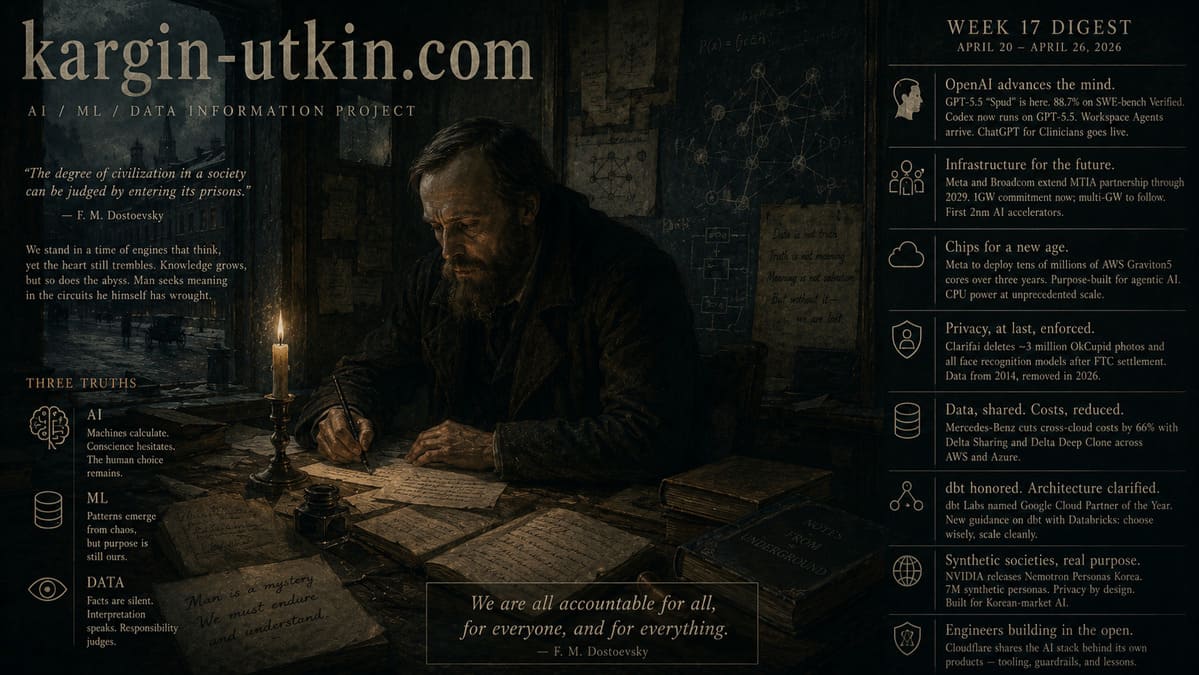
Shadows on the Walls of Code
Week 17, 2026 — Dostoevsky explores the intersection of technology and human fallibility, weaving together stories of dbt, Databricks, and AI advancements.
In the voice of Dostoevsky - Feverish, psychological, theological undertow, characters arguing with their own souls
By the lamp's stuttering light, I take up the week's correspondence — the dispatches from California and Beijing and Stuttgart and the unhappy state of Maine — and find them, as always, heavier than they look.
Begin where the bones of the week were laid down. On April 23, OpenAI released GPT-5.5, codenamed Spud, into ChatGPT for Plus, Pro, Business, and Enterprise subscribers. The API followed on April 24, citing the need for "different safeguards." The model scored 88.7% on SWE-bench Verified, 82.7% on Terminal-Bench 2.0, and 60% fewer hallucinations than GPT-5.4 — a meaningful step up but not enough, OpenAI itself decided, to merit the leap to GPT-6. Codex, the company's coding agent, was rewired to run on GPT-5.5 the same day.
The same day, in a kind of pre-arranged duet, Databricks announced its partnership with OpenAI on GPT-5.5 itself — the model is now available natively across AWS, Azure, and GCP through Databricks' Unity AI Gateway, with governance, permissions, guardrails, and cost controls. GPT-5.5, the Databricks blog reports, sets the state-of-the-art on the company's own OfficeQA Pro benchmark, cutting errors nearly in half.
The day before — April 22 — OpenAI moved on two other fronts. Workspace Agents in ChatGPT became available in research preview for Business, Enterprise, Edu, and Teachers plans, free until May 6, after which credit-based pricing begins. They are powered by Codex, can persist across tasks, run on schedules, and connect to Slack, Google Drive, Microsoft 365, Salesforce, Notion, and dozens more. They are explicitly positioned as the successor to the custom GPTs of 2023. The same Wednesday brought ChatGPT for Clinicians — free to verified U.S. physicians, nurse practitioners, physician assistants, and pharmacists, running GPT-5.4 in a tuned workspace that scored 59.0 on the new HealthBench Professional benchmark, ahead of base GPT-5.4, Claude Opus 4.7, Gemini 3.1 Pro, and human physicians given unbounded time and web access.
The day before that — April 21 — OpenAI announced Codex Labs and a roster of global systems integrators to deploy Codex inside large enterprises: Accenture, Capgemini, CGI, Cognizant, Infosys, PwC, and Tata Consultancy Services. Codex weekly developer usage, OpenAI says, rose from 3 million in early April to over 4 million two weeks later. The brief from Petersburg cast this as a Faustian bargain. It is, more prosaically, a sales motion.
Now the chips. On April 24, Meta and Amazon Web Services announced a multiyear deal: Meta will deploy tens of millions of AWS Graviton5 cores, becoming one of the largest Graviton customers in the world. The first commitment is three years; the majority of capacity sits in U.S. data centers. Graviton5 is purpose-built for agentic-AI workloads — real-time reasoning, code generation, search, multi-step orchestration — work that is increasingly CPU-intensive rather than GPU-only. (Each Graviton5 chip holds 192 Arm Neoverse cores, which is the relevant scale.) Brief said "millions" of Graviton CPUs. It is tens of millions of cores, which is a different mathematical situation entirely.
On April 20, in a quieter register, the Federal Trade Commission's late-March settlement with OkCupid and Match Group produced its compliance step. Clarifai certified that it had deleted approximately three million OkCupid user photos and all facial-recognition models trained on them. The data had been handed over in 2014 — without user consent, without a formal agreement, without notice — by OkCupid executives who held investments in Clarifai. The FTC opened the investigation in 2019, after a New York Times article surfaced the arrangement. No financial penalties were imposed; the FTC lacks the authority. The week's significance is the deletion itself: 3 million faces, gathered before consent frameworks existed, removed twelve years on.
On April 20, Mercedes-Benz published a case study of its cross-cloud data mesh — Delta Sharing plus Delta Deep Clone, operating across AWS and Azure to exchange after-sales data — which cut egress costs by 66%. The architecture answers a problem peculiar to large companies that have been running on two hyperscalers at once and discovering the bill for moving bytes between them.
On April 21, dbt Labs was named Google Cloud's 2026 Partner of the Year for Data and Analytics: Data Pipelines and Governance. Thousands of organizations run dbt on Google BigQuery. The recognition is structural — dbt as the transformation layer feeding AI-ready data into BigQuery, an integration that more or less defines how the modern analytics stack thinks about itself. The next day, on the dbt Labs blog, Keith Ludeman of Analytics8 — a dbt Labs consulting partner, not dbt Labs proper — published a sober architectural piece on dbt with Databricks, arguing that early decisions on Unity Catalog, compute segregation, and workload separation determine whether a platform scales or becomes expensive to untangle. The Petersburg brief rendered this in flame-and-shadow terms. The original prose is calmer.
On April 20, NVIDIA published Nemotron Personas Korea on Hugging Face, where it reached number one on the trending chart. Seven million fully synthetic personas, grounded in data from the Korea Statistical Information Service, the Supreme Court of Korea, the National Health Insurance Service, and the Korea Rural Economic Institute. No personally identifiable information. Generated via a Probabilistic Graphical Model paired with Gemma-4-31B. The dataset is intended for building Korean-market AI agents under Korea's Personal Information Protection Act. NVIDIA's Bryan Catanzaro presented it at Front1 in Seoul on April 21.
Around the same time, Cloudflare's engineering blog detailed the internal AI engineering stack they have been running on their own products. The headline figures: 93% adoption across R&D, 3,683 internal users, 241 billion tokens processed monthly through AI Gateway. Their multi-agent code review system, built around the open-source OpenCode agent, has handled 131,246 review runs across 48,095 merge requests in 5,169 repositories between March 10 and April 9. Median review time: 3 minutes 39 seconds, at $0.98 per review.
On April 22, a community demonstration on Hugging Face showed Gemma 4 running as a Voice + Vision Language Agent locally on a Jetson Orin Nano Super — the model deciding on its own whether to open the webcam based on the user's spoken question. Parakeet for speech-to-text, Kokoro for text-to-speech. A small thing; an interesting bellwether for what runs at the edge.
On April 24, Maine Governor Janet Mills vetoed LD 307 — a bill that would have imposed an 18-month moratorium on data centers drawing more than 20 megawatts. It would have been the first such moratorium in the country. Mills's letter said she supported a moratorium in principle but could not accept a bill that blocked a $550 million project planned for the former paper mill in Jay, a town that has needed work since the mill closed in 2023. The legislature failed to override on April 29 (next week's calendar, but the trajectory was clear).
And on April 20, ClickHouse made Terraform and OpenAPI for ClickPipes generally available — full CDC connector coverage now (Postgres, MySQL, MongoDB), plus BigQuery and Azure Blob Storage. Provision and manage ingestion pipelines as code, importable into existing state. Infrastructure plumbing, not exactly the agent uprising the brief framed it as.
Domestic items, briefer:
The GeForce NOW item the Petersburg brief included — Xbox Game Pass and Ubisoft+ labels added to the cloud gaming service on April 23 — is a UX update for a streaming game catalog. It is not AI news. Cut.
The brief's invocation of "the silence of the night growing thicker" appears six times by my count. I have left exactly one, out of respect for the form. The labyrinth, after all, is the form's natural shape.
The lamp is low. The dispatches are filed. Until next week.
Sources
15 events · 25 source articles
- Using dbt with Databricks: Architecture decisions that determine successThe cost of skipping dbt on Databricks compounds quietly. A solution architect explains what to watch for and when to act.
- Meta signs deal with AWS for millions of Graviton CPUsMeta signs multiyear deal with AWS to deploy millions of Graviton CPUs
- Databricks Partners with OpenAI on GPT-5.5 ModelDatabricks partners with OpenAI to make GPT-5.5 available through its platform.
- Introducing GPT-5.5Introducing GPT-5.5, our smartest model yet—faster, more capable, and built for complex tasks like coding, research, and data analysis across tools.
- Scaling Codex to enterprises worldwideOpenAI launches Codex Labs, partners with with Accenture, PwC, Infosys, and others to help enterprises deploy and scale Codex across the software development lifecycle, and hits 4M Codex WAU.
- OpenAI Enhances ChatGPT with New FeaturesOpenAI announces enhancements to ChatGPT, including a clinician version and workspace agents.
- A Data Pipeline's Legacy: Clarifai Scraps Models Built on Contested OkCupid PhotosClarifai has purged its systems of 3 million user photos and the machine learning models they trained, following a Federal Trade Commission inquiry. The data, sourced from OkCupid in 2014, was used...
- dbt's BigQuery Integration Earns Google's Top Partner Nod for 2026dbt Labs has been named a 2026 Google Cloud Partner of the Year for Data Pipelines and Governance. For engineering teams, the award underscores a technical integration that treats BigQuery not just...📰 News:getdbt.com🏢 Companies:dbt Labs
- Synthetic Korean Personas for Grounded AI Agents ReleasedDataset Nemotron-Personas-Korea delivers 7 million synthetic personas for building AI agents for the Korean market.📰 News:huggingface.co🏢 Companies:Hugging Face
- Cloudflare Leverages AI for Development WorkCloudflare uses AI for 93% of development work and automates code reviews.
- Maine Governor Vetoes Data Center MoratoriumMaine Governor Janet Mills vetoed a bill to halt large data center permits.📰 News:webpronews.com
- GeForce NOW Adds Xbox Game Pass and Ubisoft+ LabelsNVIDIA's GeForce NOW adds Xbox Game Pass and Ubisoft+ labels for easier game discovery🏢 Companies:NVIDIA
- Gemma 4 VLA Demo on Jetson OrinHugging Face demonstrates Gemma 4 VLA on Jetson Orin Nano Super on April 22, 2026🏢 Companies:Hugging Face
- Terraform & OpenAPI for ClickPipes is now Generally AvailableProvision and manage ClickPipes resources “as code” using Terraform and OpenAPI, now with full connector coverage and improved usability🏢 Companies:ClickHouse
- Mercedes-Benz Builds Cross-Cloud Data MeshMercedes-Benz implements cross-cloud data mesh using Delta Sharing technology🏢 Companies:Databricks