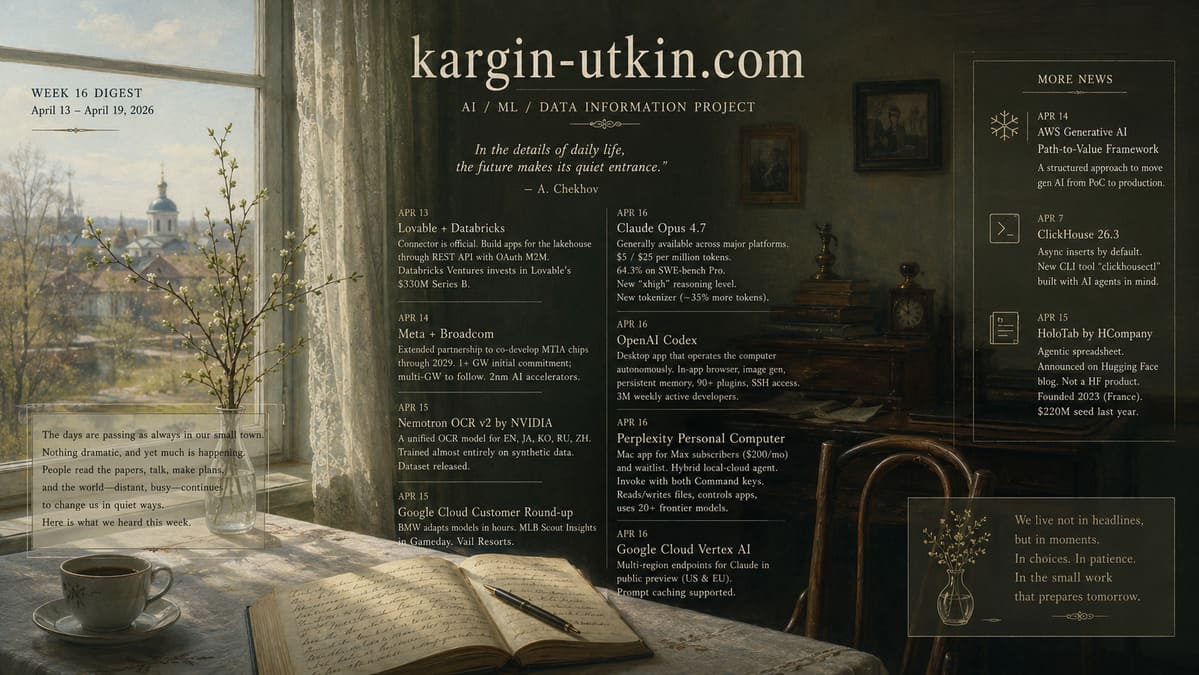
Whispers of Distant Lands and Code
Week 16, 2026 — Chekhov reflects on the intersection of technology and human experience, weaving together stories of innovation and connection.
In the voice of Chekhov - Quiet irony, the small human detail under the big headline, gentle melancholy
The morning train comes in two days late, which surprises no one. The thaw has done its slow work on the rails. Sofia, the postmaster's daughter, sorts the mail with the look of someone who has been waiting for news and has finally received it.
"They have made the two of them one," she says, holding up a paper. "Lovable and Databricks. The connector is official now. A person who cannot write code may build an application that reads and writes the lakehouse — through the REST API, with OAuth machine-to-machine. April 13. Databricks Ventures is also putting money into Lovable's three-hundred-thirty-million Series B." She folds the paper. "A dashboard, in plain English. Imagine."
Ivan, the clerk, is not in his usual place. Word arrives by midday that he has gone to the foundry, where there is more interesting news. Meta and Broadcom — April 14 — have extended their partnership to co-develop multiple generations of MTIA chips, custom silicon for AI training and inference. The agreement runs through 2029. The first commitment is more than one gigawatt of compute; multi-gigawatts will follow over time. Broadcom says the chips will be the industry's first two-nanometer AI accelerators. Hock Tan, the Broadcom chief executive, will leave Meta's board and continue as an advisor. The clerk, when he returns to his desk in the late afternoon, looks tired but contented. He has heard, also, that on April 16 Anthropic released Claude Opus 4.7 — generally available the same day across Claude.ai, the API, Bedrock, Vertex AI, Foundry, Snowflake Cortex, and GitHub Copilot. The pricing did not move: five dollars per million input tokens, twenty-five per million output. The model scored 64.3% on SWE-bench Pro and added a new "xhigh" reasoning level. The tokenizer is new and inflates token counts roughly thirty-five percent for the same English text, which is the kind of small print one only notices on the second invoice.
Mikhail, the foreman, comes into the tavern with the wind behind him and asks for tea. "OpenAI has shipped a great deal," he reports, "on April 16. The Codex desktop application can now operate the computer on its own. There is an in-app browser, image generation, persistent memory between sessions, more than ninety plugins, SSH access to remote devboxes. They call it Codex for (almost) everything. They say three million weekly active developers now — nearly double what they had a month ago." He drinks the tea slowly. The room listens.
Nikolai, the merchant, is pacing again. He has read about Perplexity, which on April 16 launched Personal Computer for the Mac — for Max subscribers at two hundred dollars a month and for those on the waiting list. A hybrid local-cloud agent. One presses both Command keys to summon it. It reads and writes local files, drives native macOS applications, orchestrates a team of specialized agents drawing from more than twenty frontier models. macOS 14 or later. Perplexity recommends a Mac mini, since the agent is meant to run continuously. Nikolai's hands are restless. He cannot tell whether this is what he needs or what will undo him.
Elena, the schoolteacher, has been thinking about scripts. NVIDIA's Nemotron OCR v2 — a single unified vision model that reads English, Japanese, Korean, Russian, and Chinese without being told which language to expect — was trained almost entirely on synthetic data. The dataset went up on April 15. It is a small thing, perhaps, but Elena, who teaches Russian to children whose grandparents could not read it, finds the idea moving. The brief from Petersburg mentioned Lorrie Cranor and Norman Sadeh on automated privacy enforcement; these are real researchers at Carnegie Mellon doing real work, but there was no announcement this week to fasten that work to. Elena sets the paper aside.
Sergei, the doctor, has the foreign newspapers spread before him. AWS published, on April 14, a framework called Generative AI Path-to-Value — a structured approach for moving generative AI initiatives from proof-of-concept to production. Sergei observes, mildly, that the brief from Petersburg described this as specifically for retail. It is not. (The retail piece — the Luggage Lab — was at the NRF Big Show in March.) The doctor makes a small mark in the margin. He prefers his facts placed correctly.
Vasili, the stationmaster, waves the April newsletter from ClickHouse like a flag. ClickHouse 26.3 — released April 7 — makes asynchronous inserts the default. A new command-line tool, clickhousectl, has been built explicitly with AI agents in mind alongside human developers. There is a piece on agentic coding at the company itself. Database news, mostly. Vasili reads everything.
There is news from Google Cloud as well. Same day, April 16: multi-region endpoints for Claude on Vertex AI, in public preview for the U.S. and EU geographies. Requests within a geography pool capacity across regions while keeping data residency intact. Prompt caching is supported. The day before — April 15 — Google Cloud's monthly customer round-up featured three projects: BMW's Connected Vehicle Platforms, where Dr. Céline Laurent-Winter's team uses automated pipelines to adapt models in hours rather than days; Major League Baseball's Scout Insights in the Gameday feature, which uses Gemini models to cross-reference decades of player data against the live situation on the field; and Vail Resorts. Sergei reads this twice. He has never seen a baseball game.
And then there is HoloTab, which Sofia, ever careful with attribution, wants on the record. The Petersburg brief credited it to Hugging Face. It is not Hugging Face's. HoloTab was built by HCompany — a French startup founded in 2023, two hundred and twenty million dollars in seed money last year — and announced on the Hugging Face blog on April 15 because that is where HCompany publishes. Hugging Face is the distribution channel, nothing more. The New Stack itself ran a correction on this point. The product is a free Chrome extension running on HCompany's Holo3 computer-use model, which scored 78.85% on OSWorld-Verified, the highest reported. A Teach Mode records a single demonstration of a workflow — clicks, narration — and turns it into a reusable routine that can be scheduled. Sensitive sites such as banks are blocked by default. The model and the work are interesting on their own terms. They do not need a borrowed name.
There is, finally, the matter of Mayank Upadhyay. Snowflake's blog ran on April 16 a post announcing him as Chief Security & Trust Officer. He had in fact joined in January, after twenty-one years at Google, where he had been Vice President of Engineering for Google Cloud security. The blog is the formal introduction of the work — unifying corporate and product security under one foundation, for what the company calls the agentic era.
Domestic items, briefer:
The brief from Petersburg also included Mikhail's musings on Linux watchdog timers and server reliability — sound infrastructure topics, but not AI news, and not tied to any announcement this week. Trimmed.
The line about a "second day of absence" for the foreman is small-town atmosphere, which is fine, but the digest serves Petersburg, not the foreman's domestic arrangements. Compressed.
I close my notebook. Outside, the lamp casts its warm circle on the page. The April night carries the smell of wet earth and the first lilacs from the priest's garden. Somewhere in California or Washington or Paris, an engineer is committing code that will be read in our small towns by the end of the week. The trains, as always, will be late. The news will arrive anyway.
End of the week of April 13.
Sources
15 events · 26 source articles
- Lovable + Databricks: Build Data-Driven Apps at the Speed of ThoughtBridging the gap between Databricks and your business teamsDatabricks gives your organization a powerful...
- Automated Privacy Enforcement: The Engineering Challenge of Scaling User ConsentA technical argument from Carnegie Mellon researchers Lorrie Cranor and Norman Sadeh proposes a counterintuitive solution to the privacy policy crisis: automated enforcement by AI systems. For data...📰 News:webpronews.com
- The Unseen Guardian: Engineering Reliable Systems with Linux's Watchdog TimersServer reliability often hinges on anticipating failure. For Linux systems, a mature but underutilized tool provides a foundational safety net: the watchdog timer. This mechanism, present since the...
- Meta Partners with Broadcom for Custom AI SiliconMeta partners with Broadcom to co-develop custom AI accelerator chips through 2029
- Synthetic Data Powers a Fast, Unified Multilingual OCR EngineWhen the first version of Nemotron OCR failed on non-Latin scripts, the team faced a classic data engineering problem: scaling high-quality, annotated training data across multiple languages was...📰 News:huggingface.co🏢 Companies:Hugging Face
- AWS Introduces Generative AI Services for RetailAWS introduces generative AI services and Path-to-Value framework to help retailers.
- ClickHouse releases updatesClickHouse announces ClickStack updates and releases April 2026 newsletter.
- OpenAI Upgrades Codex with Desktop Control and Memory FunctionOpenAI updates Codex with macOS control and memory features
- Claude Opus 4.7 Released on AI PlatformsClaude Opus 4.7 is released on Vertex AI and Snowflake Cortex AI.
- Snowflake Appoints Mayank Upadhyay as Chief Security & Trust OfficerSnowflake appoints Mayank Upadhyay as Chief Security & Trust Officer to advance AI data security and cloud protection.🏢 Companies:Snowflake
- Anthropic Releases Claude Opus 4.7 ModelAnthropic released Claude Opus 4.7, a model for autonomous coding and system tasks, showing improvements on engineering benchmarks.📰 News:webpronews.com
- Perplexity Launches Mac Agent for Multi-Agent AI SystemPerplexity releases Mac software for its multi-agent AI system, initially for paying subscribers.📰 News:engadget.com
- Multi-region endpoints available for Claude on Vertex AIGoogle Cloud AI announces U.S. and EU multi-region endpoints for Claude on Vertex AI available in public preview.🏢 Companies:Google Cloud AI
- Google Cloud customers build innovative solutionsGoogle Cloud highlights customer projects, including BMW and MLB's Scout Insights AI, in April edition.🏢 Companies:Google Cloud AI
- Hugging Face Releases HoloTabHugging Face releases HoloTab, an AI browser companion, on April 15, 2026.🏢 Companies:Hugging Face