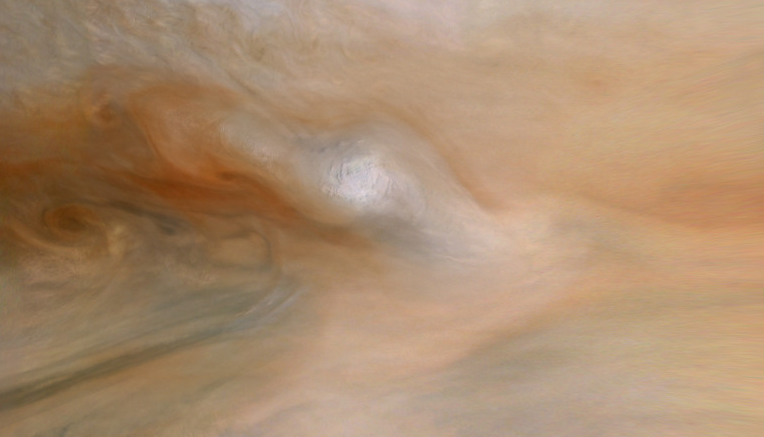
NASA's Juno spacecraft is still beaming high-value telemetry from Jupiter, revealing lightning strikes 100 times more intense than terrestrial equivalents. These insights, published March 20 in AGU Advances, rely on datasets captured during 2021 and 2022. While the hardware remains operational, the pipeline's future is uncertain.
Funding tensions peaked last year when the White House requested closeout plans for Juno and over a dozen other robotic missions. The proposal aimed to halve NASA's science budget. However, Congress intervened, approving a fiscal year 2026 allocation of $2.54 billion for planetary science. This figure surpasses the administration's request but still represents a $220 million reduction from prior funding levels.
Some data streams remain secure. OSIRIS-APEX, having delivered asteroid samples in 2023, secured fuel for a 2029 target intercept. The Lunar Reconnaissance Orbiter also gained a three-year extension. Yet, Juno's status hangs in the balance. Interrupting this telemetry now would discard years of calibrated instrument baselines essential for long-term planetary modeling.
Louise Prockter, director of NASA's planetary science division, addressed the reality during a National Academies meeting this week. "We can't quite afford to support everything that we have done in the past," Prockter stated. The budget contraction forces agency leaders to prioritize specific data outputs over others. For engineers monitoring deep-space telemetry, the message is clear: the hardware works, but sustaining the data flow requires navigating tighter fiscal constraints than ever before.
Source: Ars Technica