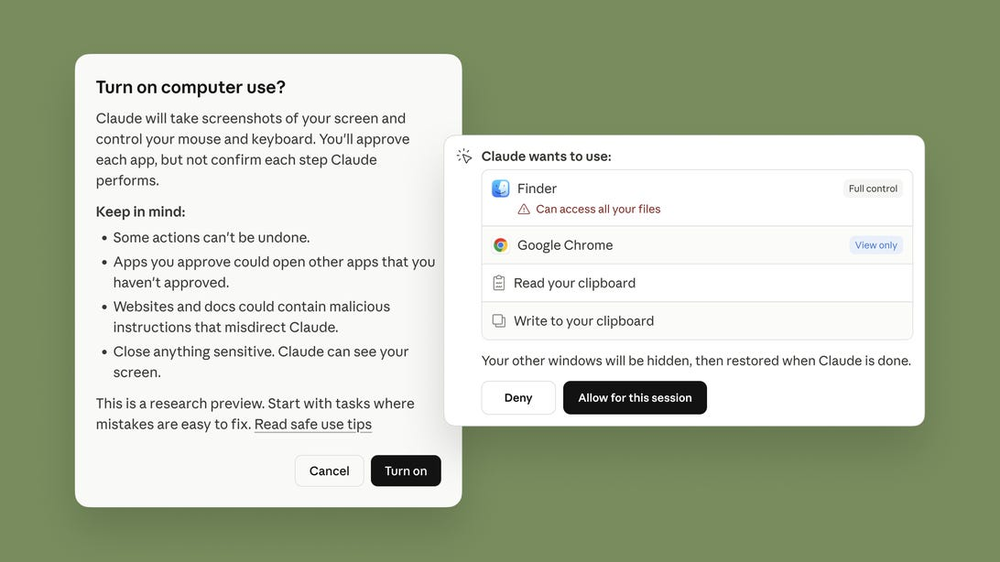
Anthropic is pushing agentic workflows further with a new capability allowing Claude to operate directly on user desktops. Announced Monday, the feature enables the model to execute tasks ranging from file retrieval to complex app interactions, provided users hold a Pro or Max subscription.
This move follows the surge of open-source agent frameworks like OpenClaw earlier in 2026. Nvidia recently introduced NemoClaw to streamline these setups, signaling intense competition in the automation space. While competitors rely on API connectors for apps like Slack or Google Calendar, Claude can also mimic human input—scrolling, clicking, and typing—when native integrations are missing. The system operates on MacOS and requires explicit user permission before executing actions, ensuring engineers maintain oversight.
Security remains a primary concern for ML teams. Agentic models can execute destructive commands rapidly if compromised. Anthropic claims to have embedded safeguards against prompt injections and automatically scans for vulnerabilities. However, the company explicitly warns against enabling the feature on applications handling sensitive data, disabling some high-risk apps by default.
The update integrates with Dispatch, allowing engineers to queue tasks via mobile devices, such as initiating code sessions or generating morning briefings. Anthropic frames this as a research preview, acknowledging that complex workflows may fail initially. The goal is to gather telemetry on failure modes before wider deployment. Engineers should expect iterative improvements as Anthropic refines the model's ability to handle unexpected UI changes. For data engineers, this represents a significant shift toward autonomous operation, though the warning labels suggest production readiness is still months away. The industry is watching to see if safety measures hold up under real-world stress.
Source: CNET